

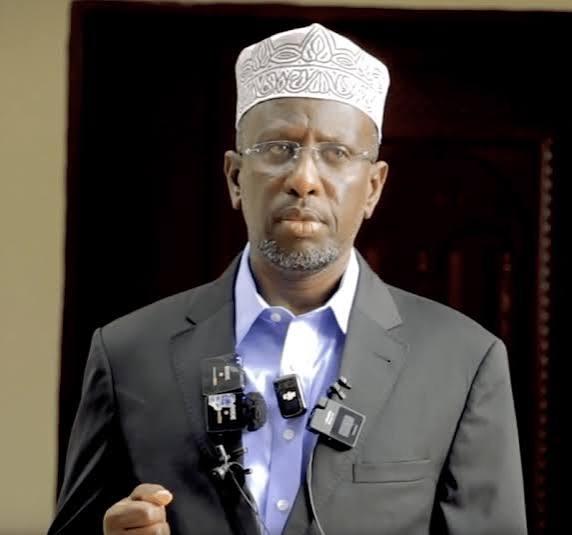

Former President of Somalia, Sheikh Sharif Sheikh Ahmed, in an extended interview lasting over an hour, addressed the country’s political situation, reported government military troop movements around his residence in Mogadishu, the ongoing controversy surrounding the election timetable, and statements by Hassan Sheikh Mohamud regarding his continuation in power.
Sheikh Sharif has spoken out explicitly in recent days regarding the national situation, calling for political disputes to be resolved through dialogue and an inclusive consensus agreement.
He also warned that political decisions made without mutual consensus could further alienate political factions.
One of the major flashpoints triggering the dispute involves military troops and armored vehicles reportedly deployed along roads near the residences of Sheikh Sharif and former Prime Minister Hassan Ali Khaire in Mogadishu.
Sheikh Sharif’s office stated on October 11 that government forces restricted movement around his residence, erecting checkpoints that impacted ingress and egress for civilians.
The office further alleged that members of his staff were abducted—claims that have not been independently verified.
Conversely, the National Intelligence and Security Agency (NISA) accused Sheikh Sharif’s security detail of attacking agency personnel and attempting to provoke an armed confrontation.
The former president’s office denied those accusations, stating that his security team deliberately avoided actions that could lead to armed conflict.
Both sides hold opposing accounts of the security incidents that transpired in Wadajir district. Pending independent verification, the mutual accusations exchanged by both parties remain conflicting claims.
Another core focus of Sheikh Sharif’s address was the federal election schedule announced by the disputed National Independent Electoral and Boundaries Commission.
The commission announced that elections for both houses of the Federal Parliament are scheduled for April 15, 2027, while the presidential election is designated for May 15, 2027.
The Federal Government asserts that the timeline is grounded in the constitution and electoral laws, whereas the opposition and select Federal Member States reject the process used for constitutional amendments and election preparations.
Sheikh Sharif is among the politicians contending that national elections must be anchored in a political agreement involving the central government, Federal Member States, and the opposition.
He also voiced support for allowing the judicial court system to rule on the constitutional dispute.
This impasse remains a formidable obstacle facing the electoral process, as stakeholders lack consensus regarding how the elections should be managed and their underlying legal foundation.
Hassan Sheikh Mohamud’s statement asserting that he will not relinquish power on the ground also forms part of the ongoing political debate.
Opposition figures link such statements to the dispute over the president’s tenure length and the legality of the electoral schedule.
On the government side, officials defend the constitutional amendments and the planned electoral framework, maintaining that state institutions are operating within a legal basis.
Sheikh Sharif and other opposition leaders insist that the country’s political future cannot be determined by the vision of a single faction alone, but requires a broad-based agreement acceptable to all political stakeholders.
The friction between the government and opposition threatens to impact capital security, election readiness, and the national leadership’s capacity to confront existing challenges, including the fight against Al-Shabaab, the humanitarian crisis, and economic instability.
Sheikh Sharif called for a return to genuine dialogue to achieve a political settlement. Opposition allies similarly demand a mutually agreed-upon electoral framework, while the Federal Government maintains it will pursue dialogue efforts while simultaneously advancing the election schedule.
Unresolved questions persist regarding how the constitutional dispute will be resolved, who will manage the elections, and how political friction can be prevented from escalating into armed security confrontations.
Ultimately, Sheikh Sharif’s interview comes at a time when Somalia faces severe political contention regarding state authority, presidential tenure, and the future of elections.
How the situation unfolds will depend on how government leadership, the opposition, and Federal Member States collaborate to reach a mutually agreed-upon political consensus.