

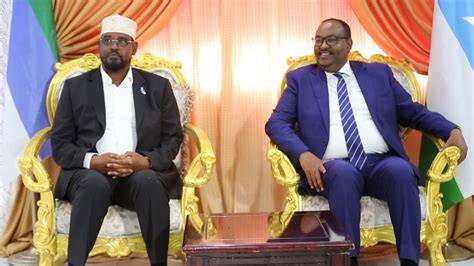

Reports of a political agreement between President Hassan Sheikh Mohamud and some opposition leaders to hold national elections within seven months have triggered fresh political controversy in Somalia, after officials from Puntland and Jubaland said they had no knowledge of such an arrangement.
According to reports circulating in recent days, Hassan Sheikh agreed during talks with opposition figures that Somalia should move toward elections within a seven-month timeframe.
The reported understanding has been portrayed as part of broader efforts to ease political tensions and reach consensus on the country’s electoral future.
However, ministers from Puntland and Jubaland told Kaab TV that they were unaware of any agreement and had not participated in discussions that allegedly produced the deal.
Their remarks suggest that, if such an understanding exists, it may currently involve only certain political actors rather than representing a nationwide consensus.
The development is significant because Puntland and Jubaland have been among the most vocal critics of the Federal Government’s electoral and constitutional reform agenda.
Both administrations have repeatedly argued that major political changes should be based on broad consultation and agreement among all key stakeholders.
The dispute reflects deeper disagreements that have shaped Somali politics in recent years.
The Federal Government and several federal member states have clashed over electoral procedures, constitutional amendments, power-sharing arrangements and the respective roles of Mogadishu and regional administrations in managing the electoral process.
President Hassan Sheikh has consistently advocated for a transition to a one-person, one-vote electoral system, arguing that Somalis should be able to directly elect their representatives rather than relying on the clan-based indirect model that has dominated previous elections.
The government maintains that electoral and constitutional reforms are necessary steps toward building a more democratic and accountable political system.
Opposition figures and some regional leaders, however, have expressed concern that such reforms are being pursued without sufficient political consensus.
They argue that changes to the electoral framework and constitution should be negotiated through an inclusive process involving all major political stakeholders.
Against this backdrop, the reported seven-month election agreement raises a crucial question: if Puntland and Jubaland are not part of the arrangement, how can a nationwide electoral process be implemented effectively?
Somalia’s electoral system relies heavily on cooperation between the Federal Government and federal member states.
Organizing national elections requires agreement on issues ranging from voter registration and election administration to security, logistics and dispute-resolution mechanisms.
Without the participation of key regional administrations, implementing a uniform electoral timetable across the country could prove difficult.
The controversy also highlights concerns about transparency. Political analysts note that any major electoral agreement must be clearly communicated and publicly explained.
When influential stakeholders claim they have not been consulted or informed, questions inevitably arise over who negotiated the deal, who supports it and how it is expected to be implemented.
Puntland and Jubaland have previously aligned with opposition groups in challenging aspects of the Federal Government’s political agenda.
Both administrations have repeatedly stated that they would not support an electoral process that lacks broad national consensus or sidelines federal member states.
If ongoing consultations fail to bridge these differences, Somalia could face competing visions for its electoral future.
The Federal Government may continue pursuing its preferred roadmap, while some regional administrations and opposition groups could reject the process or challenge its legitimacy.
The latest dispute underscores a broader reality facing Somalia’s political transition: setting an election date alone may not be enough.
What remains critical is reaching a comprehensive political agreement on how elections will be conducted, who will oversee them, what role federal member states will play and how all parties can be assured that the outcome will be accepted as legitimate.
As discussions continue, the focus is likely to remain on whether Somalia’s political leaders can move beyond competing narratives and negotiate an inclusive electoral framework capable of securing nationwide support and avoiding another cycle of political confrontation.