


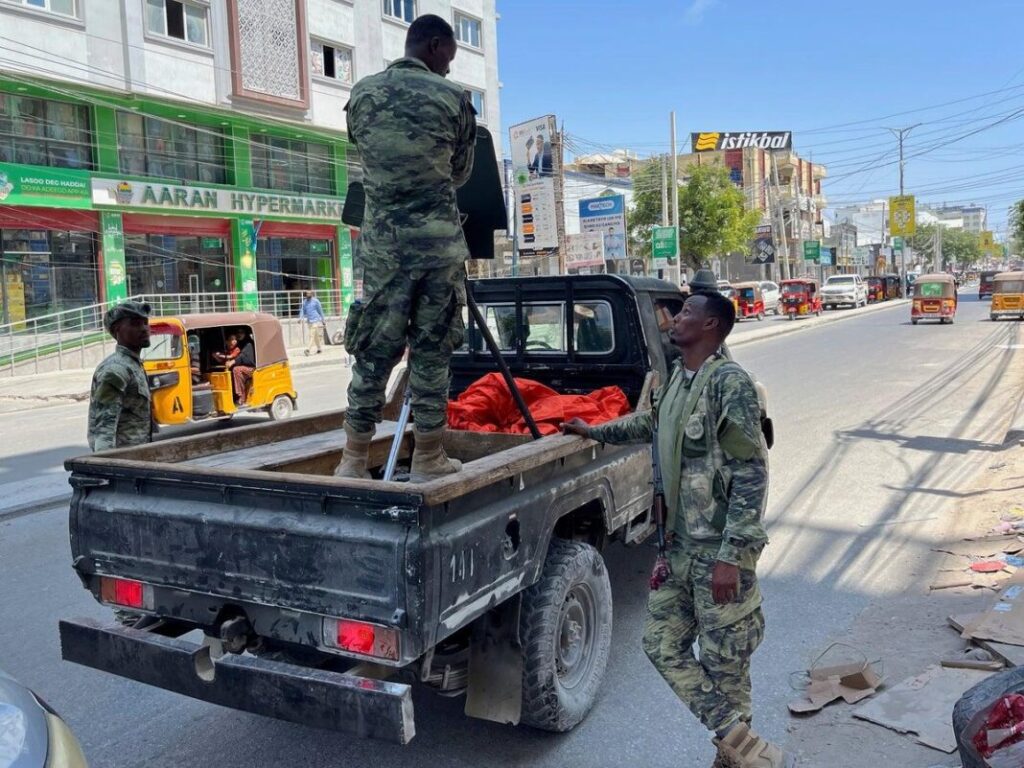


A segment of residents living in Mogadishu has expressed concern over the country’s security situation, arguing that political disputes, leadership divisions, and the influence of foreign nations on Somali politics could create an opportunity for Al-Shabaab to exploit the nation’s vulnerability.
Proponents of this view contend that Somalia is navigating a sensitive juncture, with external actors pursuing their own interests amid domestic political rifts—a dynamic they believe could weaken state capacity and undermine the war against armed militant groups.
Some residents also fear that Al-Shabaab could capitalize on political fragmentation and weak inter-agency coordination among government institutions to exert heightened pressure on the capital.
Mogadishu has recently faced security anxieties linked to Al-Shabaab attacks, militant movements along key supply corridors leading into the capital, and the group’s capacity to execute coordinated assaults.
Regional security experts and research centers have previously warned that political disputes in Somalia could degrade the nation’s ability to combat Al-Shabaab.
A report published by the Africa Center for Strategic Studies on November 17, 2025, warned that friction between the central government and Federal Member States could escalate security risks in Somalia and create conditions enabling Al-Shabaab to exploit political division.
That report emphasized that Somalia’s challenge is not confined strictly to military warfare, but also depends on the capacity of the country’s political leadership to build cooperation and national consensus.
This warning demonstrates that Mogadishu’s security is closely intertwined with the broader political environment across the country.
Are Foreign Actors Involved in Plots to Weaken Somalia?
The question regarding the role of foreign nations in Somalia’s politics and security has become a subject of widespread public debate.
A study released by Chatham House in October 2026 noted that regional rivalries and competing foreign interests in Somalia are further complicating domestic political disputes.
The study observed that Turkey maintains close ties with the Federal Government, whereas the United Arab Emirates maintains relationships with several regional administrations and politicians opposed to Mogadishu. It also pointed out that certain Somali factions seek external backing to strengthen their political leverage.
This dynamic illustrates that Somalia has become an arena where divergent regional and global interests intersect.
Nevertheless, political ties, diplomatic support, or economic agreements that a foreign country maintains with a Somali faction do not constitute evidence that it supports Al-Shabaab or any plot for the group to capture Mogadishu.
It is essential not to conflate geopolitical competition among foreign states with allegations of backing terrorist organizations.
Conflicting Reports Regarding Public Intimidation
Divergent narratives have also emerged regarding how public fear of Al-Shabaab is being utilized.
Meanwhile, residents concerned about Mogadishu’s security argue that the Al-Shabaab threat is not merely a tool used to intimidate the public, but rather a long-standing security reality that must be genuinely addressed.
These two perspectives illustrate that the current security debate revolves around two distinct questions: the actual operational threat level posed by Al-Shabaab, and the possibility that political actors may exploit public anxiety.
One of the gravest threats to Somalia’s security is the risk that political disputes impair coordination among security institutions.
When the central government and Federal Member States clash over power-sharing, elections, and national governance, establishing a unified security strategy becomes difficult.
Furthermore, when the nation’s politicians become preoccupied with internal disputes, military forces and security agencies may face confusion regarding operational priorities and chains of command.
Al-Shabaab stands to benefit from any scenario that produces division, lack of coordination, and distraction of government forces from active counter-insurgency operations.
This is why some security analysts argue that resolving political disputes is an essential component of the war against Al-Shabaab.
What Is Required of the Federal Government?
The Federal Government is expected to provide the public with transparent information regarding the security environment, Al-Shabaab movements, and actions undertaken by security agencies.
It is equally vital to strengthen cooperation between the central government and Federal Member States, establishing a security architecture insulated from political disputes.
Simultaneously, allegations regarding foreign interference must be grounded in verifiable evidence so as to avoid baseless accusations that could further polarize society and political factions.
Foreign countries maintaining ties with Somalia are likewise expected to respect the nation’s sovereignty and refrain from any actions that could exacerbate internal conflicts.
What Is Feared in Mogadishu?
The anxiety among Mogadishu residents reflects a question broader than any single attack or security incident: how can Somalia safeguard its capital if political disputes and institutional divisions persist?
The Al-Shabaab threat cannot be assessed through political rhetoric alone; rather, it is critical to evaluate the group’s operational capability, areas of activity, executed attacks, and the counter-offensive capacity of government forces.