

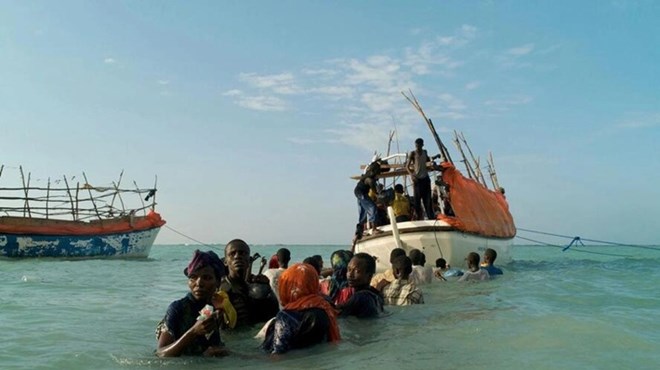

MOGADISHU (KAAB TV) – Migrants and asylum seekers traversing Somalia are increasingly exposed to life-threatening dangers, including violence, human trafficking, and exploitation, according to a new report released by the United Nations High Commissioner for Refugees (UNHCR).
The report warns that critical migration routes through and around Somalia are becoming more hazardous, placing tens of thousands of lives at risk.
The UNHCR’s latest “Mixed Movements” report emphasizes Somalia’s complex role as both a country of origin and a key transit hub for migration across the Horn of Africa.
The country continues to witness significant movements of Somali returnees, Ethiopian migrants, and asylum seekers fleeing climate-related disasters and armed conflict.
Deadly Journeys and Rising Death Tolls
The dangers of these migration routes were tragically highlighted in August 2025, when a boat carrying Ethiopian migrants capsized off the coast of Yemen near Abyan. Initially, at least 68 deaths and 74 missing persons were reported.
The International Organization for Migration (IOM) later revised the toll to 56 confirmed dead and 132 missing, underscoring the precarious nature of these maritime crossings.
The IOM noted that in just the first half of 2025, a minimum of 348 people died or went missing along the Eastern Migration Route—a dangerous path that connects the Horn of Africa to the Gulf states through Yemen.
This figure represents a significant increase from the same period in 2024. During this timeframe, approximately 238,000 migrants were recorded along the route, marking a 34 percent rise in migrant flows compared to the previous year.
Exploitation, Extortion, and Gender-Based Violence
According to UNHCR, those crossing through Somalia’s southern border regions or attempting to reach official border points are particularly vulnerable. Migrants face severe threats such as extortion, abduction, and gender-based violence.
The report sheds light on the pervasive presence of human trafficking networks, especially in Yemen and the Gulf countries, where many migrants are lured by false promises of safety or employment opportunities.
Children, particularly unaccompanied minors, are at elevated risk. Many are exposed to exploitation, and some are forcibly recruited by armed groups operating in conflict zones.
Misinformation and Limited Humanitarian Access
The report also highlights a major concern: widespread misinformation. Many migrants rely on smugglers or informal sources to plan their journeys, often unaware of the actual risks, costs, or conditions they will encounter.
The lack of accurate information leaves them susceptible to dangerous decisions and greater vulnerability.
Compounding the crisis is limited humanitarian access. Aid agencies face immense challenges in reaching remote or insecure regions, curbing the delivery of essential services such as legal assistance, emergency shelter, and medical care.
This limited access significantly reduces the ability to respond to emergencies or offer protective services to at-risk individuals.
Regional Crisis Driving Mass Migration
Somalia’s migration crisis is closely tied to a broader regional emergency fueled by conflict, chronic poverty, and worsening climate conditions.
Recurring droughts, floods, and food insecurity continue to drive hundreds of thousands of people each year to undertake perilous journeys across the Horn of Africa in search of safety and opportunity.
In response to the escalating crisis, some steps have been taken. In April 2025, the IOM inaugurated a new Migration Response Center in Burco, Somaliland.
The facility provides emergency shelter, basic healthcare, mental health support, and voluntary return options for stranded migrants.
UNHCR Urges Coordinated Action
In light of the escalating risks, UNHCR has called on national governments and humanitarian agencies to scale up efforts to protect vulnerable migrants. Key recommendations include:
-
Expanding access to safe shelters and legal aid
-
Launching awareness campaigns to prevent exploitation by trafficking networks
-
Strengthening regional cooperation to address the root causes of irregular migration
-
Improving humanitarian access to remote or high-risk areas
The agency stresses that without coordinated and sustained action, more lives will be lost, and the humanitarian crisis will continue to deepen across one of the world’s most vulnerable migration corridors.