




The political and security crisis in Baidoa has escalated once again, with rival factions of the Southwest administration deeply divided over political authority and the governance of the city.
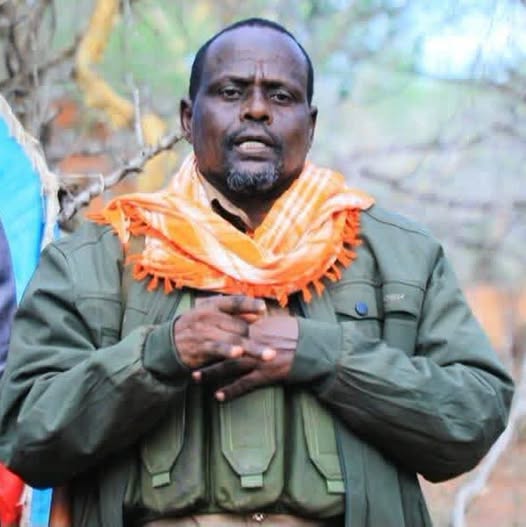
Malaaq Shanla Gaab, a traditional elder in Southwest State, stated in a public address regarding the regional political situation that if war or armed confrontation breaks out, Baidoa will serve as the final, decisive battleground.
The elder also addressed Sheikh Adan Mohamed Nur (Adan Madobe) directly, declaring that if authorities are searching for labeled terrorist elements or armed insurgents, he should be considered the primary individual linked to them.
Furthermore, Malaaq Shanla Gaab reaffirmed that the administration led by Abdiaziz Hassan Mohamed Laftagareen remains the leadership recognized by their camp, insisting that the legal government is the preceding administration and that Laftagareen is the legitimate president of Southwest State.
The faction led by Sheikh Adan Mohamed Nur currently controls the interior of Baidoa, while military units and officials loyal to former president Abdiaziz Laftagareen remain stationed on the city’s outskirts.
Recent reports indicate that forces allied with Laftagareen have moved closer to the perimeter surrounding Baidoa, heightening anxieties that renewed urban combat could erupt.
This standoff follows previous armed skirmishes within the city and its environs.
While both sides trade blame for the worsening climate, local residents remain deeply fearful of a return to full-scale warfare.
The administration led by Adan Madobe recently imposed a nighttime curfew in Baidoa, ordering residents and vehicles to restrict their movement following the Maghrib prayer.
This measure was introduced as part of ongoing efforts to reinforce security in the city.
Malaaq Shanla Gaab’s statement that “Baidoa will be the decisive battleground” comes at a time when both sides are locked in a dispute over the control of the city and the political future of Southwest State.
Laftagareen’s camp has previously stated that it will continue what it terms efforts to re-liberate Southwest State, whereas Adan Madobe’s administration insists it remains the legitimate authority currently governing Baidoa.
Consequently, the conflict intertwines political disputes, administrative authority, and security concerns.
If dialogue fails, anxieties persist that the standoff could once again deteriorate into armed clashes.
Traditional elders have played a prominent role in the Southwest political crisis of late, with various figures throwing their weight behind opposing political factions.
Malaaq Shanla Gaab is among the traditional leaders who have spoken out explicitly on the situation, his remarks signaling that a segment of traditional elders continues to back Laftagareen.
Meanwhile, Adan Madobe’s camp has sought to incorporate traditional elders, clerics, politicians, and civil society members into broader initiatives aimed at defusing the tension.
On September 18, Adan Madobe appointed a reconciliation committee tasked with fostering peace, resolving disputes, and facilitating dialogue among the communities of Southwest State.
The committee includes traditional elders, clerics, scholars, and civil society representatives.
Even as harsh rhetoric persists, parallel efforts have begun to cool the situation.
On October 1, 2026, a delegation led by former House of the People Speaker Mohamed Mursal Sheikh Abdirahman arrived in Baidoa and was received by Adan Madobe.
The meeting focused on the political and security situation in Southwest State, state-building, political consultation, and strengthening community unity.
It was also noted that a reconciliation forum involving politicians and rival factions is anticipated in the city.
The visit by Mohamed Mursal’s delegation indicates that a political pathway to resolve the dispute is still being pursued, even as certain sides maintain hardline rhetoric alongside political and security mobilizations.
Baidoa is home to a large population, including displaced persons from other regions of Somalia.
Consequently, further conflict within the city could severely impact civilians and essential services.
Previous clashes in the city disrupted commercial activities and daily life, with residents repeatedly voicing fears that the skirmishes might widen.
Residents in Baidoa are currently closely watching the outcomes of dialogue and reconciliation efforts, amid persistent fears that if the political dispute is not resolved through negotiation, the situation could regress into violence.
The Southwest State conflict has now entered a sensitive phase.
Adan Madobe’s faction holds administrative control within central Baidoa, while Laftagareen’s faction retains political supporters and military elements stationed on the city’s outskirts.
Malaaq Shanla Gaab’s statements highlight how rigid the positions of groups backing Laftagareen have become, particularly regarding the question of legitimate authority over Southwest State.
Meanwhile, the meetings and reconciliation efforts underway in Baidoa indicate that a political pathway to seek a solution still exists.
The primary expectation from all sides now is that they avoid rhetoric and actions that could further escalate tensions, and instead work toward dialogue to resolve the political dispute.
Baidoa has thus become the epicenter of a political conflict that impacts Southwest State and the relationship between the regional administration and opposition factions.
The future trajectory of the situation will heavily depend on whether the parties succeed in reaching a political agreement through dialogue or if the dispute once again deteriorates into armed confrontation.