


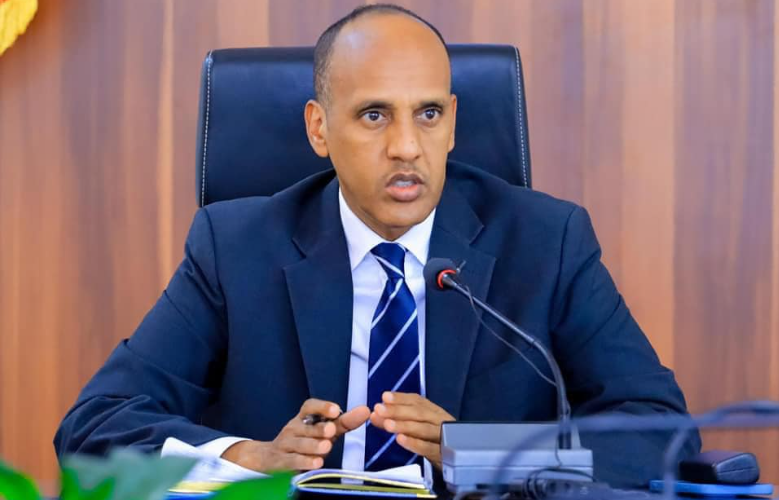


Mustafe Mohamed Omar “Cagjar” has been re-elected as president of Ethiopia’s Somali Regional State, securing another five-year term to lead the region.
Cagjar was elected by the newly constituted Somali Regional State Parliament, which also elected Mubashir Dubad Raage as its new speaker on the same day.
Cagjar has been at the helm of the Somali Region since 2018, when he was initially appointed acting president following the removal of former regional president Abdi Mohamed Omar “Abdi Ilay.” He later became the region’s full-time president.
His return to office in 2018 marked a major political transition for the Somali Region after years of tensions and allegations of human rights abuses under the previous administration.
The change followed broader political reforms under Prime Minister Abiy Ahmed, which led to Abdi Ilay’s removal and a restructuring of the regional political leadership.
Cagjar, who had previously been known as a critic of the former administration, emerged as a prominent figure during the transition.
Before becoming regional president, he had worked in humanitarian and international affairs, including roles connected to the United Nations and experience in several countries.
The political transition also coincided with the 2018 peace process between the Ethiopian government and the Ogaden National Liberation Front (ONLF).
The ONLF formally ended its armed struggle and entered peaceful political engagement after signing a peace agreement with the Ethiopian government in October 2018. The agreement contributed to a broader reduction in armed conflict in the region.
Over the past eight years, Cagjar’s administration has focused on security, infrastructure and economic development, with regional authorities highlighting projects involving roads, health facilities, agriculture, natural resources and investment.
Independent assessments have also described the post-2018 period as a significant political transition for the region, although they have noted continuing political and institutional challenges.
The Somali Regional State remains strategically important to Ethiopia because of its large territory, borders with Somalia and Djibouti, and its role in pastoralism, trade and natural-resource development.
Jijiga serves as the regional capital and the main political and administrative centre.
Cagjar’s latest re-election therefore extends a period of leadership that began amid a major political realignment in 2018.
The regional government is now expected to continue addressing issues including economic development, governance, security, political participation and relations between the regional and federal authorities.
In recent remarks, Cagjar has also continued to engage in debates over the region’s political history and the legacy of armed movements, including the ONLF.
In September 2026, he criticized claims by individuals or organizations seeking exclusive credit for past political struggles in the region, arguing that ordinary communities had borne much of the human cost of decades of conflict.
The Somali Regional State president’s office currently lists Mustafe Mohamud Omar as president, confirming his continued position at the head of the regional administration.