

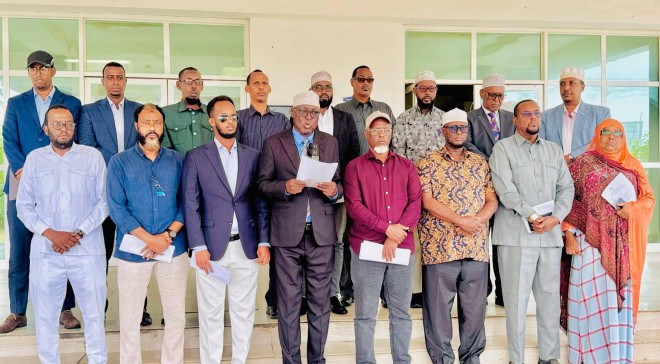

Jubaland’s Ministry of Environment and Climate Change has issued an early warning over the risk of heavy rains and widespread flooding expected to begin in October, urging residents to prepare for potential disasters that could affect hundreds of thousands of people across the state.
Speaking to local media, Jubaland Minister for Environment and Climate Change, Caydiid Suleymaan Xaashi, said weather forecasts indicate a heightened risk of above-average Deyr seasonal rains, particularly from early October onward.
He warned that several districts could experience severe flooding, especially communities located along riverbanks, floodplains, and low-lying areas.
The warning comes amid growing concerns from meteorological agencies and humanitarian organizations that Somalia could face another challenging rainy season between October and December 2026, with forecasters predicting the continued influence of El Niño-related weather patterns.
Such conditions often bring heavier-than-normal rainfall to parts of East Africa, increasing the likelihood of flash floods and river overflows.
According to the minister, as many as 12 districts in Jubaland are considered vulnerable to flooding and extreme rainfall.
Residents living near the Jubba River, seasonal streams, and flood-prone settlements have been advised to monitor weather updates closely and relocate to safer areas if conditions deteriorate.
Climate projections for the region suggest that Somalia could receive rainfall significantly above the seasonal average, with the greatest flood risk concentrated along the Jubba and Shabelle river basins.
Humanitarian agencies have repeatedly warned that these areas remain highly susceptible to flooding due to weak drainage systems, riverbank erosion, and recurring extreme weather events linked to climate change.
Minister Caydiid said an estimated 1.8 million people could be affected by the anticipated rains and flooding, while more than 351,000 people may face displacement if severe flooding materializes.
He added that nearly 45 health facilities and at least 10 schools are among the critical institutions that could be impacted by major flood events.
The warning revives memories of the devastating floods that struck Somalia in 2023, when heavy rains displaced more than a million people, submerged towns and villages, destroyed infrastructure, and damaged vast areas of farmland.
Those floods were among the worst in recent years and highlighted the country’s vulnerability to climate-related disasters.
The minister also called on residents, businesses, civil society organizations, and the Somali diaspora to prepare in advance and support emergency response efforts if needed.
He noted that communities across Jubaland had previously shown resilience during prolonged droughts through coordinated efforts involving local authorities, religious leaders, businesses, security forces, and humanitarian groups.
However, Caydiid criticized the Federal Government of Somalia, arguing that Jubaland did not receive the level of support it expected during previous drought emergencies.
He urged international partners to ensure that humanitarian assistance intended for Jubaland reaches the region directly and without delay.
The ministry further called on government institutions to develop sector-specific contingency plans to reduce the impact of potential flooding. Particular attention was placed on health services, agriculture, livestock, education, and community protection programs.
Officials from the Ministries of Agriculture and Livestock were urged to strengthen climate adaptation measures and support farmers and pastoralists who could be affected by flooding.
Meanwhile, the Ministries of Health and Women’s Affairs were encouraged to prepare emergency response plans to address the humanitarian and public health consequences that often accompany large-scale flood disasters.
As part of long-term preparedness efforts, the minister also proposed the creation of a specialized disaster-response unit trained to react rapidly to floods and other natural emergencies, arguing that Somalia needs stronger domestic capacity to respond to increasingly frequent climate-related crises.
With the Deyr rainy season approaching, authorities say the coming weeks will be critical for preparedness efforts as communities across Jubaland brace for what could become one of the region’s most challenging weather seasons in recent years.