

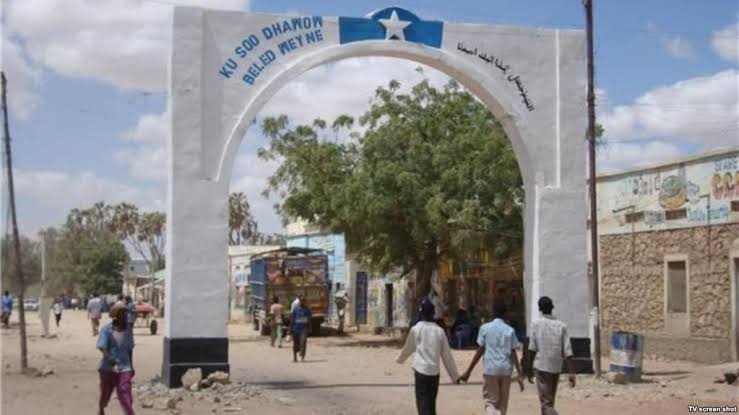

Hirshabelle State’s political crisis has entered a new phase, with opposition to the administration in Beledweyne accompanied by local political and military mobilisation, while preparations are underway in Jowhar for the inauguration of the state’s re-elected leadership.
The two main cities are now facing sharply different political realities.
Jowhar is preparing to reaffirm Ali Gudlawe’s leadership, while opposition in Beledweyne centres on the disputed election process, Hiiraan’s political representation and the distribution of power between the two regions that make up Hirshabelle.
The growing divide has raised questions about whether the state can remain a unified administration or whether the dispute could lead to the emergence of competing political structures.
Beledweyne has become the main centre of resistance to the leadership re-elected in Jowhar.
Several politicians, traditional elders and community representatives in Hiiraan have rejected the election process, arguing that no inclusive political agreement was reached on the formation of the administration or the allocation of positions.
The dispute began before the election, when politicians from Hiiraan called for the process to be suspended until an agreement could be reached on the region’s representation and its role in the new administration.
Hawadle traditional elders had also expressed opposition to a political arrangement they considered lacking broad consultation and community consensus.
Those rejecting the Jowhar leadership argue that longstanding grievances in Hiiraan remain unresolved and that the structure of Hirshabelle needs to be reconsidered to ensure a fairer distribution of political authority between Hiiraan and Middle Shabelle.
One of the most concerning developments is the growing involvement of local armed groups in the dispute. In the days following the political mobilisation, a local force known as Dulmi-diid was publicly presented.
Former Hiiraan regional governor Mohamed Hussein Mohamed called on Hirshabelle officials in Beledweyne to leave the city and warned of consequences if they failed to comply.
The involvement of armed personnel has increased concerns that the dispute could move beyond political confrontation.
When security forces and local militias become aligned with rival political interests, the risk of armed clashes, civilian displacement and disruption to everyday life increases.
The arrival of Abdullahi Mohamed Ali Sanbaloolshe in Beledweyne has also added political weight to the developments, given his prominence in Somali politics and his connections to the region.
Meanwhile, Jowhar is preparing for the inauguration of Hirshabelle’s re-elected leadership.
Ali Abdullahi Hussein Gudlawe was re-elected as state president in late October 2026, while Abdifatah Hassan Afrah secured the position of vice president.
Their election took place in Jowhar despite strong opposition from politicians and traditional leaders in Hiiraan.
For Gudlawe, the challenge extends beyond the inauguration ceremony. He must demonstrate how his administration intends to govern a state in which a section of the population, particularly in Hiiraan, disputes the legitimacy of the process that returned him to office.
His re-election provides an opportunity to continue his administration, but it has not resolved the grievances in Beledweyne.
Attention is therefore focused on whether the inauguration will be accompanied by a meaningful appeal for reconciliation and dialogue or will primarily serve as a display of support for the new leadership.
Vice President Abdifatah Hassan Afrah travelled to Beledweyne on November 7 in an apparent effort to ease tensions. He said he wanted to meet traditional elders and armed groups to hear their concerns and explore ways of reaching an understanding.
His visit carries political significance because Afrah previously served as Hiiraan regional governor and has established ties with local communities.
If he succeeds in bringing the opposing sides together, the visit could provide an opening for negotiations. However, meetings that produce no practical commitments may do little to prevent the dispute from escalating.
The crisis is rooted in several longstanding disagreements. Political representation remains a central concern, with some politicians in Hiiraan arguing that their region has not received an appropriate share of positions and influence within Hirshabelle’s institutions.
Disputes over power-sharing have also persisted, particularly regarding how political offices and administrative authority are divided between Hiiraan and Middle Shabelle.
Economic issues have added to the tensions, including disagreements between regional officials and Hirshabelle’s leadership over revenue distribution, notably taxes collected from Beledweyne’s livestock market.
The election process itself has become another major point of contention. Some Hiiraan politicians and elders insist that a new administration must emerge from broad consultation and a negotiated agreement.
The leadership in Jowhar, meanwhile, maintains that the election has produced a legitimate administration.
A lasting settlement is unlikely to emerge simply by persuading one side to accept the election outcome without addressing the broader grievances that have fuelled the dispute.
The federal government also faces scrutiny over its role in the crisis. The Hirshabelle election took place against the backdrop of wider national disagreements over constitutional amendments, the electoral system and the distribution of political authority.
President Hassan Sheikh Mohamud has expressed support for the re-elected Hirshabelle leadership, while opponents of the election process have accused the federal government of influencing the political direction of the state.
The government is under pressure to facilitate reconciliation without resorting to military intervention or political pressure.
It is also important for federal leaders to distinguish between supporting an elected regional administration and their wider responsibility to protect peace, political inclusion and the rights of communities in both regions.
Hirshabelle now faces several possible political outcomes. The first would be an agreement between Jowhar and Beledweyne on representation, power-sharing, the administration of Hiiraan and economic matters.
Such a settlement could help end the dispute through dialogue while preserving the unity of the state.
A second possibility is the emergence of a rival administration if opposition groups in Beledweyne maintain their rejection of the Jowhar leadership and agree on an alternative political structure.
This could create competing centres of authority claiming to represent Hirshabelle, although no separate administration has been formally established.
A third and more dangerous scenario would be further escalation if negotiations fail and armed groups in the region become increasingly involved. Such a development could trigger fresh clashes and disrupt civilian life, commercial activity and security operations.
These are possible scenarios arising from the current political situation, rather than predictions of what will necessarily happen.
The dispute also carries implications for Somalia’s wider campaign against Al-Shabaab. Local forces, particularly the Macawiisley militias in Hiiraan, have played an important role in fighting the militant group and defending communities.
If these forces become preoccupied with internal political divisions, their ability to participate in security operations could be weakened.
Al-Shabaab could potentially exploit divisions among local forces, disagreements between political leaders and reduced cooperation between security institutions.
The crisis in Hirshabelle therefore extends beyond the question of who leads the regional administration. Its outcome could affect security across central Somalia, particularly efforts to maintain pressure on Al-Shabaab.
Jowhar has a re-elected leadership preparing to take office, while Beledweyne remains a centre of political resistance accompanied by local military mobilisation.
Gudlawe and Afrah face the challenge of rebuilding confidence among communities in Hiiraan, while politicians and traditional elders in Beledweyne must clarify how they intend to address their grievances without provoking armed confrontation.
The future of Hirshabelle will largely depend on whether both sides can reach an agreement that addresses the underlying disputes and preserves the unity of the state.
The central question is whether the inauguration in Jowhar will create an opportunity for reconciliation or whether Beledweyne will move towards a separate political arrangement outside the authority of the Jowhar leadership.