

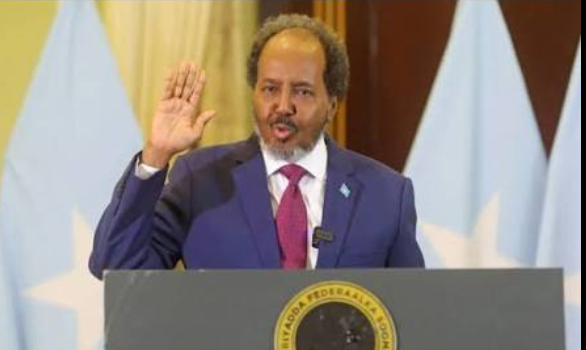

Hassan Sheikh Mohamud has said his government is not seeking to shed blood or create conflict, but his remarks are facing renewed scrutiny following operations of forced evictions in Mogadishu and the reported shooting of a woman during a peaceful protest by the Haramcad police unit.
Responding to accusations that his administration is contributing to internal conflict, Hassan Sheikh said the government would prevent anyone from engaging in bloodshed and would enforce the law.
“Anyone who seeks to shed blood, we will stop them, reject it and prevent it. The government is never, in any way, seeking to shed blood. It does not create conflict or work for conflict, but [it will uphold] the law and the country’s legal framework,” Hassan Sheikh said.
He added that maintaining national unity and enforcing the law were among the government’s primary responsibilities.
“Protecting the law and ensuring that the country moves forward as one and remains united is the government’s foremost responsibility,” he said.
His comments, however, come amid growing controversy over the government’s handling of land disputes and evictions in Mogadishu.
Residents and opposition figures have accused federal authorities of using security forces to remove families from homes and settlements, while the government has argued in previous cases that some of the land being cleared is public property that had been unlawfully occupied.
Shooting of Protester Raises Questions
The latest controversy intensified after the Haramcad police unit, a federal security force, reportedly opened fire during a protest in Mogadishu’s Waberi district, injuring a Somali woman who was among the demonstrators and was taken to hospital.
Footage circulated by local media reportedly shows armed Haramcad officers firing in the direction of protesters in the Buulo Eelay area. The demonstrators were protesting over what they described as land seizures and forced evictions.
The incident has raised questions about the government’s commitment to peaceful assembly and the proportional use of force by security forces.
The government has not publicly provided a detailed explanation of the circumstances surrounding the shooting or clarified whether an investigation has been opened.
The incident is particularly sensitive because the Haramcad unit operates under the Federal Government’s security structure.
While it would be inaccurate to describe individual actions by officers as personally ordered by the president without evidence of such an order, the conduct of federal security forces ultimately raises questions about command responsibility, accountability and oversight.
Evictions Have Become a Major Political Issue
Land and eviction disputes have increasingly become intertwined with Somalia’s political crisis.
The European Union Agency for Asylum reported in June 2026 that more than 1 million people had experienced forced evictions in Mogadishu between 2017 and 2025, with another 7,134 evictions recorded in the capital in January 2026 alone.
Residents have repeatedly protested against demolitions, with some saying they possess documents supporting their claims to the properties.
Reuters documented protests in Mogadishu in May 2026 in which residents accused the government of selling public land and demanded protection of their homes.
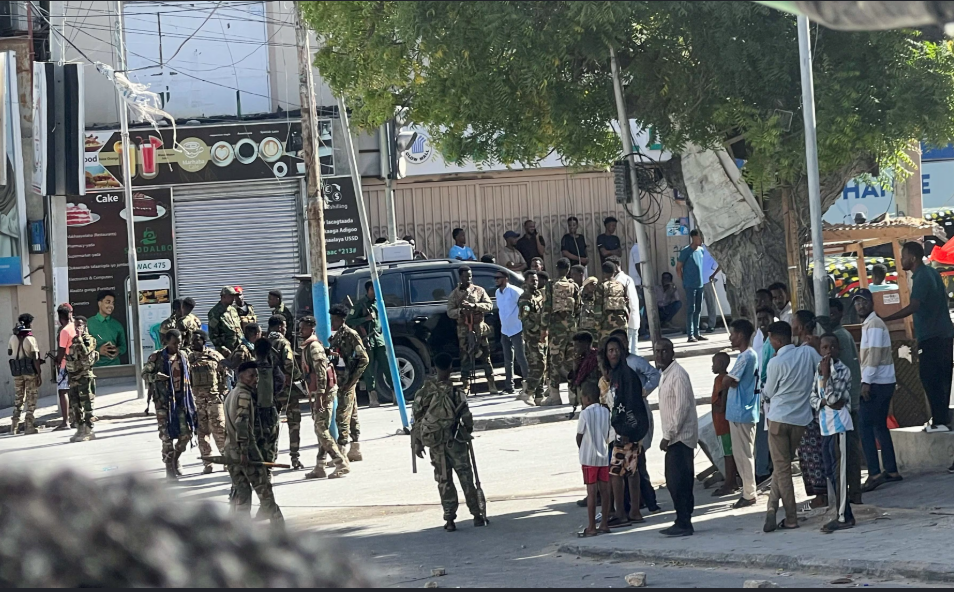
The issue has also generated clashes between rival armed groups.
In previous eviction operations, Haramcad and other government-affiliated forces have faced resistance from opposing security personnel and local groups, turning land disputes into broader security confrontations.
The Irony at the Center of the Debate
This is where the president’s latest statement has created a political contradiction for his critics.
Hassan Sheikh says the government does not seek bloodshed and is committed to preventing conflict.
Yet residents facing eviction say security operations intended to enforce those policies have sometimes involved armed confrontations, while the reported shooting of a peaceful demonstrator has now added a fresh allegation of excessive force.
The government’s position is that enforcing the law and protecting public property are legitimate responsibilities of the state.
Critics, however, argue that law enforcement cannot be separated from the manner in which it is carried out: if civilians are forcibly removed or peaceful protesters are shot, the government’s stated commitment to protecting citizens and preventing bloodshed comes under serious scrutiny.
Somalia’s own eviction guidelines call for protection against arbitrary and forced evictions and emphasize safeguards against disproportionate force, access to remedies and appropriate procedures for people facing displacement.
The controversy also comes against a broader backdrop of political tension between the federal government and opposition groups, with disputes over presidential authority, elections, constitutional changes and the use of state security forces increasingly overlapping with disputes over land and public property.
For Hassan Sheikh’s administration, the challenge is therefore not simply to say that it does not want bloodshed, but to demonstrate that federal institutions and security forces are operating in a manner consistent with that principle.
An independent investigation into the reported shooting, greater transparency over eviction operations and a clear mechanism for resolving land disputes could help determine whether the government’s actions match the president’s stated commitment to preventing violence and upholding the law.