


Somalia’s caretaker Prime Minister, Hamza Abdi Barre, stated in a speech delivered last night that the Federal Government of Somalia has dissolved the framework known as the C6+, and that the United Nations political mission in Somalia has concluded.
In his remarks, Hamza indicated that Somalia no longer requires an external mechanism to mediate domestic political disputes, stating that the government makes its decisions based on national interests and the public good.
The caretaker Prime Minister’s statement has sparked questions regarding what the C6+ was, the role it played in Somalia, and why the Federal Government terminated cooperation with that framework.
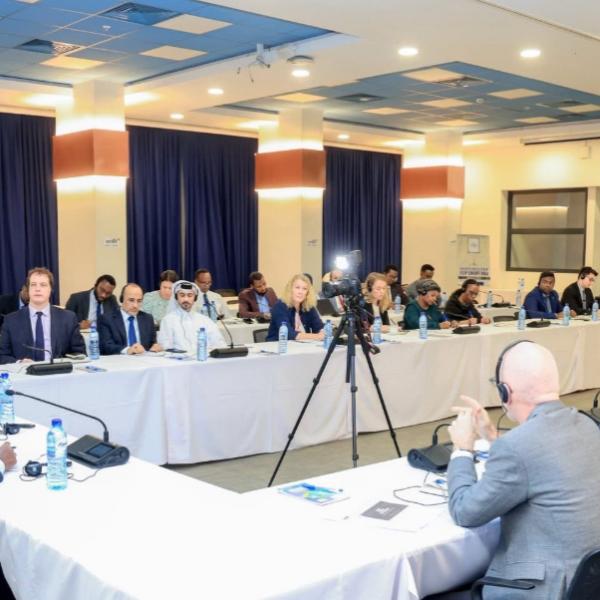
The C6+ was a coordination and consultation mechanism uniting Somalia’s international partners.
Established in 2010, the framework aimed to enable international nations and organizations to coordinate their support for Somalia, particularly in the areas of politics, elections, reconciliation, and state-building.
The name C6+ referred to a core group of countries and international bodies working on Somali affairs—including the United States, the United Kingdom, the European Union, the African Union, IGAD, and the United Nations—alongside other participating partners.
The C6+ was neither a government administering Somalia nor an institution with the authority to override the government or its decisions. Rather, it served as a platform through which international partners aligned their positions and supported Somalia’s political process.
While Somalia was undergoing phases of state-building and reconciliation, there was a clear need to harmonize international support so that different countries would not pursue conflicting agendas.
The C6+ played a role in coordinating efforts related to elections, the establishment of state institutions, political dialogue, and the resolution of disputes among Somali stakeholders.
It also served as a forum where international partners monitored Somalia’s political situation, offering support and advice to both the government and other political actors in the country.
In 2025, the Federal Government of Somalia distanced itself from the C6+ structure, arguing that the legacy system was no longer compatible with the new phase of Somalia’s state-building.
The government’s position was that Somalia had reached a stage where it could independently lead its own political affairs, eliminating the need for a dedicated external mechanism influencing domestic consultations.
However, this move was opposed by opposition politicians, who argued that dissolving the C6+ removes a vital platform for consultation and the mediation of political disputes.
Another point highlighted in Hamza’s speech was the conclusion of the United Nations political mission in Somalia, known as UNTMIS.
The UNTMIS mission officially concluded on October 31, 2026, following the completion of a transition plan transferring the mission’s functions to Somali institutions and other United Nations entities.
It is important to distinguish between the end of the political mission and a complete United Nations withdrawal. The closure of UNTMIS does not mean that all UN agencies have exited Somalia, as humanitarian, development, and other specialized offices continue their operations.
Some opposition figures had previously expressed concern over the government’s decision to step back from the C6+.
They argue that Somalia still requires international mediation and support, particularly when disputes arise over the constitution, elections, and the mandates of state institutions.
Conversely, the Federal Government insists that Somalia’s internal affairs must be Somali-led and that external interference undermining national sovereignty cannot be accepted.
Hamza’s remarks come at a time when Somalia is facing political disputes regarding the constitution, elections, and the Federal Government’s relations with Federal Member State administrations and the opposition.
This raises a crucial question: if the Somali government has eliminated the C6+ and the UNTMIS political mission has ended, in what capacity will the international community participate in supporting political dialogue in Somalia?