


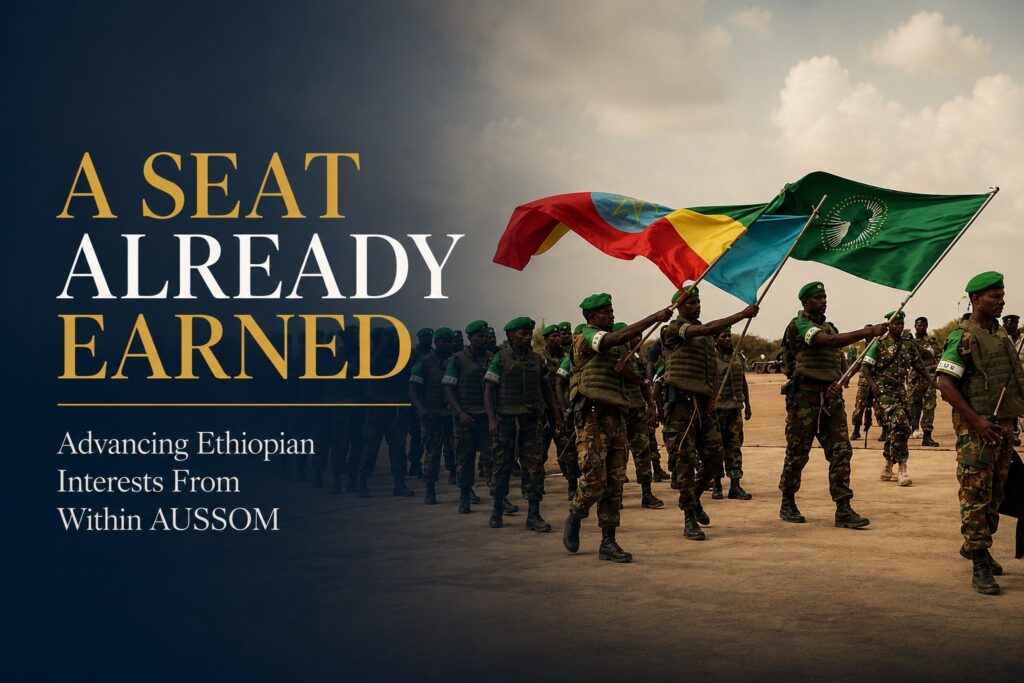


Ethiopia is seeking to transform its long-standing military presence in Somalia into greater political and strategic influence over the future direction of the African Union Support and Stabilization Mission in Somalia (AUSSOM), according to a new report examining Addis Ababa’s role in the mission.
For more than a decade, Ethiopia has maintained troops in Somalia and has been one of the key contributors to regional efforts against Al-Shabaab.
Ethiopian forces participated in both the African Union Mission in Somalia (AMISOM) and its successor, the African Union Transition Mission in Somalia (ATMIS), and are now part of AUSSOM.
Their lengthy deployment has provided Ethiopia with extensive operational experience and a deep understanding of Somalia’s security landscape.
The report argues that Addis Ababa wants to leverage that experience to secure a stronger voice in shaping the future of AUSSOM.
Ethiopia has been authorized to contribute nearly 2,500 troops to the mission, which currently consists of fewer than 12,000 personnel from countries including Uganda, Kenya, Djibouti, Egypt, and Ethiopia.
Beyond its contribution to African Union missions, Ethiopia has also maintained troops in Somalia under bilateral security agreements for many years.
This long-term presence gives Addis Ababa a significant stake in discussions about the future of AUSSOM, particularly as concerns grow over funding, troop levels, and the mission’s future beyond 2026.
Relations between Ethiopia and Somalia have experienced significant strain in recent years, especially following the controversial Memorandum of Understanding signed between Ethiopia and Somaliland in January 2024.
The agreement triggered a major diplomatic dispute with Mogadishu and raised questions about whether Ethiopian troops would be excluded from Somalia’s new African Union mission.
Despite those tensions, Ethiopia ultimately remained one of the countries contributing forces to AUSSOM.
The report notes that Ethiopia continues to play an important role in Somalia’s security architecture.
In August 2026, Ethiopian forces handed over the strategic Buurhakaba military base to Somali government troops after maintaining a presence there for years, highlighting ongoing adjustments within the AUSSOM framework while preserving Ethiopia’s influence on the ground.
According to the report, Ethiopia’s interests extend beyond defending its borders against threats emanating from Somalia.
Addis Ababa is seeking a more active role in planning the future of AUSSOM, including decisions related to leadership structures, operational coordination, troop deployments, and long-term strategy.
Al-Shabaab remains one of the most significant security threats to both Ethiopia and Somalia.
Ethiopian officials view the militant group’s activities as a direct concern because instability in Somalia can quickly affect security along the two countries’ shared border.
As a result, Ethiopia is keen to ensure that AUSSOM retains sufficient capacity to combat Al-Shabaab, particularly in areas whose instability could threaten Ethiopian security interests.
The report also emphasizes Ethiopia’s interest in strengthening intelligence-sharing and military coordination among AUSSOM, Somali security forces, and other troop-contributing countries.
Years of military operations inside Somalia have provided Ethiopian forces with extensive knowledge of Al-Shabaab’s tactics, networks, and areas of operation, giving Addis Ababa valuable expertise that it hopes to bring to future mission planning.
A key concern for Ethiopia is the future financing of AUSSOM. The mission continues to face serious funding challenges, and uncertainty remains over how troop deployments and operations will be sustained after 2026.
Ethiopia views stable and predictable funding as essential to regional security, warning that a sudden reduction in troop numbers could create security gaps that Al-Shabaab could exploit.
The report also highlights growing geopolitical competition between Ethiopia and Egypt inside Somalia. Egypt has expanded its security and military cooperation with Somalia and is among the countries participating in AUSSOM.
This development is being closely watched by Addis Ababa, particularly given the long-running dispute between Ethiopia and Egypt over the Grand Ethiopian Renaissance Dam (GERD).
However, the report cautions Ethiopia against turning AUSSOM into a platform for direct rivalry with Egypt.
Instead, it recommends that Addis Ababa support the mission’s African Union mandate and advocate for clearly defined command structures and responsibilities among all troop-contributing countries.
The Somaliland issue presents another challenge for Ethiopia. While Addis Ababa maintains close ties with Somaliland, it also needs a functional working relationship with the Federal Government of Somalia, especially on security matters.
AUSSOM provides a mechanism through which Ethiopia can continue cooperating with Mogadishu even during periods of political tension.
The report further advises Ethiopia not to use AUSSOM as leverage in disputes related to Somaliland.
Keeping security cooperation separate from political disagreements, it argues, would help Ethiopia protect its security interests in Somalia while maintaining broader regional relationships.
Overall, the report concludes that AUSSOM offers Ethiopia a significant opportunity to expand its influence through its troop contributions, operational experience, geographic proximity to Somalia, and longstanding relationship with the African Union. Nevertheless, Ethiopia’s influence is not unlimited.
Somalia retains full sovereignty over its territory and security decisions, making it essential for Addis Ababa to take into account the priorities of the Somali government and the interests of other troop-contributing countries.
As debates intensify over the future of AUSSOM, its funding, and its mandate beyond 2026, the central question remains whether Ethiopia can successfully convert its years of military involvement in Somalia into lasting political and strategic influence while maintaining constructive relations with Mogadishu and regional partners.