

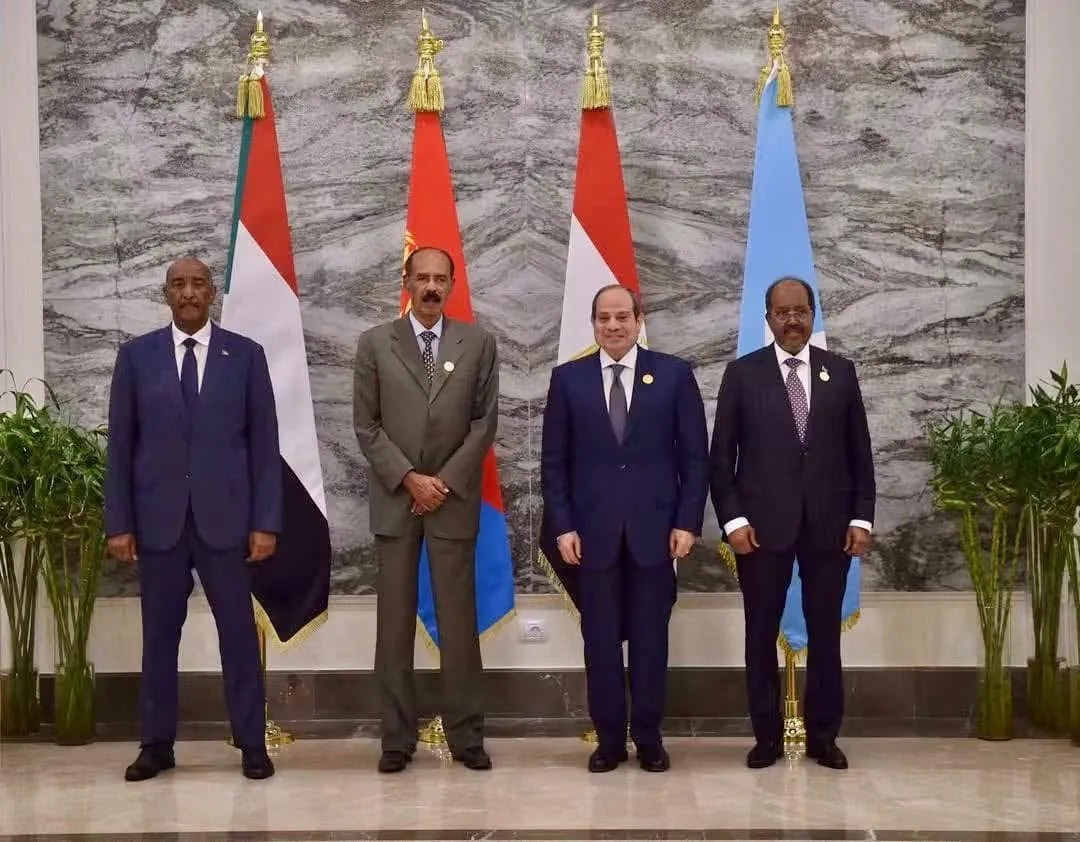

Ethiopia has strongly criticized a joint statement signed by the leaders of Somalia, Egypt, Eritrea and Sudan on October 4, 2026, in New Alamein, Egypt, amid growing regional tensions over the Nile, Red Sea security and Ethiopia’s efforts to secure maritime access.
The four countries agreed to strengthen political, economic and security cooperation and establish mechanisms to follow up on the implementation of decisions reached at future meetings.
Their leaders also reaffirmed respect for national sovereignty, territorial integrity and the peaceful resolution of regional disputes through dialogue.
One of the most sensitive sections concerns the Nile River. The four governments called for adherence to international law governing transboundary water resources and emphasized the principle that states should avoid causing significant harm to one another.
They also stressed that major projects involving shared water resources should be preceded by notification, consultation and agreement among the countries concerned.
The language directly touches on the longstanding dispute between Ethiopia and Egypt over the use of Nile waters, particularly the Grand Ethiopian Renaissance Dam (GERD).
Addis Ababa has consistently defended its right to develop its natural resources, while Egypt has argued that major upstream projects must not adversely affect its vital water supplies.
The joint statement also placed significant emphasis on the Red Sea, stressing the special responsibility of coastal states for the security and management of the strategic waterway.
The position is particularly sensitive for Ethiopia, a landlocked country that has intensified efforts in recent years to secure reliable and potentially independent access to the Red Sea or Gulf of Aden.
The statement comes at a particularly tense moment in Ethiopia-Eritrea relations. Addis Ababa has accused Eritrea of supporting armed groups opposed to the Ethiopian federal government, allegations that Asmara has rejected.
Eritrea has maintained that it is not responsible for renewed fighting and instability in parts of Ethiopia.
The alignment of Somalia, Egypt, Eritrea and Sudan on issues involving the Nile, Red Sea security and regional sovereignty could therefore be viewed in Addis Ababa as a significant diplomatic development.
It comes as Ethiopia faces growing strategic pressure from several neighboring states over its water policies and maritime ambitions.
For Somalia, the statement also reflects its increasingly close relations with Egypt and its emphasis on national sovereignty and territorial integrity.
The developments could further complicate the already sensitive relationship between Mogadishu and Addis Ababa, particularly as Ethiopia continues to seek greater access to the Red Sea and maintains significant security and political interests in Somalia.