


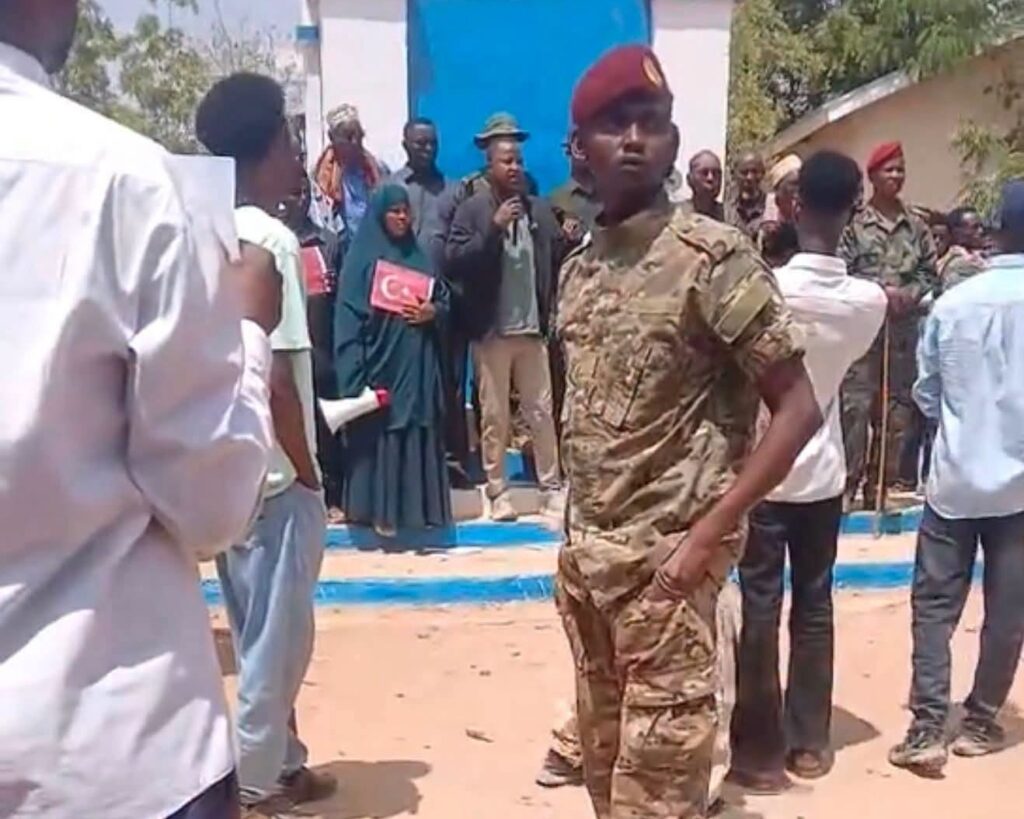


Residents of Doolow in Somalia’s Gedo region staged a protest on Friday led by local officials, condemning an attack that injured former Somali Custodial Corps commander Gen. Mahad Abdirahman Aden, widely known as Mahad Shub.
According to reports from Doolow, hundreds of residents gathered in the town’s streets to express anger over the incident at the general’s residence.
The demonstration comes amid escalating political tensions and competing narratives surrounding the attack, which has sparked a dispute between Jubaland and the Federal Government of Somalia.
Jubaland officials claim Gen. Mahad Shub and several civilians were wounded in what they describe as an airstrike carried out by Turkish military aircraft.
In a statement, the administration alleged that two missiles were fired during the attack, with one reportedly striking the residence of the Doolow district commissioner. Jubaland said Gen. Mahad and four civilians were injured.
The protest highlights how the incident has evolved beyond a security event into a politically charged issue affecting relations between Jubaland, the federal government, and Turkey.
Demonstrators have called for an independent investigation into the attack and demanded answers about why the residence of Gen. Mahad Shub was targeted.
Gen. Mahad, a former commander of Somalia’s Custodial Corps, remains a prominent figure in the country’s security and political circles. His injury has triggered strong reactions from politicians, former leaders, and Jubaland officials.
The incident has further deepened tensions between Jubaland and Mogadishu.
Jubaland has suggested the attack may be linked to political disputes involving Gen. Mahad and federal authorities, while the Federal Government has firmly rejected claims that an airstrike took place.
In an official statement, the government said the explosions were not caused by an aerial attack.
Instead, it claimed the blasts resulted from explosive materials allegedly being prepared inside the residence, based on what it described as security findings. The government denied any involvement in a strike.
The conflicting accounts have created two sharply different narratives.
Jubaland and several opposition figures insist that the residence was hit in an airstrike, while the federal government maintains that the explosion originated from within the compound.
Turkey has also become a central part of the controversy after Jubaland directly accused Turkish military aircraft of carrying out the attack.
However, there has been no independent verification of those claims, and Ankara has not publicly responded to the allegations.
The accusations carry wider implications given Turkey’s longstanding military partnership with Somalia.
Ankara has trained and supported Somali security forces for more than a decade, making claims of Turkish involvement particularly sensitive diplomatically and politically.
Doolow, located near the Somalia-Ethiopia border, is a key commercial and transit hub in Gedo region.
Any major security incident in the town has the potential to affect local stability, trade, and cross-border movement.
The protests also come as Jubaland calls for a review of Somalia’s military capabilities and international security arrangements.
The administration argues that if foreign military assets can be used in operations inside Somalia, there must be greater transparency regarding command authority and accountability when civilians are harmed.
The incident has drawn reactions from prominent Somali political figures.
Former Prime Minister Hassan Ali Kheyre warned against the use of armed drones or air power in political disputes, arguing that such actions could further destabilize the country.
Former President Mohamed Abdullahi Farmaajo also commented on the incident, stating that Gen. Mahad survived what he described as a drone strike.
His remarks added to the political pressure facing the federal government following the events in Doolow.
Reports indicate that Gen. Mahad sustained injuries but survived the attack and is receiving medical treatment.
The exact number of casualties and the condition of other injured individuals remain unclear, with different sources providing varying accounts.

Observers fear the incident could further inflame political tensions between Jubaland and the federal government.
Continued protests in Doolow may also create new security challenges if tensions between demonstrators and security forces escalate.
The allegations against Turkey have added a diplomatic dimension to the crisis.
Somalia and Turkey maintain close military, economic, and political ties, and many observers expect Ankara may eventually respond to the accusations.
For residents of Doolow, the central question remains unanswered: what exactly happened on the night of September 3–4, who carried out the attack, and why was Gen. Mahad Shub targeted?
What is confirmed is that a powerful explosion or attack occurred at the residence of Gen. Mahad Shub, that he was injured, and that the incident has triggered protests and political fallout.
What remains unverified is who carried out the attack and what type of weapon was used.
As demands for an independent investigation grow, Doolow has become the center of a dispute that now extends beyond Gedo region, touching on relations between the Federal Government, Jubaland, and one of Somalia’s closest international partners, Turkey.
Without a credible and widely accepted investigation, the incident risks deepening Somalia’s political divisions and fueling further instability in the region.