

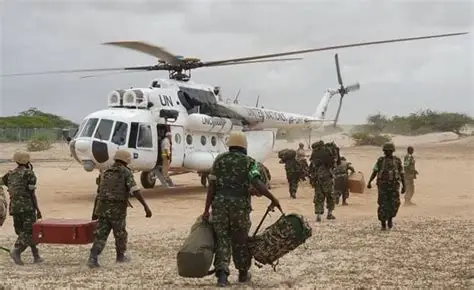

The transfer of an Ethiopian military base in Buurhakaba, Bay region, to Somali forces has renewed debate over Somalia’s ability to assume full responsibility for national security as African Union forces gradually reduce their presence.
Ethiopian forces have maintained a presence in parts of southern Somalia, including Bay and Bakool, for years as part of efforts to support Somali authorities and fight Al-Shabaab.
The handover of the Buurhakaba base represents another step in the broader security transition aimed at placing Somali forces in greater control of areas previously secured by foreign troops.
Why Buurhakaba Matters
Buurhakaba is strategically important because of its location along routes connecting Mogadishu, Baidoa and other parts of South West State.
The military base therefore served not only as a security post but also as a platform for protecting important roads and supporting military operations in surrounding areas.
Ethiopian forces have been present in Buurhakaba since 2014 and have participated in operations against Al-Shabaab.
With Somali forces now expected to assume greater responsibility, the government faces the challenge of securing the town, maintaining the base and protecting the roads around it.
AUSSOM and the Security Transition
The African Union Support and Stabilization Mission in Somalia (AUSSOM) replaced ATMIS in 2025 and remains an important part of Somalia’s security transition.
The objective is not for African Union forces to leave the country all at once. Instead, responsibilities are expected to be transferred gradually to Somali forces according to the security situation in individual areas.
For that transition to succeed, Somalia needs adequately trained troops, reliable logistics, weapons and equipment, intelligence capabilities and sufficient funding.
Coordination between the federal government, federal member states and different security institutions will also be critical.
What If the Transition Moves Too Quickly?
The biggest concern is the possibility of a security vacuum.
If foreign forces leave an area before Somali forces are capable of securing it, Al-Shabaab could attempt to exploit the gap by attacking newly established positions or retaking territory where government forces are weak.
Road security is another major concern. Taking control of a military base is not enough if troops cannot safely patrol the roads connecting it to nearby towns and communities.
Any deterioration in road security could affect civilians, trade, transportation and the delivery of essential services.
For communities in areas where foreign forces withdraw, a decline in security could also lead to displacement, restrictions on movement and increased fear of militant attacks.
The Transition Could Also Be an Opportunity
Despite these risks, the withdrawal of African Union forces could represent an important opportunity for Somalia.
For years, the country has relied heavily on international and regional forces to provide security.
A carefully managed transition could allow Somalia to build a more capable national army and strengthen its ownership of security operations.
The key is timing and preparation. Somali forces must be ready to take over before foreign troops leave, rather than being expected to fill security gaps after the withdrawal has already taken place.
What Somalia Needs
The Somali security forces will require sustained training in combat operations, intelligence, civilian protection and emergency response. Troops deployed to remote bases also need regular supplies of food, water, fuel, medical support and ammunition.
Political cooperation will be equally important. Disagreements between the federal government and federal member states could complicate security operations if they prevent forces from operating under a coordinated national strategy.
If the transition is rushed, Al-Shabaab could launch attacks against newly transferred bases, vulnerable roads could become insecure and civilians could bear the greatest cost.
What Lies Ahead for AUSSOM?
AUSSOM continues to play an important role in supporting Somali forces and combating Al-Shabaab. Its gradual reduction should therefore be viewed as a security transition rather than a sudden withdrawal of all African Union forces.
The handover of the Buurhakaba base provides an important test of that process.
If Somali forces can successfully secure the base, surrounding communities and key transport routes, it could demonstrate that the country is moving closer to taking full ownership of its security.
But if the handover creates vulnerabilities that Al-Shabaab can exploit, it could highlight the dangers of withdrawing international forces before Somali institutions are sufficiently prepared.
Ultimately, the success of Somalia’s security transition will depend not simply on how quickly foreign forces leave, but on whether Somali forces are ready to take their place when they do.