

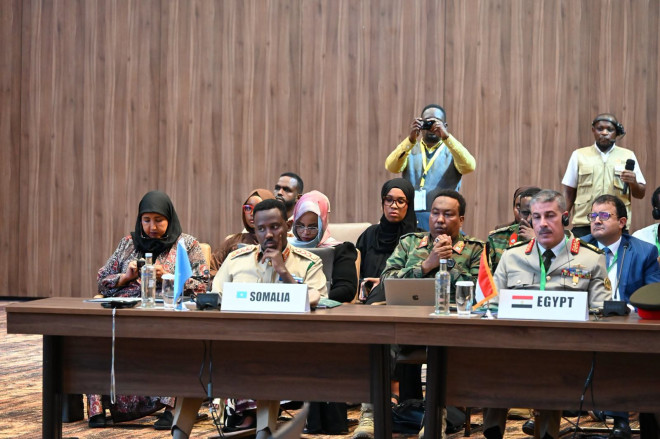

Leaders from countries contributing troops to the African Union Support and Stabilization Mission in Somalia (AUSSOM) gathered in Uganda on Wednesday for a three-day summit aimed at determining the future of the peace support mission as it confronts an increasingly severe financial crisis.
The Special Summit of AUSSOM Troop-Contributing Countries (TCCs), running from July 29 to 31, has brought together heads of state and government from Burundi, Djibouti, Egypt, Ethiopia, Kenya, Somalia, and Uganda, alongside senior representatives from the African Union (AU), the United Nations (UN), and the Intergovernmental Authority on Development (IGAD).
Held under the theme “Sustaining Momentum in Somalia’s Stabilization Process,” the summit is expected to focus on the future of AUSSOM, regional security cooperation, Somalia’s security transition, and efforts to secure long-term and predictable funding for the mission.
The summit opened on Wednesday with a meeting of Chiefs of Defense Forces, followed by a session of defense ministers on Thursday.
Heads of state are expected to convene on Friday to consider recommendations from the military and ministerial meetings before adopting a final communiqué on the mission’s future.
Among the senior international participants are the UN Under-Secretary-General for Peace Operations, the Deputy Special Representative of the UN Secretary-General for Somalia, and the head of the United Nations Support Office in Somalia (UNSOS).
The African Union delegation includes the AU Deputy Chairperson, the Commissioner for Political Affairs, Peace and Security, and the Special Representative of the AU Commission Chairperson for Somalia, who also serves as the Head of AUSSOM. IGAD is represented by its Deputy Executive Secretary.
Uganda, the host nation, said the summit reflects its continued commitment to promoting peace, security, and regional stability under the African Union framework while working closely with the United Nations, IGAD, and other international partners.
The discussions come at a pivotal moment for AUSSOM, which replaced the African Union Transition Mission in Somalia (ATMIS) in January 2025 as the AU’s new peace support mission.
AUSSOM continues to assist Somali security forces in operations against Al-Shabaab, while supporting stabilization efforts and the restoration of state authority in areas recovered from the militant group.
However, the mission faces growing uncertainty after the United States announced it would end funding for UNSOS after December 2026.
UNSOS provides critical logistical support—including food, fuel, medical services, transportation, engineering support, and casualty evacuation—for approximately 12,000 AUSSOM personnel. Without a replacement funding mechanism, officials warn the mission could face significant operational challenges.
Security analysts say the funding shortfall threatens not only AUSSOM’s effectiveness but also Somalia’s broader counterterrorism campaign.
They argue that troop-contributing countries and international partners must agree on a sustainable financing model to prevent security gaps that could be exploited by Al-Shabaab and undermine recent stabilization gains.
Somali officials maintain that national forces have recaptured several strategic areas over the past year and restored basic public services in some locations previously controlled by Al-Shabaab.
Nevertheless, international partners continue to press Somalia to present a credible roadmap for assuming full responsibility for national security as the African Union mission gradually transitions its role.
The Kampala summit also comes as Turkey expands its diplomatic and security engagement in Somalia.
Earlier this month, Ankara hosted talks between the Federal Government and opposition political leaders in an effort to ease political tensions and encourage dialogue on constitutional and electoral disputes—issues that many international partners view as essential to long-term stability.
The recommendations emerging from Kampala are expected to be submitted to the African Union Peace and Security Council and the United Nations Security Council, where they will help shape the next phase of the AU’s security role in Somalia.
The summit is expected to conclude with recommendations on AUSSOM’s future, including proposals for sustainable financing, stronger regional coordination, continued international support, and an accelerated but orderly transition toward Somali-led security.