


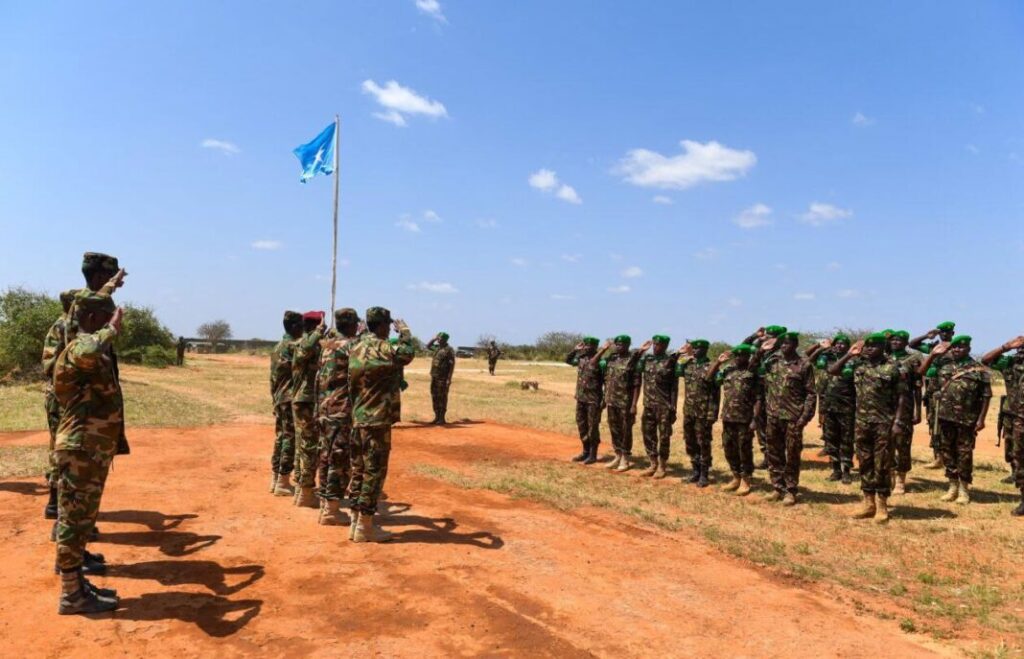


The number of African Union forces stationed in Somalia has dropped significantly compared to previous years, with released data indicating that forces from Uganda, Ethiopia, Djibouti, and Kenya total 9,930 personnel, whereas in 2022 over 20,000 troops belonging to the African Union mission were present in Somalia.
This transformation illustrates a new phase regarding Somalia’s security, as foreign forces gradually reduce their presence while the Somali government is expected to fully assume security responsibilities.
The released figures break down as follows: Uganda contributes 4,500 troops, Ethiopia 2,500, Djibouti 1,520, and Kenya 1,410 troops. Combined, these four nations total 9,930 personnel.
Nevertheless, it is important to note that this figure does not reflect the entirety of the previously announced AUSSOM quota. The 2025 agreement between the African Union and the Somali government also allocated 1,091 personnel to Egypt.
Consequently, the agreed total across the five nations amounts to 11,021 personnel, with the mission also incorporating police and other personnel.
In 2022, when the ATMIS mission succeeded AMISOM, mission force levels were planned to reach 18,586 military personnel, alongside police and other civilian staff. Reports from that period indicated that total African Union personnel numbers approached 20,000.
Utilizing the baseline estimate of 24,000 cited in data, the 9,930 figure represents a reduction of 14,070 personnel, corresponding to a decline of nearly 59 percent.
This reduction did not occur overnight. It resulted from phased plans encompassing troop drawdowns, base handovers, and efforts to enable Somali forces to assume security responsibilities.
The 2025 security assessment report by the Government of Netherlands noted that ATMIS maintained approximately 20,000 troops at the beginning of April 2022, and that 27 out of the mission’s 50 bases were either closed or handed over to Somali forces by the end of 2024.
Uganda remains the largest troop contributor in Somalia, with its allocated AUSSOM quota standing at 4,500 personnel.
In November 2026, Uganda announced the commencement of its troop withdrawal from Somalia.
According to Reuters, the initial contingents repatriated belonged to forces stationed in Uganda under bilateral agreements outside the AUSSOM framework.
Uganda stated it will phase out its troops incrementally, including those operating under the African Union mission, with the broader transition slated for completion by the end of 2027.
This step has raised concerns regarding bases vacated by Ugandan forces and the mechanisms for securing them.
An Associated Press report noted that AUSSOM has planned to take over four critical forward operating bases near Mogadishu—namely Sabid-Anole, Bariire, Awdheegle, and Bulonagad—to prevent Al-Shabaab from exploiting security voids.
Ethiopia, Djibouti, and Kenya also participate in AUSSOM, though each nation retains distinct national security interests.
Ethiopia was allocated 2,500 troops under the African Union mission. Additionally, some Ethiopian forces operate in Somalia under bilateral agreements, meaning the total aggregate of Ethiopian troops in the country is not restricted to the AUSSOM quota.
Djibouti was assigned 1,520 personnel, while Kenya was allocated 1,410 troops. Forces from these nations operate across diverse sectors of Somalia, supporting government forces, securing vital installations, and participating in counter-insurgency operations against Al-Shabaab.
It is vital to distinguish between allocated mission quotas and actual on-the-ground troop strength at any given time, as base handovers and force rotations continuously alter numerical figures.
The core debate arising from African Union troop reductions centers on whether territories vacated by foreign forces have directly fallen under Al-Shabaab control.
The data presented indicates that Maxaas district in Hiiraan region is the sole documented locality reported to have reverted to the group following troop withdrawals.
This situation requires careful examination, because vacating a military base does not inherently mean an entire district has fallen to Al-Shabaab.
A clear distinction must be maintained between an abandoned base, a tactical relocation of troops, and a fully overrun district.
Nevertheless, Maxaas serves as a prime illustration of the foremost challenge confronting the security transition plan: if foreign forces evacuate critical positions without deploying capable Somali forces to defend them, Al-Shabaab gains an opportunity to reoccupy territory.
The reduction of African Union forces can be characterized as progress toward security self-reliance if accompanied by adequate Somali force capabilities to defend urban centers, supply routes, and vital installations.
However, drawing down foreign troop numbers alone does not prove that Somalia has fully assumed security control.
Sustained security requires Somali forces equipped with adequate weaponry, transport, logistical supply, intelligence support, regular remuneration, and the combat capacity to hold liberated areas.
Furthermore, government forces must maintain a permanent garrison in areas cleared of Al-Shabaab rather than withdrawing post-operation, which otherwise allows the militant group to re-infiltrate.
The United Nations Security Council, via Resolution 2809 of 2025, authorized AUSSOM to maintain its presence in Somalia until December 31, 2026, capping uniformed personnel strength at 11,826, inclusive of 680 police officers.
This demonstrates that the African Union mission has not yet concluded, but is navigating a novel phase concerning force numbers, financing, and security handover frameworks.
Meanwhile, Uganda’s announced withdrawal schedule extending through the end of 2027 further compounds questions regarding who will fill the vacuum left by departing contingents.