


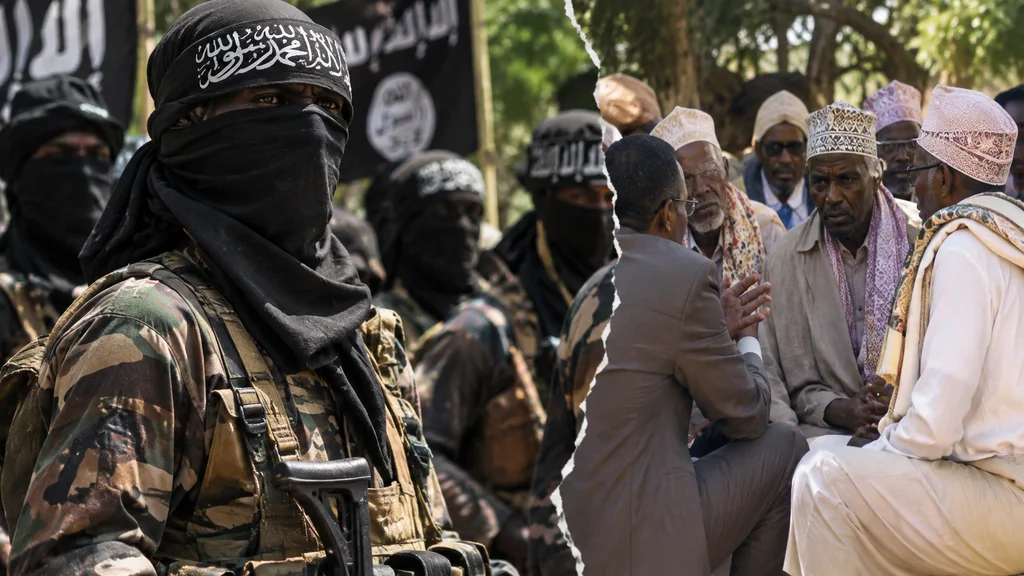


Reliable intelligence reports indicate that Al-Shabaab is actively striving to exploit Somalia’s political disputes, public grievances, and leadership divisions in order to reinforce its military, intelligence, and financial capabilities.
According to available intelligence, the group’s strategy is predicated on capitalizing on volatile political circumstances, particularly friction between the Federal Government of Somalia, the opposition, and select Federal Member States.
Reports further suggest that Al-Shabaab seeks to leverage public grievances and clan disputes to expand its domestic influence.
These reports indicate that senior commanders within the group have been assigned to specifically monitor political and security developments, attempting to exploit vulnerabilities arising from societal fragmentation and institutional weaknesses within the government.
The intelligence suggests that Al-Shabaab is placing heavy emphasis on cultivating relations with traditional elders, business leaders, and community figures, intending to influence community decision-making and local administration in certain areas.
Reports also note that millions of dollars have been allocated toward efforts aimed at securing social and political influence. However, detailed specifics regarding these funds, who manages them, and how they are deployed remain unverified independently.
This dynamic illustrates that Al-Shabaab’s campaign is not confined strictly to attacks executed against military bases and government installations, but also encompasses financial, intelligence, and societal influence dimensions.
One of the foremost concerns regarding the nation’s situation is the risk that political disputes could escalate into armed conflict between government forces and opposition factions.
Should such a scenario materialize, Al-Shabaab could secure an opportunity to exploit the preoccupation of political power contenders—especially if government forces become distracted by internal fighting rather than maintaining focus on counter-insurgency operations.
The group could consequently attempt to expand its attacks, seize territories abandoned by government forces or experiencing reduced troop presence, and exert pressure on vital supply routes and corridors critical for military and civilian transit.
Nevertheless, this represents a projected risk rather than confirmation that such fighting has occurred or that Al-Shabaab currently possesses a verified plan to capture military positions.
The 2026 security report published by the European Union Agency for Asylum (EUAA) on Somalia indicated that Al-Shabaab retains military and administrative capacity across substantial portions of central and southern Somalia. The report also noted that the group has capitalized on political disputes, clan grievances, and government force vulnerabilities to expand its influence across diverse areas.
The report highlighted the group’s capacity to exert influence in territories outside its direct administrative control through intimidation, taxation, and the implementation of governance systems in select localities.
Meanwhile, a report issued by the Security Council Report this November stated that Al-Shabaab is exploiting the nation’s political climate, sustaining attacks, bombings, and asymmetric ambushes across central and southern Somalia.
The country’s political friction arrives at a time when Somalia remains engaged in ongoing efforts to build and unify security institutions, which play a central role in the war against Al-Shabaab.
Should political disputes impair cooperation among government security forces, a decline could occur in operational coordination, intelligence-sharing, and the capacity to secure liberated areas.
Similarly, any conflict between the central government and Federal Member States can adversely impact security cooperation among distinct military units. This dynamic can further complicate efforts to ensure that territories liberated from Al-Shabaab receive functioning governance and sustained security protection.
Concerns also persist regarding the future of international support for Somalia, particularly the financing and stabilization backing for the African Union Support and Stabilization Mission in Somalia (AUSSOM).
The Security Council Report indicated that the AUSSOM mission faces financial constraints at a time when Somalia is simultaneously navigating political and constitutional disputes. If military support and security coordination diminish, the operational burden on Somali security forces will increase.
Nevertheless, these challenges alone do not signify that government forces are collapsing or that Al-Shabaab will directly seize new territories, though they heighten the imperative for a unified security strategy and political cooperation.
This situation imposes a heavy responsibility upon the nation’s leaders, opposition factions, and regional member states. It is vital that political disputes be resolved through dialogue and legal mechanisms rather than escalating into conflict capable of damaging state institutions and national security.
Furthermore, the armed forces must be insulated from political competition, ensuring that operational commands and missions remain anchored in national interests rather than subservient to rival political factions.
Traditional elders, business communities, and civil society actors likewise hold a critical role in preventing Al-Shabaab from exploiting public grievances. This requires the government to address civilian complaints, strengthen justice delivery, and demonstrate reliable public administration and services.
Ultimately, Somalia’s primary danger stems not merely from Al-Shabaab’s military capability, but also from the opportunities the group derives when political cohesion, state institutions, and public trust erode. If the nation’s leaders fail to resolve their disputes through peaceful means, the greatest cost will ultimately be borne by the Somali public and national security.