


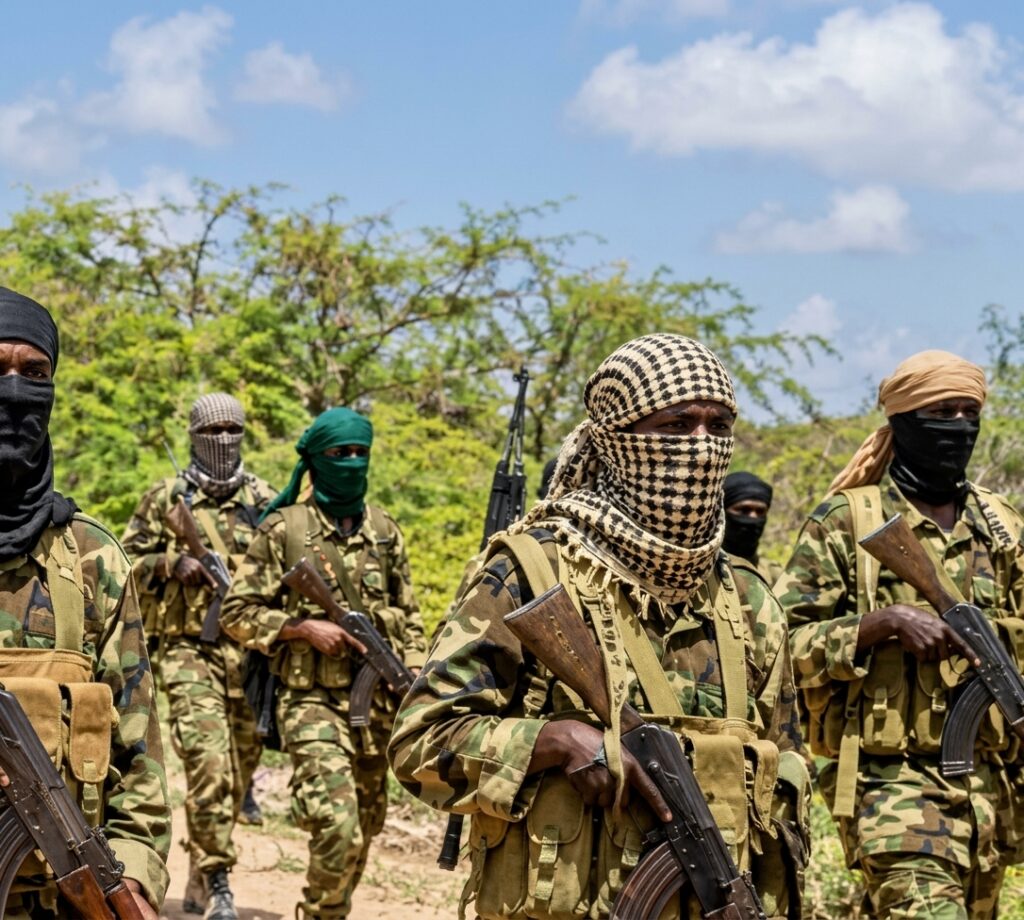


Reports emerging from the Lower Shabelle region indicate that the Al-Shabaab group is conducting military maneuvers and force agglomeration across various parts of the region, amid unfolding plans regarding the reduction and withdrawal of foreign forces stationed in Somalia.
The localities reported as sites of insurgent activity include Siigale, Ugunji, Biibi, Busleey, Maduuloow, Buulo, and Cabdalle.
Particular emphasis was placed on Buulo Bashiir and Buula Shufeeri, which are cited as focal points for the group’s force concentration.
These reports generate profound security concerns, as Lower Shabelle constitutes a vital theater safeguarding the capital, Mogadishu, and securing transit corridors linking southern Somalia.
The Lower Shabelle region holds singular strategic importance concerning Somalia’s overall security architecture.
Situated in close proximity to Mogadishu, it connects the capital to numerous territories across the southern provinces.
Furthermore, the region encompasses major agricultural zones, commercial trade routes, and livelihoods critical to the local populace.
Consequently, any security disruption within the region directly impacts civilian mobility, commerce, and state administrative functions.
Al-Shabaab has long maintained attacks and military operations in the region, while the Somali National Army and African Union forces have conducted sustained campaigns to dislodge the group from its strongholds.
Should reports of this new force concentration prove factual, it remains imperative for the Federal Government of Somalia to assess the security posture of these areas to prevent civilian casualties from potential armed clashes.
These reported developments in Lower Shabelle coincide with persistent challenges in securing areas where government forces confront Al-Shabaab.
The militant group has historically utilized rural terrain to launch attacks and disrupt logistical supply lines for both military forces and civilians, exposing numerous regional localities to recurring conflict and instability.
Conversely, civilian populations residing in these areas routinely bear the brunt of hostilities, including displacement, commercial paralysis, and severed transit routes.
It remains essential that reports regarding force agglomerations are not prematurely classified as confirmed imminent attacks, but rather treated as actionable intelligence requiring rigorous verification by security agencies.
On November 2, 2026, the Government of Uganda confirmed the initiation of repatriating its military personnel from Somalia under a bilateral framework agreement concluded with the Federal Government.
This measure forms part of a broader phased withdrawal plan terminating Uganda’s military footprint by the end of 2027.
This retrograde occurs as Ugandan forces have historically maintained a foundational role in counter-Al-Shabaab operations, particularly across southern Somalia.
An Associated Press (AP) report published on November 3 stated that AUSSOM African Union forces are planning to assume control of four strategic locations in Lower Shabelle: Sabiid-Anole, Bariire, Awdheegle, and Bulonagad.
This operational blueprint is designed to prevent Al-Shabaab from exploiting positions evacuated by Ugandan forces. Nevertheless, questions persist regarding which entities will fully secure all evacuated installations.
Baraawe and Shalanbood Face a New Security Phase
A report published by *Somali Guardian* on November 3 indicated that Ugandan forces formally transferred security responsibilities for the towns of Baraawe and Shalanbood to the Somali National Army (SNA) following over a decade of Ugandan deployment.
This development exemplifies the ongoing evolution of foreign military operational models within Somalia.
However, mere transfer of base control or territorial oversight does not suffice to guarantee regional security. Sustainable stabilization requires permanent troop deployment, logistical supply lines, mechanized transport, intelligence-gathering apparatuses, and administrative governance capable of delivering basic public services.
Without robust prior preparation, securing territories vacated by international forces remains an uphill challenge.
What Awaits if All Foreign Forces Withdraw?
Should international forces execute a total future withdrawal from Somalia, the Federal Government will inherit security responsibilities vastly exceeding its current operational footprint.
Somali security forces will be tasked with independently securing urban centers, trunk roads, state installations, and liberated territories.
Without adequate equipment, financial resourcing, and specialized training for national forces, security vacuums could emerge, offering Al-Shabaab tactical openings to intensify attacks or re-infiltrate previously cleared areas.
Associated Press reporting noted that regional security experts have expressed serious reservations regarding the financial and material capacity of Somali forces, particularly relative to the immense scope of the security mandate ahead.
Conversely, foreign force withdrawal does not automatically equate to immediate territorial capture by Al-Shabaab; operational outcomes will depend entirely on the preparedness of Somali forces and the governance frameworks established in government-held areas.
The prevailing operational environment compels the Federal Government to institute a long-term, self-sustaining security blueprint rather than relying on reactive measures post-withdrawal.
It is imperative to reinforce the Somali National Army, ensuring regular salary disbursements, adequate logistical supply, and robust materiel support.
Equally critical is the unification of security institutions and the strengthening of coordination between the Federal Government and Federal Member States. Political friction and inter-institutional discord directly undermine overarching counter-insurgency strategies.
A further operational priority is ensuring that liberated areas are not left solely under military occupation; they require concurrent deployment of civil administration, law enforcement, and essential public services.
Without sustained security, judicial access, and administrative governance, achieving durable stability remains elusive.
The AUSSOM mission continues to provide crucial support to Somali security forces; however, the mission faces acute funding deficits and challenges regarding sustained international backing.
The November 3 AP report highlighted that financial constraints remain central impediments governing Ugandan force postures and the broader restructuring of African Union operational sectors.
Consequently, the future of Somali security hinges not merely on the numerical drawdown of foreign contingents, but on sustained investment in training, logistical sustainment, and equipment pipelines for indigenous Somali forces.