


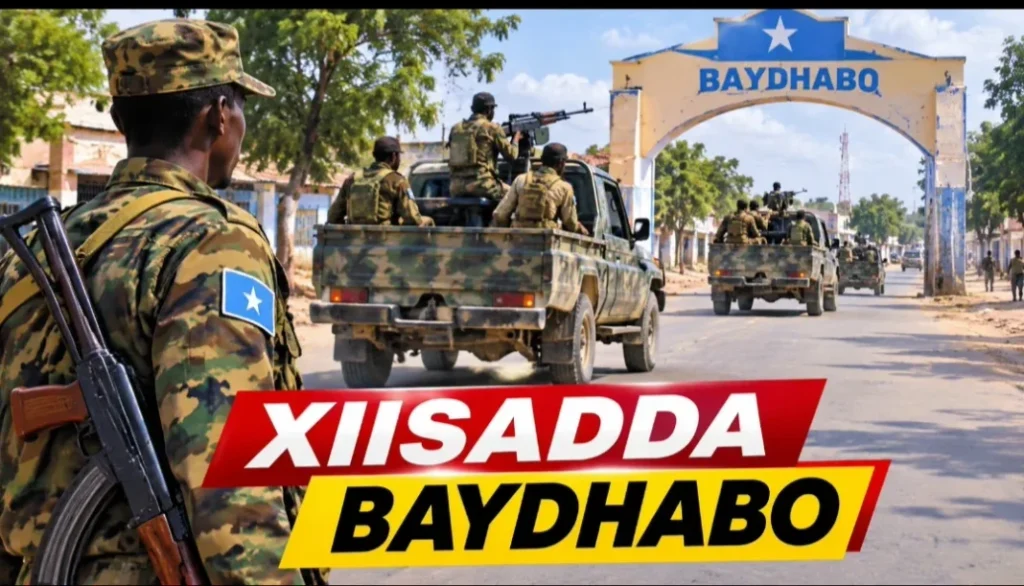


The security situation in the city of Baidoa has once again sparked concern following reports of troop movements observed in the Towfiiq neighborhood and other parts of the city.
Some reports indicate that forces loyal to Abdiaziz Hassan Mohamed Laftagareen are carrying out maneuvers across various directions near the South West State administration headquarters.
These movements come at a time when the city is experiencing an intensifying political crisis, rooted in disputes between factions competing for leadership of the South West administration.
Reports from Baidoa indicate that units of the South West Darawish forces aligned with Laftagareen have been spotted in areas on the outskirts of the city, while inside Baidoa, heightened vigilance is being displayed by security forces.
Some reports suggest that these forces are positioned across multiple directions, leading local residents to question whether these movements constitute routine military preparations or are linked to a new tactical plan.
Another alarming element is reports indicating distrust among certain security forces stationed within Baidoa.
Various units are reportedly exhibiting heightened alert status, as the political climate threatens to impact the cooperation and coordination of security forces.
Baidoa hosts diverse forces, including Federal Government troops and South West administration forces, which play roles in securing government installations, vital roadways, and other strategic locations.
The security tension in Baidoa is closely intertwined with the political dispute between supporters of Abdiaziz Hassan Mohamed Laftagareen and the administration led by Sheikh Adan Mohamed Nur (Adan Madoobe).
Both sides hold divergent views regarding the leadership and political future of South West State, with this dispute increasingly impacting the regional security environment.
Military maneuvers and reports regarding territorial control indicate that the conflict is no longer confined solely to political discourse, but has also impacted the region’s military posture.
A report published on October 19 stated that forces loyal to Laftagareen were conducting maneuvers in areas across the Bay region, including Qansaxdheere and Buurhakaba. That report also noted that control over certain areas required additional verification.
The Federal Government of Somalia plays a critical role in the political and security landscape of South West State, as federal troops are stationed in Baidoa and administrative disputes directly affect relations between the central government and regional political factions.
The official stance of the Federal Government regarding these new reports of troop movements and measures to secure the city is currently awaited.
Furthermore, it remains essential to determine how federal leaders and South West political factions can collaborate to prevent political disputes from escalating into conflict affecting civilians.
Residents of Baidoa fear that ongoing tensions could trigger renewed conflict impacting their livelihoods and the city’s economy.
Should armed clashes occur, commerce could stall, transportation and public movement disrupted, and numerous families displaced from their neighborhoods.
Among the most vulnerable populations are children, women, the elderly, and families already enduring difficult living conditions.
Additionally, renewed conflict would place additional strain on medical facilities and other public services, particularly if clashes occur in densely populated residential areas.
Consequently, protecting civilians and avoiding frontlines where military forces are deadlocked remain vital to mitigating risks arising from the current situation.
The primary question at hand is how the Baidoa crisis will conclude and what actions will be taken by rival factions competing for control of the South West administration.
The reported troop movements, heightened citywide vigilance, and persistent political disputes all represent critical dynamics requiring close monitoring.