


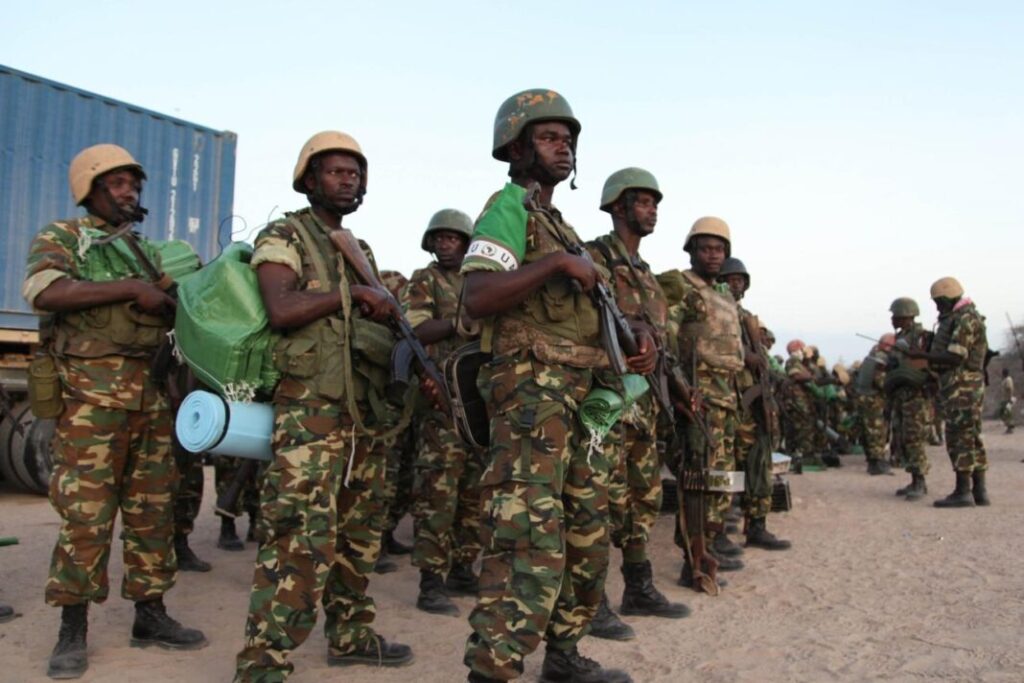


The Government of Burundi is reportedly making efforts to withdraw its remaining troops from Somalia under the African Union Support and Stabilization Mission in Somalia (AUSSOM), at a time when the future of the mission faces uncertainty related to funding and logistical support.
Burundian troops have served in Somalia since 2007, participating in the AMISOM and ATMIS operations, which were subsequently transitioned into AUSSOM. The country has long been one of the largest troop contributors to African Union missions in Somalia.
Reports concerning the withdrawal of remaining forces indicate that Burundi is heavily reliant on United Nations logistical and transport support to finalize the repatriation of its troops. However, precise figures on the troops still present and the official timetable for their departure have not been independently verified.
Friction between Somalia and Burundi surfaced in late 2024 during negotiations over troop allocations for the newly formed AUSSOM mission.
Burundi sought to contribute around 3,000 troops to the mission, but the Federal Government of Somalia insisted on a lower allocated number. A report published by the Institute for Security Studies (ISS) in January 2025 stated that Somalia agreed to approximately 1,000 personnel, a figure Burundi found unacceptable.
Other reports noted that the troop quota assigned to Burundi was 1,041 personnel, whereas the Burundian side sought a larger deployment. This disagreement caused Burundi’s participation plan in AUSSOM to stall, though the African Union subsequently called for finalizing the repatriation of Burundian forces and establishing a mechanism to manage their presence while the process is underway.
The United Nations, specifically the United Nations Support Office in Somalia (UNSOS), provides AUSSOM with critical services including rations, fuel, water, medical services, transport, and mobility support.
This support is also vital for nations withdrawing their forces from Somalia, as UNSOS assists with the transport and repatriation of soldiers and their equipment.
In February 2026, the African Union renewed its call to accelerate the repatriation of Burundian forces while awaiting the deployment of Egyptian troops to Somalia to prevent security vacuums in areas vacated by Burundian troops.
The Burundian issue coincides with AUSSOM facing a major financial crisis. On July 1, 2026, the United States announced it would no longer sustain financial and logistical support through UNSOS beyond the end of 2026.
A Reuters report published on July 2 warned that Washington’s decision could imperil the mission’s continuity, given that AUSSOM heavily relies on services provided by the United Nations. The UNSOS budget is estimated at roughly $500 million annually.
Nevertheless, another Reuters report published on September 18, 2026, stated that the U.S. agreed to grant the United Nations an additional 12-month period to gradually phase out logistical support, with that timeline expected to begin in January 2027.
This step affords AUSSOM extra time to secure funding and alternative entities to take over critical services, though it does not yet resolve the mission’s core financial deficit.
The United Nations Security Council, via Resolution 2809 adopted in December 2025, extended the mandate authorizing the AUSSOM mission until December 31, 2026. The resolution authorized up to 11,826 military and police personnel to operate within the mission.
It is important to distinguish between the expiration of the mission’s mandate authorization and the termination of UN logistical support. The two matters are distinct, and efforts are ongoing to find a framework to sustain mission support.
Meanwhile, the African Union has been consulting troop-contributing countries in Somalia regarding AUSSOM’s future roadmap and securing long-term sustainable funding.
The withdrawal of Burundian troops could constitute a significant shift in the architecture of African Union forces in Somalia, particularly since the country has been part of security efforts for nearly two decades.
If Burundian forces withdraw without fully preparing replacement forces to take over their positions, questions may arise regarding who will secure those bases and how security will be maintained across areas where those troops operated.
This development also coincides with Uganda’s initiated drawdown and repatriation plan, with Kampala announcing that all its forces will withdraw from Somalia by the end of 2027.
Consequently, Somalia faces a critical juncture requiring a clear strategy regarding mission financing, the replacement of withdrawing forces, and the operational capacity of the Somali National Armed Forces to assume full security responsibilities.