

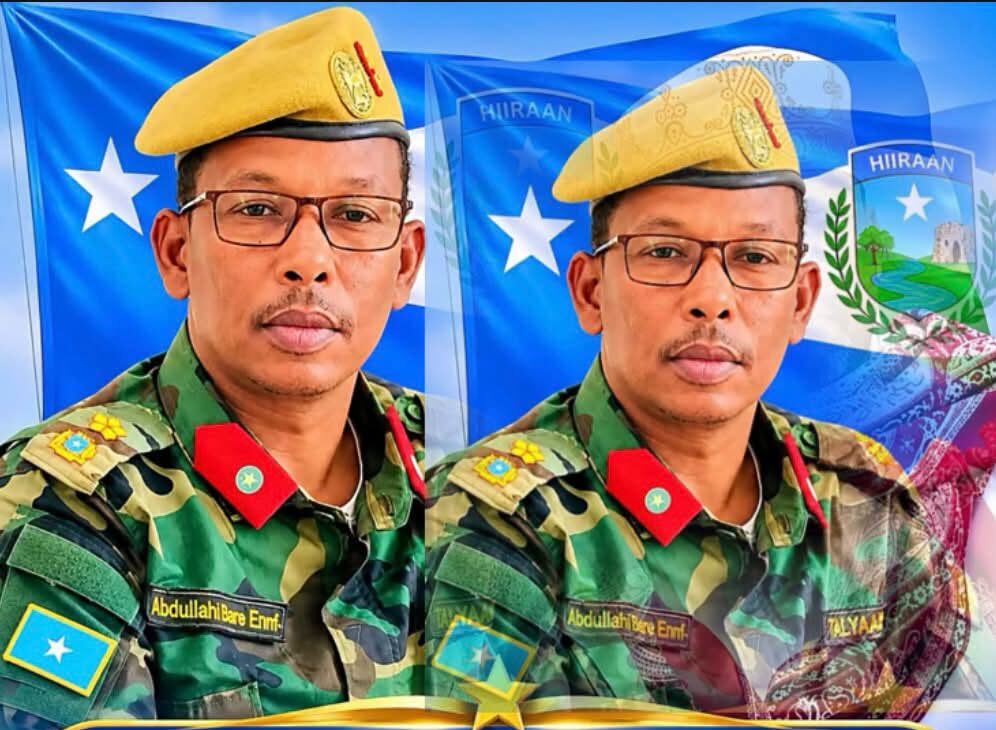

The appointment of Colonel Abdullahi Barre Elmi as the new governor of Hiiraan region has raised questions about whether the Hirshabelle administration can use the leadership change to address persistent political tensions, particularly in Beledweyne, where disputes over governance, political representation and the handling of local grievances have strained relations between regional authorities and sections of the community.
Hirshabelle President Ali Abdullahi Hussein, widely known as Ali Gudlawe, appointed Colonel Barre to replace Muse Salad Wehliye, who resigned after saying he had disagreements with the regional leadership over how to respond to complaints from Hiiraan residents.
Barre, a Somali National Army officer and former commander of the 27th Division, takes office at a time when the Hirshabelle administration is facing pressure from local politicians, traditional elders and other community representatives seeking changes in how the region is governed.
His appointment has also drawn attention because he comes from the Hawadle clan, which has a significant presence in Hiiraan’s political and social affairs.
However, his clan background alone does not establish whether he will receive broader public support. His ability to engage different political groups and communities will be central to how his appointment is received.
Wehliye announced his resignation on November 8, saying his disagreements with Hirshabelle’s senior leadership centred on the approach to public grievances.
He said he did not support resolving community complaints through military force, coercion or intimidation, arguing instead that genuine dialogue, consultation and practical measures were needed to address the concerns of residents.
His departure demonstrated that the dispute in Hiiraan extends beyond disagreements between the regional administration and its opponents, reaching into the administration’s own appointed leadership.
For Ali Gudlawe, this presents a governance challenge, as a regional governor needs both administrative authority and public confidence to carry out his duties effectively.
The appointment has also raised questions about the legal position of a serving military officer taking up a civilian administrative post.
Holding the rank of colonel does not, by itself, establish that the appointment is unlawful. The key issue is whether Barre remains on active military service and, if so, whether military regulations and public service rules permit him to assume a civilian office.
If he has retired, left active service or received formal authorisation to take up the civilian role, his legal position may be different.
Establishing his current military status and whether the required procedures were followed is therefore essential to assessing the legality of the appointment.
The Hirshabelle Constitution, adopted on October 5, 2016, provides the basic framework for the powers of the regional administration and the appointment of officials.
Previous appointments and dismissals of regional governors have also been carried out through presidential decrees.
However, the precise constitutional and legal provisions governing this appointment, alongside the applicable military service regulations, would need to be examined to determine whether all required procedures were followed.
Beyond the legal questions, Barre faces a difficult political task. He will need to maintain working relations with the Hirshabelle presidency while responding to the concerns of residents and political figures who have challenged the administration’s approach to Hiiraan.
Reports following his appointment say he has pledged to prioritise reconciliation, peacebuilding, community dialogue, conflict resolution and restoring public confidence.
He has also expressed willingness to work with traditional leaders, religious scholars, politicians, young people, women, business representatives and other institutions.
Such commitments could provide a starting point for engagement, but their impact will depend on whether they translate into concrete action.
Meetings with traditional elders, opposition politicians and communities that have raised grievances could help create opportunities for dialogue.
Conversely, if the appointment is viewed primarily as an attempt to strengthen the regional administration’s political influence without addressing the underlying complaints, the existing divisions may persist.
The appointment has also prompted debate over whether selecting a governor from the Hawadle clan could change public attitudes towards Hirshabelle.
Hawadle is a prominent community in Hiiraan, and its traditional and political leaders have played an important role in discussions about the region’s future.
However, Barre’s clan affiliation does not mean that all Hawadle residents or leaders will support him.
Critics of Hirshabelle argue that the dispute is not simply about who occupies the governor’s office, but also concerns governance, political representation, power-sharing and the extent to which local communities are consulted on decisions affecting them.
The new governor will therefore face the challenge of demonstrating that he represents all residents of Hiiraan, rather than being perceived as serving a particular political interest.
Barre’s appointment came less than a week after Wehliye’s resignation, raising questions about whether the new governor will be able to remain in office and carry out his responsibilities amid the same political pressures that confronted his predecessor.
There has been speculation that, unless the dispute between the Hirshabelle presidency and sections of Hiiraan’s political and traditional leadership is addressed, the new governor could face serious difficulties in performing his duties.
However, there is no official indication that Barre intends to resign shortly after his appointment. Any suggestion that he may leave office should therefore be treated as political speculation, not a confirmed development.
The wider dispute has increasingly centred on Beledweyne, where disagreements between Hirshabelle authorities and local political and traditional leaders have deepened since the regional leadership elections.
Ali Gudlawe’s re-election on October 24, alongside the election of Abdifatah Hassan Afrah as vice president, was rejected by some Hiiraan politicians and elders.
They argued that the process lacked sufficient consultation and an inclusive political agreement on representation and power-sharing.
Other political figures, including members of the Hawadle community, have supported Gudlawe, highlighting divisions within the region’s political landscape.
The tensions have also taken on a security dimension.
On November 7, Hawadle traditional leader Ugaas Yusuf Ugaas Hassan called on security personnel from Hiiraan to gather in Beledweyne, while the arrival of Vice President Afrah and former intelligence chief Abdullahi Mohamed Ali Sanbaloolshe, each accompanied by armed escorts, heightened concerns about a possible confrontation.
More recently, elders and community representatives called for an inclusive political conference involving all communities in Hiiraan.
On November 15, armed Macawiisley fighters from the Afar Makane clan also staged a show of force in Beledweyne and expressed support for Ugaas Yusuf, reflecting the growing involvement of local groups in the dispute.
These developments mean Barre is taking office in an environment marked by political mistrust, competing positions and concerns about the possible involvement of armed groups.
Preventing the political dispute from turning into a security confrontation will be an important issue for the new governor and the regional authorities.
The appointment could be an attempt by Gudlawe to restore the Hirshabelle administration’s influence in Hiiraan and place a new figure in charge of engaging with local communities.
But replacing the governor alone is unlikely to resolve a dispute rooted in wider disagreements over political representation, power-sharing and consultation.
The central test for Barre will be whether he can open channels of communication with traditional elders, opposition politicians and other community representatives, while maintaining working relations with the Hirshabelle leadership.
His ability to engage groups beyond his own clan will also be important in determining how broadly his leadership is accepted.
Ultimately, easing tensions in Hiiraan will require more than a change of personnel. It will depend on meaningful political dialogue and an agreement that addresses the grievances behind the dispute.
Until those issues are tackled, the new governor will inherit many of the same challenges that led to his predecessor’s resignation.