

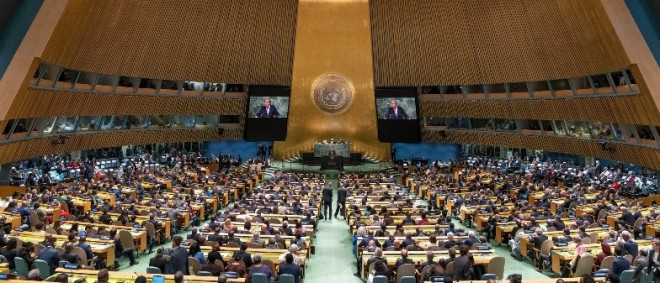

Somalia has joined 133 countries in supporting a United Nations resolution calling for a halt to executions worldwide, renewing international debate over the future of capital punishment and the protection of human rights.
The resolution, numbered A/C.3/81/L.43, was approved on November 13, 2026, by the UN General Assembly’s Third Committee. A total of 133 countries voted in favour, 33 opposed it, while 16 abstained.
Titled Moratorium on the Use of the Death Penalty, the resolution urges UN member states to suspend executions, with the broader objective of gradually moving towards the abolition of capital punishment.
Somalia’s support has drawn particular attention because the death penalty remains part of its legal system, and courts in the country continue to issue death sentences, some of which are carried out.
By voting in favour, Somalia aligned itself with countries advocating an international suspension of executions. The vote may signal a diplomatic position in support of the right to life and a reassessment of how capital punishment is applied.
However, it does not automatically change Somali law or mean that the government has formally abolished the death penalty or ordered an end to executions.
The voting results highlighted a significant divide among UN member states. Among those opposing the resolution were the United States, China, India, Ethiopia and Saudi Arabia.
These countries and others have maintained that states should retain the right to determine their own criminal justice systems and decide appropriate penalties for serious offences, while meeting their obligations under international law.
Debates within the committee also reflected differing priorities. Some governments emphasised national legal sovereignty, while others argued that protecting the right to life and preventing miscarriages of justice should take precedence.
The Third Committee’s approval is not the final stage of the process. The resolution will be forwarded to the UN General Assembly for further consideration and a vote.
A moratorium on the death penalty refers to a suspension of executions, either for an indefinite period or until a government makes a further decision.
It does not necessarily mean that capital punishment has been removed from national legislation. A country can retain the death penalty in its laws while choosing not to carry out sentences imposed by its courts.
The UN resolution encourages governments to take steps to reduce the use of capital punishment and consider suspending executions as a possible pathway towards its eventual abolition.
It also calls for safeguards to protect vulnerable groups, including children, pregnant women and people with intellectual or psychosocial disabilities, while encouraging restrictions on the range of offences punishable by death.
In Somalia, the issue is particularly complex because the country’s legal framework incorporates national legislation alongside principles of Islamic law.
Capital punishment remains an available penalty in certain cases, including those involving qisas, under which the family of a murder victim may have rights relating to retribution, forgiveness or the acceptance of financial compensation, known as diya.
This legal framework means that any debate over suspending executions in Somalia involves not only human rights considerations but also religious, cultural and legal questions.
Supporters of retaining capital punishment argue that it is a legitimate penalty for the most serious crimes and forms part of the justice system’s response to victims and their families.
Human rights organisations, however, warn that flawed investigations, incomplete evidence and inadequate judicial safeguards can result in innocent people being sentenced to death and executed, with no possibility of reversing the outcome.
The debate therefore extends beyond whether capital punishment should be supported or abolished. It also raises questions about the quality of criminal investigations, judicial independence, access to legal representation and the right to appeal.
One of the main questions following Somalia’s vote is whether the government intends to change its domestic policy on executions.
So far, the country’s support for the UN resolution does not establish that authorities have adopted a domestic decision to suspend the implementation of death sentences.
Information published by the World Coalition Against the Death Penalty continues to classify Somalia as a country that retains capital punishment in law. The organisation has also documented death sentences and executions in recent years.
The Federal Government will therefore need to clarify the significance of its vote and whether it intends to introduce a moratorium on executions or review the country’s existing laws governing capital punishment.
Resolution A/C.3/81/L.43 will now proceed to the UN General Assembly, where it is expected to be debated and put to a vote in December 2026.