


The political situation in Somalia is intensifying by the hour as new reports indicate that a leadership change is underway within the Somali Police Force, while Prime Minister Hamza Abdi Barre faces mounting political pressure driven by growing disputes among government institutions.
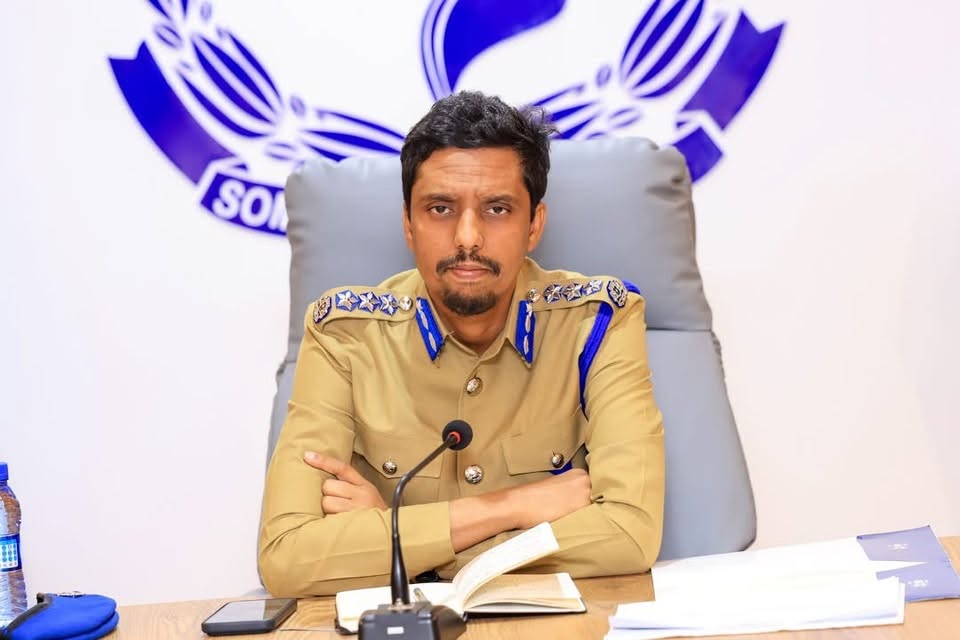
Emerging reports indicate that the Commander of the Somali Police Force, Brigadier General Asad Osman Abdullah Diyano, is facing removal from office, with rumors suggesting this matter could be decided during an emergency meeting expected to be held by the Council of Ministers on Monday.
The anticipated Monday meeting of the Council of Ministers could prove crucial, as it comes at a time when reports have surfaced that the cabinet meetings scheduled for the past two consecutive Thursdays were canceled.
Some political reports link the cancellation of these meetings to internal disputes within the Council of Ministers, although no official government statement has yet confirmed that a political conflict was the actual reason for the cancellations.
Should the matter of the Police Commander be raised during Monday’s meeting, an official response regarding Asad Diyano’s future and the new direction of the Somali Police leadership is expected to emerge.
Although rumors of his dismissal are strong, official information currently available indicates that Asad Diyano remains the Commander of the Somali Police Force.
In recent days, the commander has been participating in official meetings discussing the security situation and police operations, demonstrating that no official decision removing him from office has been publicly announced up to this time.
Some reports link the matter to an evaluation of the performance of security agencies and the management of the country’s security operations.
The Police Command is among the most vital institutions of the federal government, and any leadership change within the command can directly impact security plans, force coordination, and ongoing operations.
On the other hand, Prime Minister Hamza Abdi Barre is facing a difficult political situation as a prominent dispute between the Government and the House of the People (Lower House of Parliament) has come to light.
The latest conflict stemmed from a decision issued by the Prime Minister regarding the management of government positions and civil servants.
Hamza supported a system based on open competition and filling government posts based on merit, capability, and experience.
However, the House of the People took action against that decision, triggering a political debate over the powers of the Government and Parliament.
The move by the House of the People was viewed as an indication that relations between the two sides are going through a difficult phase.
The dispute between the Government and the House of the People is not merely about government personnel.
It touches upon a broader question regarding how government powers are divided and where the authority of each institution begins and ends.
The Government argues that an open competition framework enhances the transparency and quality of the public service.
The House of the People, for its part, took a stance opposing the decree issued by the Prime Minister’s Office.
This situation has created a new political atmosphere, and it remains to be seen whether the two sides will reach a resolution or if the conflict will escalate to a new phase.
Political rumors are growing that Prime Minister Hamza Abdi Barre is being pressured to resign before a motion is brought against him in the House of the People.
If a formal motion against the Prime Minister is officially submitted to the House of the People, the matter will enter a parliamentary and constitutional phase.
A formal motion requires specific procedures, and it will be crucial to determine who submitted it, the reasons cited, and how the House of the People will debate it.
Likewise, if Hamza resigns before a motion is tabled, the situation will take a different political and constitutional path.
Every government requires ongoing cooperation among state institutions, particularly when dealing with matters related to national security and administration.
If these disputes continue, they could potentially impact the routine work of government institutions and the implementation of the government’s plans.
The anticipated Monday meeting of the Council of Ministers is currently a matter of great anticipation.
It will be essential to see whether Asad Diyano’s case is added to the official agenda and whether the Council of Ministers reaches a decision on it.
If Asad Diyano is removed from office, the immediate question that will arise is who will be appointed to the position.
The new commander will be expected to introduce a strategy regarding internal security, capacity-building for the forces, crime-fighting, and strengthening cooperation among security agencies.
It will also be crucial how the leadership transition within the command is managed so that the change in leadership does not disrupt ongoing security operations.
Somalia is currently going through a critical political phase, as government factions and politicians remain deeply engaged in matters of governance, security, and the future of state institutions.