

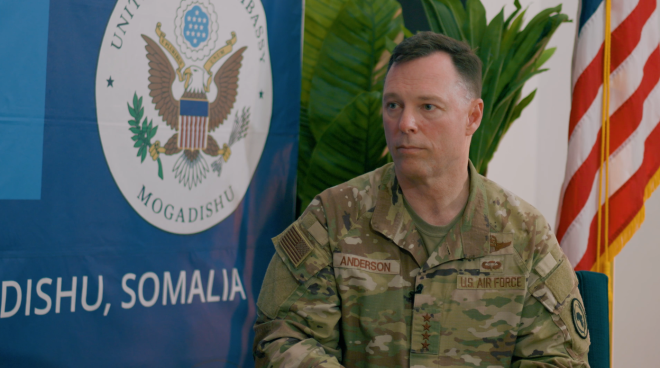

The United States Africa Command (AFRICOM) has confirmed carrying out two airstrikes against Al-Shabaab militants in Somalia as part of ongoing counterterrorism operations conducted in coordination with the Federal Government of Somalia.
According to AFRICOM, the first airstrike took place on September 4, 2026, targeting Al-Shabaab fighters at a location approximately 175 kilometers west of Mogadishu.
The operation was conducted in partnership with Somali authorities as part of efforts to weaken the militant group’s operational capabilities and reduce its ability to threaten Somali, U.S. and allied interests.
AFRICOM said the strike forms part of a broader campaign involving the United States, the Somali Federal Government and the Somali National Army aimed at degrading Al-Shabaab’s capacity to plan and carry out attacks.
The command, however, did not disclose the number of militants killed or wounded during the operation.
A second airstrike was conducted the following day, September 5, near Quumbi, a location roughly 75 kilometers northwest of Kismayo.
AFRICOM stated that this operation was also carried out in coordination with Somali authorities as part of ongoing efforts to target the group’s activities in southern Somalia.
The U.S. military declined to provide additional details about the operations, including the aircraft or weapons used, citing operational security concerns.
AFRICOM traditionally releases limited information about its air campaigns, often withholding casualty figures and tactical details until assessments are completed.
The latest strikes come as Somalia and its international partners continue to intensify military pressure on Al-Shabaab.
Throughout 2026, AFRICOM has regularly announced air operations targeting the group across various parts of the country, reflecting Washington’s continued commitment to supporting Somalia’s fight against the insurgency.
Although AFRICOM confirmed both strikes, neither the U.S. military nor the Somali government has yet released detailed battle damage assessments or information on the exact impact of the operations.
As a result, the full extent of casualties and damage inflicted on Al-Shabaab remains unclear.
The airstrikes also coincide with ongoing ground offensives by Somali security forces against the militant group.
Despite sustained military pressure, Al-Shabaab continues to demonstrate its ability to conduct attacks against government forces, security installations and civilian targets across Somalia.
The United States has long been one of Somalia’s key security partners, providing intelligence support, military training and aerial operations aimed at disrupting Al-Shabaab’s leadership, logistics networks and combat capabilities.
U.S. officials have consistently argued that such operations help prevent the group from planning attacks against American interests and regional partners.
Security analysts note that airstrikes remain an important component of the broader counterterrorism strategy, particularly in areas where militant fighters operate in remote or difficult-to-access terrain.
However, they also emphasize that long-term success against Al-Shabaab will depend on sustained military operations, effective governance and stabilization efforts in areas recovered from the group.
With the confirmation of the September 4 and 5 strikes, AFRICOM has signaled that U.S. support for Somalia’s counterinsurgency campaign remains active.
While the immediate results of the operations have not yet been disclosed, the strikes form part of an expanding military effort aimed at weakening Al-Shabaab’s influence and reducing the threat it poses to Somalia and the wider region.