

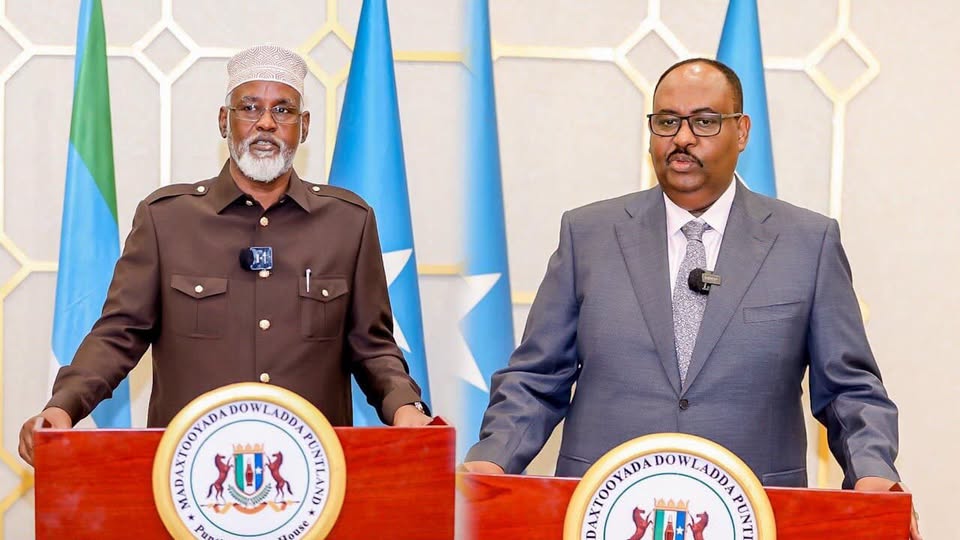

Efforts by international partners and Somali political stakeholders to bring Puntland President Said Abdullahi Deni and Jubbaland President Ahmed Mohamed Islam (Ahmed Madobe) to Mogadishu for talks on Somalia’s electoral future have reportedly stalled over disagreements regarding the role of the international community in any final political agreement.
Sources familiar with the ongoing discussions say both leaders are demanding formal guarantees for any election-related deal and want the role of international partners clearly defined in the final agreement.
According to the reports, Puntland and Jubbaland are not satisfied with an arrangement in which international actors serve only as facilitators of dialogue.
Instead, they are seeking a more explicit role for international partners as guarantors of any political settlement reached between Somali stakeholders.
The efforts to bring Deni and Ahmed Madobe to Mogadishu were part of a broader initiative aimed at securing a comprehensive political agreement on Somalia’s electoral process and the country’s next political transition.
However, disagreements over how to structure guarantees and who would be responsible for ensuring compliance with the agreement have emerged as major obstacles.
The two regional leaders are said to believe that stronger international involvement would provide greater confidence that commitments made by all sides will be honored.
Their position contrasts with that of some other political actors, who argue that international partners should limit their role to facilitating dialogue rather than becoming formal parties to any agreement.
International partners have spent recent months encouraging Somalia’s political leaders to return to negotiations amid growing tensions over the electoral process.
The debate over the role of the international community has now become one of the most contentious issues facing the talks.
Reports indicate that Villa Somalia, sections of the opposition, and international partners appear to hold broadly similar views regarding the international community’s role, while Puntland and Jubbaland continue to push for stronger guarantees and a more clearly defined mechanism for oversight and implementation.
The dispute comes at a time when Somalia remains deeply divided over key electoral issues, including the electoral model, constitutional amendments, and the institutions responsible for managing elections.
Differences between the Federal Government, federal member states, and opposition groups have repeatedly delayed efforts to reach a nationwide political consensus.
Political observers warn that failure to secure an inclusive agreement could deepen tensions between the Federal Government and regional administrations, potentially affecting national stability and complicating preparations for future elections.
Mogadishu remains the focal point of ongoing efforts to bring Somali political leaders together.
The proposed visit by Deni and Ahmed Madobe was widely viewed as a potential breakthrough that could pave the way for broader negotiations on resolving the country’s political disputes.
For now, however, the conditions put forward by Puntland and Jubbaland have slowed the process, leaving uncertainty over when talks may resume and whether the parties can reach a compromise on the role of the international community.
Should an agreement be reached on these issues, it could open the door to formal negotiations on Somalia’s electoral future and help lay the groundwork for a broader political settlement among the country’s competing stakeholders.