

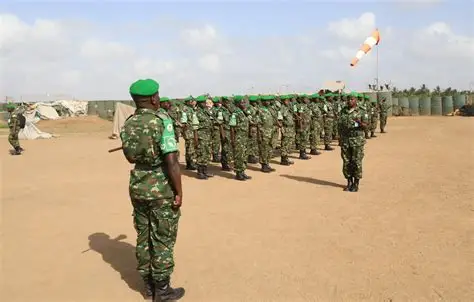

Reports that the United States plans to end its support for United Nations-funded assistance to the African Union Support and Stabilization Mission in Somalia (AUSSOM) by the end of 2026 have raised fresh concerns about the future of the mission and the sustainability of security operations against Al-Shabaab.
The development comes at a critical time for Somalia, where government forces continue to wage military campaigns against Al-Shabaab while relying heavily on international assistance for logistics, transportation, training, intelligence support, and operational funding.
AUSSOM, which replaced the African Union Transition Mission in Somalia (ATMIS) in early 2025, remains a key pillar of Somalia’s security architecture.
The mission provides support to Somali security forces operating in frontline areas and helps maintain stability in regions recovered from Al-Shabaab control.
According to recent international reports, Washington informed the African Union in July 2026 that it would not continue supporting UN-funded logistical assistance for AUSSOM beyond December 31, 2026.
The move has intensified concerns among policymakers and security analysts about how the mission will be financed in the coming years.
A reduction in international financial support could create significant challenges for AUSSOM, particularly in areas such as transportation, fuel supplies, medical services, troop sustainment, and operational logistics.
The mission currently depends on extensive support provided through the United Nations Support Office in Somalia (UNSOS), which delivers non-combat assistance to both AUSSOM and Somali security forces.
According to UNSOS, approximately 240 metric tons of food and other supplies are distributed monthly to troops deployed across various parts of Somalia.
Security experts warn that any disruption to this support network could affect the operational effectiveness of forces engaged in ongoing campaigns against Al-Shabaab.
The funding debate comes as Somali forces continue expanding military operations in southern and central Somalia, where government troops and allied forces are attempting to weaken Al-Shabaab’s presence and disrupt its ability to launch attacks.
Although the Somali government has made gains in several regions, Al-Shabaab remains capable of conducting complex attacks, bombings, and guerrilla operations across large parts of the country.
The Somali government has repeatedly stated that its long-term objective is for Somali security forces to assume full responsibility for national security.
President Hassan Sheikh Mohamud’s administration has emphasized the need to strengthen the Somali National Army, police forces, intelligence agencies, and other security institutions to reduce dependence on foreign troops.
However, security analysts note that achieving this goal requires sustained investment, training, equipment, and financial resources.
If international support declines before Somali institutions are fully prepared, gaps could emerge in security operations and stabilization efforts.
The potential reduction in external funding may therefore require Somalia to increase domestic spending on defense and security while simultaneously seeking alternative international partners and funding mechanisms.
Another important aspect of the mission’s future involves Egypt’s planned participation in AUSSOM.
The African Union has repeatedly stated that the deployment process for Egyptian troops should be finalized as part of broader efforts to strengthen the mission.
Cairo has consistently expressed support for Somalia and indicated its willingness to contribute to efforts aimed at improving security and stability in the country.
On July 31, 2026, Egypt’s Foreign Ministry reaffirmed its commitment to supporting Somalia’s state institutions and security sector while emphasizing the need for sustainable funding for AUSSOM.
Discussions regarding Egypt’s deployment have been ongoing since 2025, when Somali President Hassan Sheikh Mohamud announced that Somalia was preparing to receive the first contingent of Egyptian forces.
Egyptian military officials have previously conducted assessments of potential deployment locations and operational requirements.
The African Union has also urged member states to complete the necessary procedures for Egyptian participation and finalize force-generation plans for AUSSOM.
Egypt’s involvement could provide Somalia with additional military expertise, training support, and operational capabilities in the fight against Al-Shabaab.
The move would also further strengthen the growing political and security partnership between Mogadishu and Cairo.
Over the past two years, Egypt has emerged as one of Somalia’s strongest diplomatic supporters, consistently backing Somalia’s sovereignty and territorial integrity amid regional tensions in the Horn of Africa.
At the same time, Egyptian participation could enhance the role of regional partners in supporting Somalia’s security transition and reduce pressure on existing troop-contributing countries.
However, analysts argue that the mission’s greatest challenge is no longer troop numbers alone but securing predictable and long-term financing.
The African Union and the Somali government are currently seeking ways to secure additional funding to sustain foreign troops operating in Somalia.
Discussions are also ongoing with troop-contributing countries regarding future arrangements should international funding levels decline.
Without a replacement funding mechanism, experts warn that AUSSOM may struggle to maintain all of its current operations.
Such a scenario could force troop-contributing countries to explore bilateral security agreements with Somalia rather than operating solely under the AUSSOM framework.
For Somalia, the situation presents a dual challenge: maintaining sufficient military pressure on Al-Shabaab while ensuring that the financial and logistical foundations of the country’s security architecture remain intact.
The coming months are therefore expected to be crucial for determining the future of AUSSOM, the role of international partners, and the pace at which Somali forces can assume greater responsibility for national security.
With the mission facing growing financial uncertainty, decisions taken by Somalia, the African Union, the United Nations, and key international partners could significantly shape the country’s security landscape beyond 2026.