

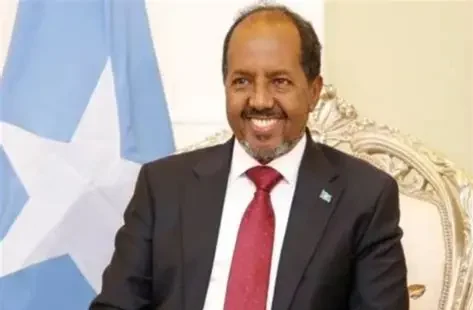

Somalia is facing one of its most serious political crises since the end of the transitional era, with a growing dispute over elections, constitutional amendments and the legitimacy of the federal government’s mandate.
At the center of the controversy is President Hassan Sheikh Mohamud’s insistence that constitutional amendments approved by Parliament extended his term in office, while opposition leaders and several political actors argue that his constitutional mandate has already expired and that any extension lacking broad political consensus is illegitimate.
The dispute has moved beyond political rhetoric and is increasingly affecting relations between the Federal Government and some Federal Member States.
In recent months, tensions have contributed to instability and, in some cases, armed confrontations, including the recent clashes in Baidoa.
The central question remains who has the authority to determine the government’s term and the timetable for the next elections.
President Hassan Sheikh has championed a transition toward a one-person, one-vote electoral system, arguing that constitutional reforms passed by Parliament provide the legal basis for extending the presidential term from four to five years.
A report published by Chatham House in June 2026 noted that as 15 May 2026 approached, uncertainty remained over Somalia’s political transition, with no broadly agreed election timetable in place.
According to the report, Hassan Sheikh signed constitutional amendments approved by Parliament that would extend his mandate until 15 May 2027.
Opposition leaders, however, reject that interpretation.
They argue that neither the President nor Parliament can unilaterally extend the government’s mandate without a comprehensive political agreement involving all major stakeholders, including opposition groups and Federal Member States.
Many opposition figures warn that failure to reach consensus on elections could push Somalia into a deeper constitutional and political crisis.
According to assessments referenced by the European Union Agency for Asylum (EUAA), Somalia’s political environment had become increasingly polarized by March 2026.
At the time, both the presidential and parliamentary mandates were nearing their scheduled conclusion while no national agreement had been reached on the electoral process.
The disagreement has widened existing divisions between Mogadishu and regional administrations, particularly Puntland and Jubaland, both of which have expressed concerns over constitutional changes and election arrangements.
Political observers warn that prolonged uncertainty over legitimacy and governance could further destabilize the country’s fragile federal system.
International actors, including the United Nations, African Union, European Union, United States, and United Kingdom, do not possess the legal authority to appoint or remove Somalia’s president.
However, they retain significant political, diplomatic, economic and security influence.
International partners can pressure Somali stakeholders to negotiate, attach conditions to financial assistance, impose sanctions, issue diplomatic statements and use other forms of leverage to encourage a political settlement.
Ultimately, however, any decision regarding presidential legitimacy or political transition must emerge from a Somali-led constitutional and political process.
Many analysts compare the current situation with the political crisis of 2021, when former President Mohamed Abdullahi Mohamed (Farmaajo) remained in office after his term expired on 8 February 2021 without elections being held.
In April 2021, Somalia’s Lower House approved a two-year term extension, triggering strong domestic and international opposition.
The European Union, United Kingdom and other international partners argued that unilateral extensions were not a solution to Somalia’s political impasse.
The crisis eventually escalated into armed confrontations in Mogadishu involving forces aligned with rival political factions.
Following sustained pressure from both domestic actors and international partners, Farmaajo abandoned the extension plan and returned to negotiations aimed at organizing elections.
Supporters of President Hassan Sheikh argue that the current situation differs significantly from 2021 because the extension of the presidential term is based on constitutional amendments approved by Parliament rather than a standalone parliamentary extension.
Opposition groups reject that argument, maintaining that the constitutional amendments themselves lack broad political consensus and therefore cannot serve as a legitimate basis for extending the government’s mandate.
As a result, the dispute is no longer simply about whether the president should leave office.
It has evolved into a broader conflict over the legality of constitutional reforms, the future electoral system, federal-state relations and the overall direction of Somalia’s political transition.
Regional and international organizations have repeatedly urged Somali leaders to resolve their differences through dialogue.
Reports published in May 2026 indicated that the African Union, IGAD and the United Nations were encouraging the resumption of political talks, while the United States and the United Kingdom were actively supporting mediation efforts.
With political tensions rising and security challenges continuing across several regions, many observers argue that a negotiated settlement remains the most viable path to avoiding a deeper constitutional crisis and preserving Somalia’s fragile stability.