

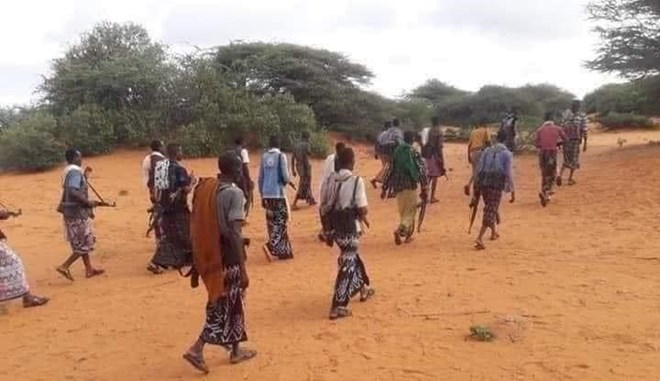

Fresh details have emerged about intense clan fighting that erupted along the border between Somalia’s Hiran and Middle Shabelle regions, where rival clan militias exchanged heavy gunfire for several hours, raising fears of a further deterioration in security.
According to local sources, the violence was triggered by a dispute over the ownership of fertile farmland located along the administrative boundary separating the two regions.
Both sides reportedly deployed a range of weapons during the fighting, although the exact number of casualties remains unclear, with no official figures released by authorities.
Residents say tensions remain extremely high despite the fighting subsiding, with fears that the clashes could resume at any moment as armed militias continue to mobilize in the area.
Traditional elders from the Middle Shabelle side accused armed fighters from neighboring Hiran of initiating the confrontation, alleging that they crossed into the area in an attempt to seize farmland.
Leaders from the Hiran side have yet to issue a public response, and the competing claims have not been independently verified.
The latest fighting highlights the recurring pattern of inter-clan violence that has plagued communities along the Hiran–Middle Shabelle border for years.
The area has witnessed repeated deadly confrontations, largely fueled by longstanding disputes over farmland, grazing areas, water resources, and poorly defined local boundaries.
Many of these conflicts have been compounded by unresolved historical grievances, cycles of revenge killings, the widespread availability of weapons, and weak state institutions unable to provide effective mediation or law enforcement.
Security analysts note that although each conflict has its own local dynamics, prolonged droughts, seasonal resource shortages, and the absence of durable land ownership mechanisms frequently intensify tensions between neighboring communities.
Traditional elders and religious leaders have often succeeded in negotiating temporary ceasefires, but many agreements collapse because underlying disputes remain unresolved.
The fighting also threatens the local economy in two of Somalia’s important agricultural regions. Clan conflicts frequently disrupt farming activities, halt trade and transportation, displace civilians, and reduce livestock production.
These economic shocks come at a time when Somalia is already facing slowing economic growth, declining international aid, climate-related challenges, and persistent insecurity, placing additional pressure on vulnerable communities.
Analysts have repeatedly warned that prolonged clan conflicts can create security vacuums that benefit extremist groups such as Al-Shabaab.
While there is no evidence that the militant group initiated the latest clashes, the United Nations, security researchers, and regional analysts have previously documented how Al-Shabaab has exploited local clan disputes to expand its influence, recruit fighters, undermine reconciliation efforts, and weaken government authority in contested areas.
Despite the renewed violence, no senior official from the Federal Government of Somalia or the Hirshabelle State administration had publicly commented on the clashes at the time of publication.
The absence of an official mediation effort has heightened concerns among local residents that the conflict could escalate further if urgent intervention by government authorities, traditional elders, and religious leaders does not take place.
The latest confrontation underscores the continuing challenge of resolving local resource disputes in central Somalia, where recurring clan violence remains one of the biggest obstacles to long-term stability, economic recovery, and the broader campaign against Al-Shabaab.