


The United States has stepped up diplomatic engagement with Somalia and Eritrea amid growing security concerns in the Red Sea, where escalating attacks on commercial shipping have heightened fears that instability could spread across both sides of one of the world’s most strategic maritime corridors.
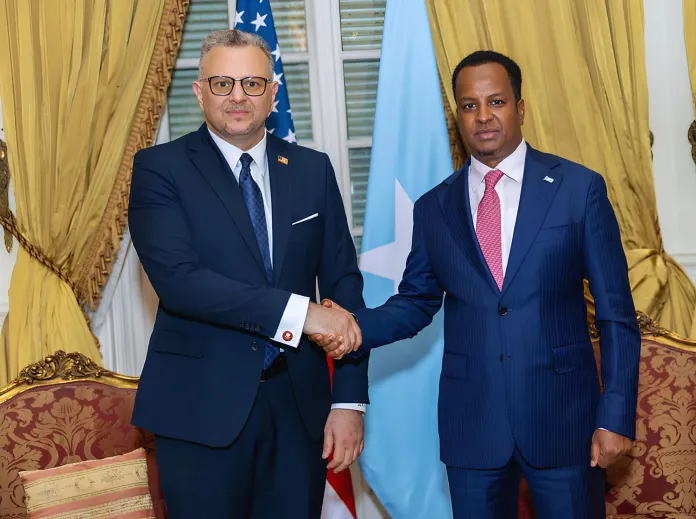
The latest diplomatic push followed high-level talks held in Cairo earlier this month involving U.S. President Donald Trump’s Senior Adviser for Arab and African Affairs, Massad Boulos, Egyptian Foreign Minister Badr Abdelatty, Eritrean Foreign Minister Osman Saleh, and Somalia’s Foreign Minister Abdisalam Abdi Ali.
According to Egyptian officials, the discussions formed part of broader efforts to strengthen peace and stability in the Horn of Africa, a region increasingly affected by conflicts in Yemen, Sudan, and the wider Middle East.
While no agreements were announced regarding military bases or naval facilities, the meetings have fueled speculation that Washington is exploring a broader regional security framework along Africa’s Red Sea coastline or seeking to prevent the conflict from expanding further.
According to statements released after the meetings, Boulos discussed regional security, political dialogue in Somalia, and cooperation on stability in the Horn of Africa with Somalia’s foreign minister.
Following his talks with Eritrean officials, he said both sides explored opportunities to strengthen economic cooperation, regional development, and security collaboration.
“At a time when collective action is more important than ever, we emphasized the need to work together constructively to address regional conflicts and promote lasting peace, stability, and prosperity across the Red Sea and the Horn of Africa,” Boulos said.
The renewed diplomatic activity comes as Yemen’s Iran-backed Houthi movement continues threatening commercial shipping passing through the Bab el-Mandeb Strait, a strategic waterway separating Yemen from Djibouti and Eritrea.
Recent attacks on oil tankers and warnings of a wider maritime blockade have forced many shipping companies to reroute vessels around southern Africa, significantly increasing transportation costs and delivery times.
At the same time, tensions surrounding the Strait of Hormuz have intensified concerns over global energy supplies.
Oil prices have also risen as international markets react to continued attacks on commercial vessels and fears of further disruptions to global shipping routes.
The United States has warned that vessels linked to the U.S., the United Kingdom, or Israel remain at elevated risk while transiting the southern Red Sea, the Bab el-Mandeb Strait, and the Gulf of Aden.
These waterways connect the Indian Ocean to the Suez Canal, making them among the world’s most important maritime routes for global trade and energy supplies.
Since the Houthis began targeting commercial shipping, many operators have diverted vessels around the Cape of Good Hope, adding weeks to shipping times and substantially increasing costs.
Eritrea’s Growing Strategic Importance
The renewed U.S. outreach has also brought Eritrea back into Washington’s strategic calculations.
Eritrea controls the ports of Massawa and Assab and possesses a lengthy Red Sea coastline overlooking some of the world’s busiest shipping lanes.
Although relations between Washington and Asmara have remained strained for years, recent regional security challenges have prompted renewed diplomatic engagement.
Any deeper partnership, however, is expected to remain politically sensitive given Eritrea’s human rights record and its longstanding tensions with neighboring Ethiopia.
Somalia’s Strategic Position
Somalia also occupies a critical geopolitical position, with a coastline stretching from the Gulf of Aden to the Indian Ocean while remaining a key U.S. counterterrorism partner.
Reports published in 2025 indicated that President Hassan Sheikh Mohamud offered the United States access to several airports and ports, including Baledogle and Bosaso, as part of broader security cooperation.
Those reports also referenced Berbera, although the proposal faces political complications because Somalia considers Somaliland an integral part of its territory while Somaliland administers the port independently.
The United States already operates its primary military base in the region at Camp Lemonnier in Djibouti and continues conducting airstrikes in Somalia targeting al-Shabaab and ISIS-Somalia.
Analysts See Shift in Regional Security Strategy
Political and security analyst Mubarak Aliyu said the coordination between Egypt and the United States reflects growing recognition that security crises across the Horn of Africa can no longer be managed separately.
According to Aliyu, the Cairo meetings suggest Egypt is seeking to help shape the emerging regional security architecture rather than merely reacting to developments.
“Coordination between Egypt and the United States recognizes that the Horn of Africa’s security challenges are interconnected and require balanced diplomacy focused on regional cooperation, threat prevention, and long-term stability,” he said.
Despite the intensified diplomatic activity, Washington has not publicly outlined its long-term strategy for the region.
However, as attacks continue around the Bab el-Mandeb Strait, both Somalia and Eritrea have gained renewed strategic importance, while Africa’s Red Sea coastline is becoming an increasingly significant focus of U.S. foreign and security policy.