

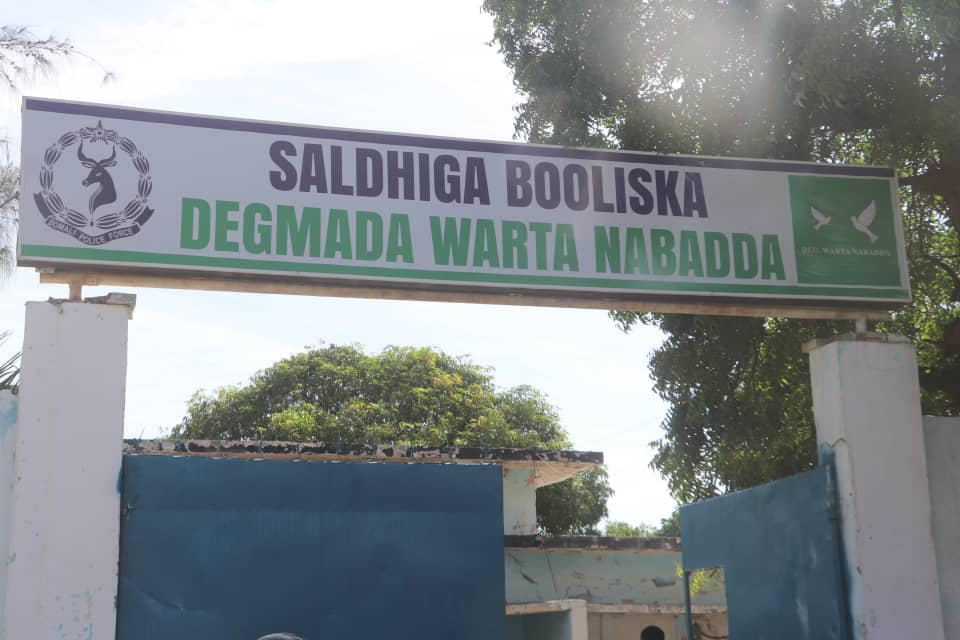

MOGADISHU (Kaab TV) — The streets of Mogadishu reverberated with gunfire on Wednesday, as opposition leaders and their armed escorts confronted Somali police outside the Warta Nabadda district station.
The clash, sparked by viral footage of police assaulting two elderly civilians during forced evictions in nearby neighborhoods, left one person dead and injured members of both the security forces and the opposition’s armed escorts, though the exact casualty toll remains disputed.
What began as a reaction to visible abuses quickly escalated into a stark demonstration of Somalia’s intertwined humanitarian and political crises.
Opposition leaders, including former President Sharif Sheikh Ahmed and former Prime Minister Hassan Ali Khaire, mobilized to protect residents from police operations they characterized as heavy-handed and illegal.
Government officials, in turn, framed the confrontation as an attempt to seize a state facility, asserting the primacy of law and order.
The Immediate Trigger
Local reporting indicates that the confrontation was sparked by widespread outrage over forced evictions in the Sinay and Warta Nabadda neighborhoods.
Videos circulated online showing police bulldozing shelters and assaulting residents. Opposition leaders responded by traveling to the area with armed escorts, confronting police outside the Warta Nabadda station.
Witnesses described attempts by opposition guards to enter the station, leading to exchanges of small-arms fire that struck detention cells and endangered civilians.
“The viral video galvanized public sentiment,” said a Mogadishu-based analyst.
“It created both a political opening for the opposition and a flashpoint for conflict.”
Political Stakes and Strategic Calculus
For the opposition, the confrontation offered a high-risk, high-reward opportunity.
By intervening visibly in the streets, leaders reinforced their narrative as defenders of the dispossessed, mobilizing urban constituencies and generating media attention. But bringing armed escorts into densely populated areas carries the risk of civilian casualties, which could delegitimize the opposition’s moral claim.
The government, by contrast, framed its response as a defense of state authority. By portraying the incident as an attempted seizure of a police station, the administration reinforced the perception that it maintains control over the monopoly of force — a critical legitimacy marker in a city already strained by insurgent activity and weak governance.
Yet the very operations that sparked the clash — mass evictions and aggressive policing — erode public trust and provide fodder for opposition narratives.
Both sides also signaled strength to international observers.
The opposition demonstrated its capacity to project force in response to grievances, while the government signaled its ability to enforce order. These competing messages are likely to shape donor and diplomatic assessments of Mogadishu’s stability.
In response to the clashes, a visibly angry Prime Minister Hamza Abdi Barre denounced the opposition’s actions as a “coup attempt.”.
Raising the stakes further, former president Sharif Sheikh Ahmed, who heads the opposition alliance, announced plans for rallies at three separate venues in Mogadishu this coming Saturday.
Security and Humanitarian Implications
Warta Nabadda sits in a densely populated district near commercial corridors and government offices, making any confrontation highly visible and dangerous.
Small-unit exchanges between opposition guards and police complicate attribution of the “first shot,” and stray bullets put civilians and detainees at risk.
The timing compounds the risk. Somalia’s security forces are already stretched by renewed al-Shabab offensives and a string of urban attacks.
Analysts warn that confrontations between political actors and police can create openings for insurgents, who thrive on state weakness and fractured urban authority.
Meanwhile, forced evictions themselves are a humanitarian crisis.
Aid agencies report that more than 140,000 people have been displaced in 2025 alone, many of them from informal settlements with limited access to basic services. The destruction of homes, schools, and water points exacerbates vulnerability and feeds the cycle of grievance that drives political mobilization.
A Test for Somalia’s Political System
The incident illustrates a broader pattern in Somali politics, where urban grievances — whether evictions, political marginalization, or security abuses — rapidly become political flashpoints. If either side escalates, clashes could spread to other districts, dividing security forces along political or clan lines and further undermining state authority.
The opposition’s strategy hinges on public sympathy for evicted residents, while the government’s approach relies on demonstrating that it can maintain order without capitulating to armed pressure. Both strategies carry risks: overreach by either side could destabilize Mogadishu and provide strategic advantage to al-Shabab.
Meanwhile, analysts suggest the crisis could take one of two paths.
In the short term, mediation efforts by elders, religious figures, or international partners could ease tensions.
Opposition legal complaints over police abuses may offer a formal channel for grievances, but they are unlikely to address the deeper conflict between the state’s drive to assert authority and the need to safeguard vulnerable communities.
Longer-term, the confrontation underscores the fragility of Somalia’s urban political order.
The streets of Mogadishu are no longer just a stage for policing and politics — they are a frontline where grievances, political ambitions, and insurgent threats collide.
How leaders navigate this complex environment will determine whether the capital remains a fragile equilibrium or descends further into political violence and instability.
For residents caught in the middle, the calculus is simple and immediate: homes, families, and personal safety remain at risk, as political power struggles play out in the streets.
–