

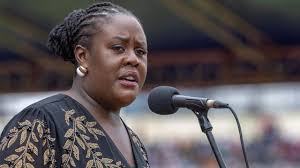
Nairobi (KAAB TV) – The youngest daughter of former Prime Minister Raila Odinga, Winnie Odinga, is emerging as a potential torch-bearer of one of Kenya’s most enduring political legacies.
As the nation mourns the passing of a man who defined opposition politics, democratisation and reform for decades, attention is increasingly shifting to Winnie, who appears ready — though not yet formally committed — to step into his formidable shoes.
Her possible emergence would mark both continuity and transformation: continuity of the Odinga family’s political lineage, and a dawn of a new era characterised by younger leadership, gender inclusion and digital-age politics.
The party she is affiliated with, the Orange Democratic Movement (ODM), is holding internal meetings as it charts the path forward. According to sources, key leadership decisions are expected in the coming days.
While some reports have suggested Winnie may be anointed to lead the party’s future direction, others indicate that her uncle, Oburu Oginga — brother of Raila Odinga — has been confirmed as party leader during this transition period.
Raila’s sister, Ruth Odinga, is also tipped for a significant role in ODM’s central management committee as the family seeks to entrench itself in party leadership.
Raila Odinga’s elder son, Raila Odinga Junior, has extended a heartfelt invitation to Kenyans from all walks of life to gather in Bondo, Siaya County — the Odinga family’s ancestral home — to honour his father.
“We welcome everyone to Bondo. Come pray with us and visit Raila’s grave,” he said, emphasising the national and inclusive spirit of the Odinga legacy. He added that no one would be restricted from visiting or paying respects: “Feel free to come mourn with us during this solemn period of reflection.”
In that simple invitation lies both a call for collective mourning and a recognition that Raila’s impact went far beyond party or tribe.
Bondo, long regarded as a stronghold of opposition politics, now becomes the symbolic resting place for a man who helped shape Kenya’s modern political identity.
The Odinga name is synonymous with struggle, resilience and reform. From Jaramogi Oginga Odinga’s fight for independence to Raila’s relentless pursuit of constitutional change and social justice, the family has stood at the centre of Kenya’s political evolution.
With Raila’s passing, the question of succession — both emotional and political — inevitably arises.
Winnie Odinga’s potential ascent represents not only the preservation of a legacy but also the reshaping of it. Winnie, currently a Member of Parliament in the East African Legislative Assembly (EALA), has already shown political acumen and forthrightness reminiscent of her father.
She belongs to a different generation — one that communicates through social media, values transparency, and demands accountability.
Her political style is assertive, modern, and appeals to younger voters who are seeking change within a system long dominated by older men. If she officially assumes her father’s mantle, she could stand as both a symbol of continuity and a bridge to the future.
Her rise also carries deep gender implications. Kenya’s political scene remains heavily patriarchal, and her leadership could challenge entrenched norms.
“Her potential to lead a national movement as a young woman reflects a broader shift in Kenyan society, where women are increasingly claiming space in politics, activism and governance,” one political observer noted.
The prospect of her leading ODM — or shaping its next chapter — could inject fresh energy into a party that has, for years, revolved around her father’s personality and charisma. Yet her path will not be without obstacles.
Dynastic politics in Kenya often provoke mixed reactions: while the Odinga name commands loyalty and respect, critics argue that inherited political influence can stifle meritocracy and innovation.
Winnie will need to demonstrate not only her capacity to lead but also her ability to modernise her father’s movement and reconnect it with the youth and working-class base that once powered Raila’s political machine.
Success will depend on how well she transforms inherited influence into authentic leadership.
Raila Junior’s public tone — a blend of mourning and hope — captures the dual nature of this moment. His message invites unity and reflection, even as it signals the family’s readiness for a political hand-over.
For many Kenyans, this moment feels like the end of a political era — and the uncertain beginning of another.
The Odinga family’s narrative, intertwined with the country’s democratic journey, continues to evolve in new and unexpected ways.
As Kenyans converge in Bondo to honour the late Raila Odinga, they will not only be paying tribute to a towering statesman but also witnessing the quiet emergence of a new figure ready to shape the next phase of that legacy.
Winnie’s challenge will be to keep alive her father’s reformist spirit while charting her own path — one that speaks to the aspirations of a younger, more diverse Kenya.
In the end, the torch is passed, but not extinguished. From Jaramogi to Raila — and now perhaps to Winnie — the Odinga story remains one of endurance, conviction and renewal.