


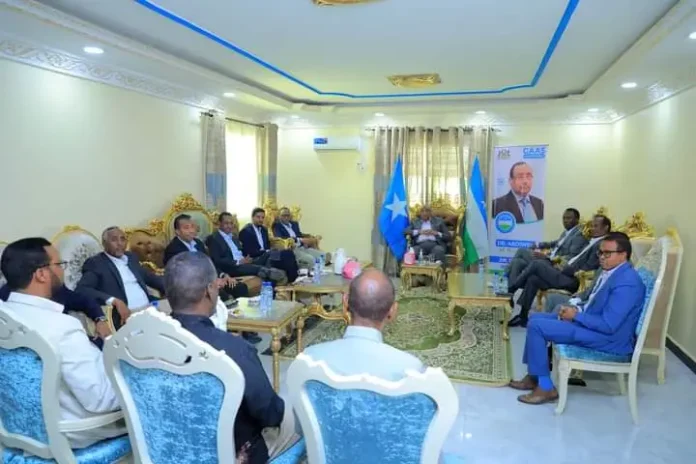


Questions are increasingly mounting regarding whether the Somali opposition will accept the dialogue forum extended by Hassan Sheikh Mohamud to political factions, at a time when the conflict between the federal government and the opposition remains rooted in the electoral process, constitutional amendments, and the country’s political future.
Hassan Sheikh Mohamud called for politicians holding opposing views on national affairs to convene at the negotiating table to achieve a resolution to the existing disputes.
On October 26, 2026, the Presidency announced formal invitations dispatched to the Peace and Development Party, the Somali Future Council, the National Unity Forum, and the Civil Society Coalition, inviting them to a national consultative summit taking place in Mogadishu from November 14 to 18, 2026.
The summit is expected to focus on federal election affairs and securing a political consensus acceptable to major stakeholders.
However, questions persist regarding the conditions under which the opposition might accept the forum, the meeting’s agenda, and whether the government is prepared to re-negotiate previously enacted decisions.
The Somali Future Council—uniting opposition politicians alongside the administrations of Puntland and Jubaland—stated on October 20 that it remains ready for genuine negotiations to achieve an electoral agreement and an executable schedule.
The council urged the federal government to halt what it characterized as unilateral actions and return to the negotiating table to secure a universally agreed-upon electoral framework.
This posture demonstrates that the opposition has not completely closed the door to negotiations, but rather seeks dialogue capable of altering the current political status quo.
Consequently, the core question is not merely whether the opposition will accept the president’s invitation, but whether the established forum satisfies the prerequisites for a genuine political settlement.
The primary dispute between the government and the opposition concerns how upcoming elections are conducted, who manages them, and how to ensure all political stakeholders maintain confidence in the results.
Hassan Sheikh Mohamud’s administration insists on implementing a direct one-person, one-vote electoral system, contending that citizens must be granted the right to directly elect their representatives.
The opposition, conversely, calls for prior political consensus regarding electoral regulations, the operational timetable, and the role of Federal Member States. They also reject making major decisions affecting the country’s future through non-consensual processes.
The conflict has escalated to the point where stakeholders hold divergent perspectives on the 2027 federal election schedule.
The electoral commission announced parliamentary elections for April 15, 2027, and the presidential election for May 15, 2027.
The government views this timetable as a core component of its election plan, whereas the opposition contends that the timetable and electoral process cannot be executed without achieving an inclusive political agreement.
This divergence positions electoral mechanics as the most formidable topic expected at the negotiation table.
In his latest address, Hassan Sheikh Mohamud emphasized that the door to dialogue remains open for politicians holding views contrasting with those of the government.
He called for resolving disputes through negotiation, mutual understanding, and compromise, prioritizing national unity and stability.
The government’s posture asserts that the country requires an electoral system granting citizens direct representation.
However, implementing this system faces ongoing political hurdles regarding stakeholder consensus, electoral administration, and public trust in the process.
Expectations now center on how the government will clarify its response to opposition demands and whether the November conference will feature an agenda jointly established by the parties.
The Nabad iyo Nolol party, led by former President Mohamed Abdullahi Farmaajo, is among the entities invited to the summit.
This party and the Somali Future Council represent distinct entities, despite both voicing criticism of select government policies.
Accordingly, expected responses from the opposition may not be uniform. Factions may differ in their mode of participation, presented preconditions, and prioritized issues.
Nevertheless, participation by Nabad iyo Nolol or another single faction alone does not signal a comprehensive agreement uniting the entire opposition bloc.
The critical factor will be whether invited stakeholders agree that negotiations should serve to resolve active disputes, rather than devolving into symbolic meetings and political rhetoric yielding no tangible outcomes.
Several key hurdles could impede the president’s dialogue initiative from securing a lasting settlement.
The primary issue is trust. The government and opposition remain divided over prior decisions regarding elections and the constitution.
For negotiations to succeed, parties require mutual assurance that any reached agreement will be respected.
The second issue is the summit agenda. If the government and opposition fail to agree on discussed topics, achieving meaningful results will prove difficult.
The third issue is agreement implementation. Even if parties reach a political consensus, establishing a clear schedule, defined responsibilities, and a mechanism ensuring adherence to agreed points remains essential.
The fourth issue is the role of Federal Member States. Because Puntland and Jubaland constitute core parties to the political dispute, their participation and perspectives remain vital for an inclusive agreement.
The summit scheduled for November can serve as an opportunity for stakeholders to resume negotiations, but its success will depend on how contested points are addressed.
If the government and opposition demonstrate readiness to hear opposing viewpoints and accept compromise grounded in a political settlement, establishing an electoral framework trusted by broad stakeholders becomes achievable.
Conversely, if the meeting remains restricted to re-stating previously entrenched positions, securing a durable solution will prove difficult.