


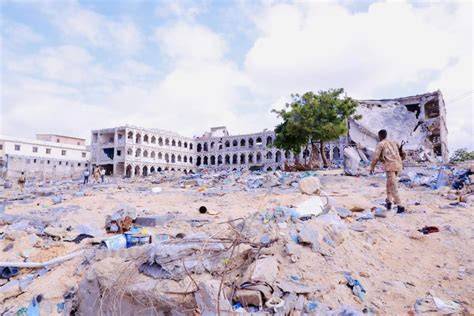


The growing demolition of homes and evictions across Mogadishu has sparked renewed debate over accountability, property rights, and the responsibilities of government institutions when families are displaced from land and houses they have occupied for years.
In recent months, numerous families have reportedly been forced to leave their homes following demolition operations carried out in different parts of the capital.
The incidents have left many residents facing displacement, economic hardship, and uncertainty about their future, while raising concerns about whether proper legal procedures were followed.
A May 2026 report by the European Union Agency for Asylum (EUAA) highlighted the scale of forced displacement in Mogadishu, describing it as a long-standing challenge.
According to the report, more than two million cases of repeated internal displacement were recorded across Somalia between 2017 and 2025, with over one million occurring in Mogadishu alone.
The agency also documented 84 protests against forced evictions across Somalia between April 2025 and March 2026, with 78 taking place in the Banadir region.
The situation has fueled questions about who should be held responsible when homes are demolished and residents displaced.
Legal experts note that responsibility depends on several factors, including who authorized the operation, whether it was backed by a valid court order, and whether security forces acted within the law.
Under legal principles, individual responsibility cannot automatically be assigned to senior political leaders unless evidence shows they directly ordered, approved, or knowingly allowed unlawful actions to take place.
However, government institutions can still bear broader responsibility for ensuring that citizens’ rights, property, and safety are protected during any eviction or redevelopment process.
If local authorities or security agencies were involved in carrying out demolitions, investigators would need to determine who authorized the operation, whether legal documentation existed, and whether affected residents received adequate notice before being removed.
Questions also arise regarding the role of commanders overseeing security personnel involved in such operations.
Human rights standards generally require that evictions and demolitions follow due legal process.
International guidelines emphasize that residents should receive advance notice, access to information, opportunities for consultation, and protection against excessive or unlawful use of force.
Authorities are also expected to provide avenues for complaints, legal appeals, compensation, or resettlement when appropriate.
A central issue in many cases is whether valid court orders were obtained before demolitions were carried out.
If residents were removed without judicial authorization, adequate notice, or legal safeguards, serious concerns could arise regarding the legality of the operation.
Rights organizations have repeatedly warned that forced evictions can trigger cycles of repeated displacement.
Families removed from one location often relocate to other informal settlements where they remain vulnerable to further eviction, creating long-term instability and worsening humanitarian conditions.
The issue extends beyond individual demolition incidents and touches on broader questions of land ownership, urban planning, and governance in Somalia’s rapidly growing capital.
Property disputes in Mogadishu remain complex, involving competing ownership claims, government land, private property, and areas occupied by internally displaced persons.
Human rights groups have continued to monitor the situation closely.
The Coalition of Somali Human Rights Defenders (CSHRD) included forced displacement among its key human rights concerns in 2026 and stressed that allegations related to evictions and demolitions require independent investigations before responsibility can be assigned.
Similarly, Human Rights Watch reported that forced evictions in Mogadishu remained a major concern during 2026, particularly affecting internally displaced communities who are often among the city’s most vulnerable residents.
According to EUAA data, 143,548 people were displaced in Mogadishu during 2025 alone, including more than 63,000 individuals removed from government-owned land.
The agency identified urban development projects as one of the leading causes of forced displacement, alongside disputes involving private landowners and public authorities.
Analysts argue that while redevelopment and modernization of Mogadishu are important goals, such efforts must be balanced with legal protections and respect for the rights of affected residents.
Failure to follow proper procedures risks undermining public trust and creating social tensions in a city already dealing with the effects of conflict, drought, and repeated displacement.
Ultimately, accountability depends on establishing who ordered an operation, whether it complied with the law, and how it was carried out.
Where allegations of unlawful demolitions exist, experts say independent investigations are essential to determine responsibility and ensure that affected communities receive justice and protection under the law.