

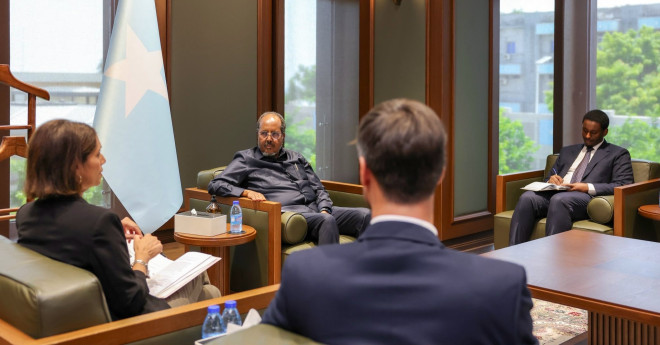

A senior British delegation has met Somalia’s outgoing President, Hassan Sheikh Mohamud, at Villa Somalia to discuss the country’s political and security situation, as tensions between the Federal Government and opposition groups continue to grow over the electoral process.
The British delegation was led by Charlotte Pierre, Director for Africa at the UK Foreign, Commonwealth and Development Office (FCDO). Charles King, the British ambassador to Somalia, also attended the meeting.
The visit comes as Somalia faces a deepening political crisis, with the government and opposition still divided over constitutional amendments, the electoral framework and the country’s future leadership.
According to information from the meeting, discussions focused on the need for inclusive political dialogue involving the Federal Government, opposition groups and other Somali political stakeholders.
Britain emphasised the importance of resolving political disagreements through dialogue and reiterated that Somalia’s future should be determined by Somalis themselves.
The visit is part of wider diplomatic efforts by international partners seeking to bring the Federal Government and opposition back to the negotiating table.
The United Kingdom, United States, European Union and Türkiye are among the international actors involved in efforts to find a political solution, particularly on elections and the country’s political transition.
Opposition groups have expressed concern over the direction of the government’s electoral plans, while Villa Somalia has continued to defend its proposed political agenda.
The meeting highlights the international community’s close attention to Somalia’s political developments and growing concern that the ongoing dispute could trigger further instability if left unresolved.
Members of the National Salvation Council have separately indicated that Hassan Sheikh is willing to engage in talks with opposition leaders in an effort to reach a political settlement.
However, it remains unclear whether this reported willingness will lead to formal negotiations or whether the opposing sides can narrow their differences on the key issues dividing them.
Opposition figures have held a series of private meetings in Mogadishu in recent days to assess the political situation and discuss their next steps.
They have not yet released a detailed official statement outlining the outcome of those discussions, leaving uncertainty over the direction of their political response.
Security issues were also discussed during the meeting between Hassan Sheikh and the British delegation. These included Somalia’s security transition and efforts to enable Somali forces to assume full responsibility for the country’s security.
Britain reaffirmed its commitment to continuing support for Somalia and its international partners in efforts to build a more secure, stable and prosperous country.
The discussions also covered preparations for the potential effects of El Niño, humanitarian needs and measures to strengthen government institutions.
Separately, the Djiboutian Embassy in Somalia issued a statement concerning the incident at Ugaas Khaliif Airport in Beledweyne. The statement comes amid wider political and diplomatic developments surrounding the country’s security situation.
However, the full details of the embassy’s position are needed to establish its precise implications for the current situation.
The British delegation’s meeting with Hassan Sheikh represents another diplomatic effort to ease Somalia’s political tensions and encourage negotiations between the government and opposition.
The central question is whether Hassan Sheikh and opposition leaders can reach an agreement on the electoral process or whether their differences will persist as the country approaches a politically sensitive period.
Attention is also focused on the positions of Somalia’s international partners and whether their diplomatic engagement will persuade the rival sides to reach an inclusive settlement.
Somalia’s political future will depend largely on how the government and opposition manage their differences and whether they can agree on an electoral framework that commands broad political acceptance.