


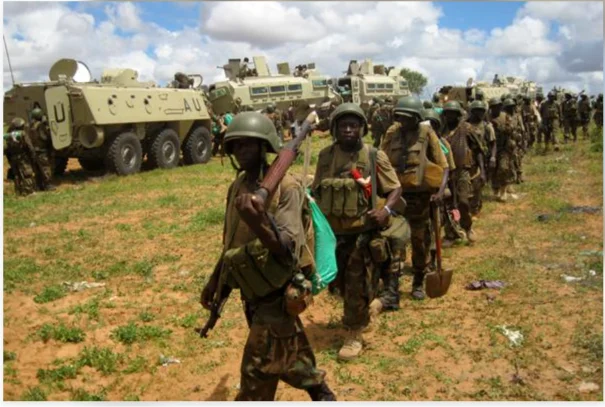


Uganda’s decision to withdraw its bilateral troops from Somalia is prompting a broader reassessment of security arrangements in the country, as Somali forces prepare to take responsibility for areas previously protected by Ugandan soldiers.
The move also comes amid uncertainty over the future deployment of African Union forces and concerns that Al-Shabaab could exploit any gaps created during the transition.
Ugandan authorities announced on November 2, 2026, that the withdrawal of troops deployed under a bilateral arrangement with Somalia had begun.
Colonel Chris Magezi said the first group of soldiers had returned home, adding that the remaining personnel under the arrangement were expected to leave in the following days.
The bilateral deployment is separate from Uganda’s contribution to the African Union Support and Stabilization Mission in Somalia (AUSSOM).
Kampala has also announced plans to withdraw all its forces serving in Somalia, including those under the AU mission, by the end of 2027. The two developments should therefore be viewed as separate stages of Uganda’s wider military disengagement.
The withdrawal is already raising questions about how the AU mission will reorganise its forces. According to an Associated Press report, AUSSOM is considering relocating troops from the Barawe sector to four military positions previously occupied by Ugandan forces: Sabiid-Caanoole, Bariire, Awdheegle and Buulo-Nagaad.
The proposed redeployment is expected to form part of a handover process during November, with an AUSSOM communication to the United Nations Support Office in Somalia reportedly outlining the arrangements.
Barawe, a strategically important coastal town in Lower Shabelle and the administrative capital of South West State, has long been a significant security location.
Somali government forces, supported by African Union troops, recaptured it from Al-Shabaab in 2014. The militant group had used the area and surrounding coastal routes to move fighters and weapons and to generate revenue through the charcoal trade.
Somalia has reportedly reinforced Barawe and other locations affected by the withdrawal. Somali National Army Chief General Ibrahim Mohamed Mohamud also visited the town, where he urged troops to remain vigilant and intensify operations against Al-Shabaab.
However, deploying additional soldiers does not automatically guarantee that the forces have sufficient equipment, supplies, intelligence and operational capacity to defend the area against major attacks.
Security analysts have repeatedly highlighted the challenges facing Somalia’s armed forces, including limited financing, logistical shortages, uneven command structures and difficulties coordinating operations across different regions.
These weaknesses could become more significant if international forces withdraw faster than Somali institutions can assume their responsibilities.
There have also been reports that Burundian troops withdrew from Hawadley in the Middle Shabelle region, allegedly allowing Al-Shabaab to take control of the area.
Those accounts have not been independently confirmed and require clarification from the relevant Somali and AU authorities.
Hawadley is an important location because of its position along routes used by security forces and communities in the region. Any change in control could have wider implications for movement and military operations.
Al-Shabaab may seek to exploit uncertainty during the handover period by attacking military positions, disrupting supply routes or attempting to regain territory.
However, the withdrawal of foreign troops does not necessarily mean that the group will automatically reclaim the areas they previously secured.
The outcome will depend on the strength, readiness and coordination of Somali forces and the effectiveness of the AU mission’s transition arrangements.
The broader situation is also complicated by financial pressures facing AUSSOM. The mission relies heavily on international support for its operations, including troop allowances, logistics and equipment.
Funding constraints have raised concerns about its ability to maintain its current presence and provide sufficient support to Somali forces.
Although Uganda has not publicly provided a detailed explanation for the withdrawal of its bilateral contingent, the wider financial and operational challenges surrounding the mission remain an important part of the discussion.
Uganda has been a central contributor to international security operations in Somalia since 2007, when it deployed troops under the African Union Mission in Somalia, known as AMISOM.
The mission later became ATMIS before being replaced by AUSSOM in January 2025. Over nearly two decades, Ugandan forces have played a major role in protecting key towns, supporting Somali military operations and helping secure strategic installations.
The transition also comes at a politically sensitive moment. The Federal Government and opposition groups remain divided over constitutional amendments, the electoral process and the future political arrangement.
Opposition figures have criticised the government’s approach to the next elections, arguing that major decisions require broader political agreement. The government, meanwhile, maintains that Somalia needs a functioning constitutional and electoral framework.
President Hassan Sheikh Mohamud has expressed willingness to engage political stakeholders, but the timing, composition and outcome of any talks remain uncertain.
A prolonged political dispute could undermine cooperation between federal institutions, regional administrations and security agencies at a time when coordination is essential.
Uganda’s withdrawal therefore presents Somalia with both an opportunity and a serious test. A gradual transfer of security responsibilities could strengthen national sovereignty and reduce long-term dependence on foreign forces.
But without adequate preparation, it could also expose vulnerable locations to renewed attacks and reverse gains made through years of military operations.
The central challenge is not simply to replace foreign soldiers at military bases.
Somalia must establish clear command arrangements, provide reliable funding and supplies, strengthen the national army and police, and ensure that local administrations can maintain security and protect civilians.
A coordinated transition involving the Federal Government, AUSSOM and regional authorities will be essential to prevent security gaps.
Ultimately, the success of Uganda’s withdrawal will depend on whether Somalia can turn the transfer of responsibility into a sustainable national security strategy.
Without stronger institutions, political cooperation and adequate resources, the departure of international troops could leave the country facing renewed instability rather than greater security independence.