

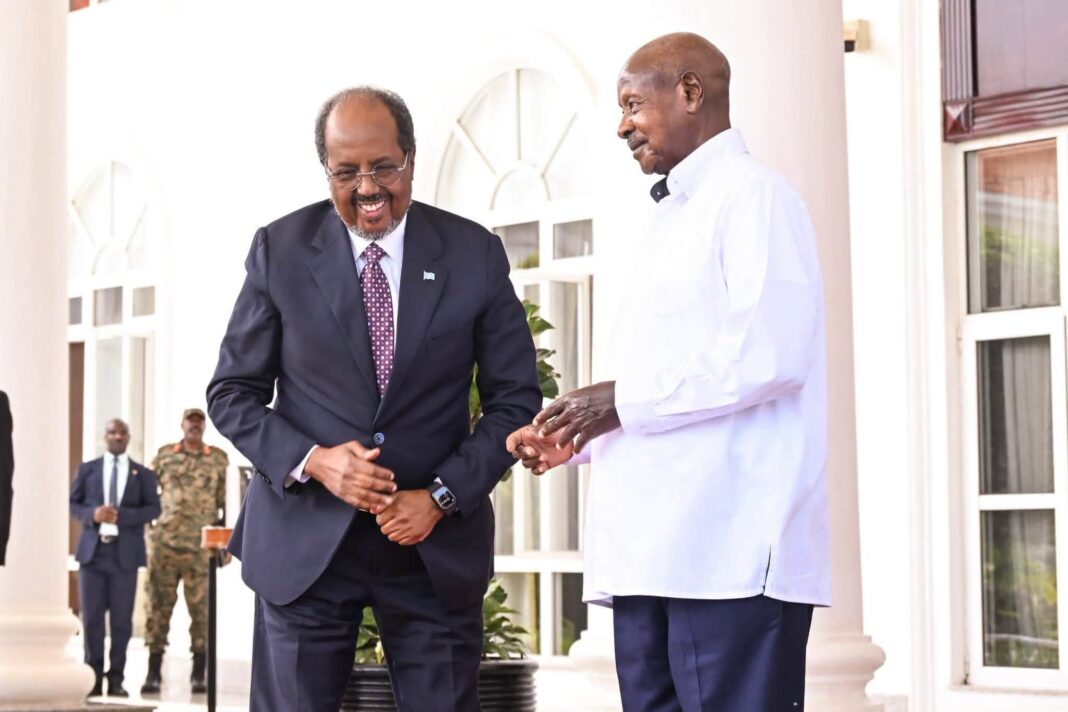

Efforts to reach a political agreement on elections in Somalia appear to be gaining momentum, as the Ugandan government plans to dispatch a committee to Mogadishu to assess the country’s political situation and listen to the views of federal government leaders, federal member states, and other political stakeholders.
Reports obtained by Kaab TV indicate that a delegation from the Ugandan government will arrive in Mogadishu at the end of this week before traveling to the capitals of the federal member states to gather the perspectives and positions of the various sides.
This initiative coincides with stepped-up diplomatic efforts by the United States and the United Kingdom, which have reportedly initiated talks with federal member state leaders to discuss Somalia’s key priorities, particularly how to reach an agreement on the electoral framework.
The delegation’s visits to the regional capitals are expected to form part of a broader push to forge a unified stance regarding the country’s political future.
The Ugandan government has long maintained close ties with Somalia, particularly in the areas of security and support for the African Union mission. President Yoweri Museveni also maintains political relationships with federal government leaders as well as several regional leaders.
President Museveni himself is reportedly expected to travel to Mogadishu following the preliminary assessment delegations and consultations with political stakeholders. His visit is anticipated to be part of the ongoing drive to resolve the electoral dispute.
Meanwhile, the United States and the United Kingdom have reportedly begun engaging with federal member state leaders, focusing on Somalia’s core priorities and ways to achieve a political settlement on elections.
This diplomatic activity underscores that countries with influence over Somali affairs want political actors to reach a consensus before January 2027.
The primary concern is that a prolonged political crisis could undermine national stability, government operations, and security plans.
The United States and the United Kingdom are placing particular emphasis on securing an agreement between the federal government and the federal member states regarding the electoral model, in order to avert a political standoff marked by dispute and deadlock.
Incoming reports indicate that Villa Somalia is facing mounting diplomatic pressure to reach an electoral agreement ahead of January 2027.
According to intelligence obtained by Kaab TV, the pressure on the government stems from the likelihood that the proposed agreement will not fully align with Villa Somalia’s political agenda and may include provisions that alter its ambitions regarding the electoral process.
This centers on ongoing disputes over how the elections will be conducted, who will manage the process, the terms of office for state institutions, and the role of the federal member states.
However, no official details have yet been released outlining the specific terms of the proposed agreement or the extent of compromises required from the political stakeholders.
Information obtained by Kaab TV also suggests that Hassan Sheikh Mohamud may plan to reassess some of his political allies amid growing pressure over an electoral deal.
These reports indicate that Hassan Sheikh Mohamud seeks to distance himself from certain officials and politicians within his camp who could be blamed for obstacles at the negotiating table.
Should this occur, it could represent a political shift signaling that Villa Somalia is looking for ways to ease both domestic and international pressure.
Various sources cited by Kaab TV state that Villa Somalia has accepted the mediation of Uganda and other troop-contributing countries in Somalia to find a pathway out of the political crisis.
This move could prove significant, as it demonstrates the federal government’s willingness to allow external diplomatic efforts to play a role in resolving the electoral dispute.
Another detail emerging from the reports is that intelligence officials from neighboring countries will participate in the efforts to broker a political agreement in Somalia.
The involvement of security actors may reflect regional concern over the potential impact of Somalia’s political dispute on national security and the broader Horn of Africa.
Ongoing efforts are specifically focused on reaching a political settlement before January 2027, a deadline viewed as critical to the future of the electoral process and Somalia’s political stability.
Failure to reach an agreement could further strain relations between the federal government and the federal member states, with political disputes potentially disrupting government operations and national plans.
Conversely, a mutually acceptable agreement could create an opportunity to defuse tensions, establish an agreed-upon electoral framework, and strengthen political trust.