


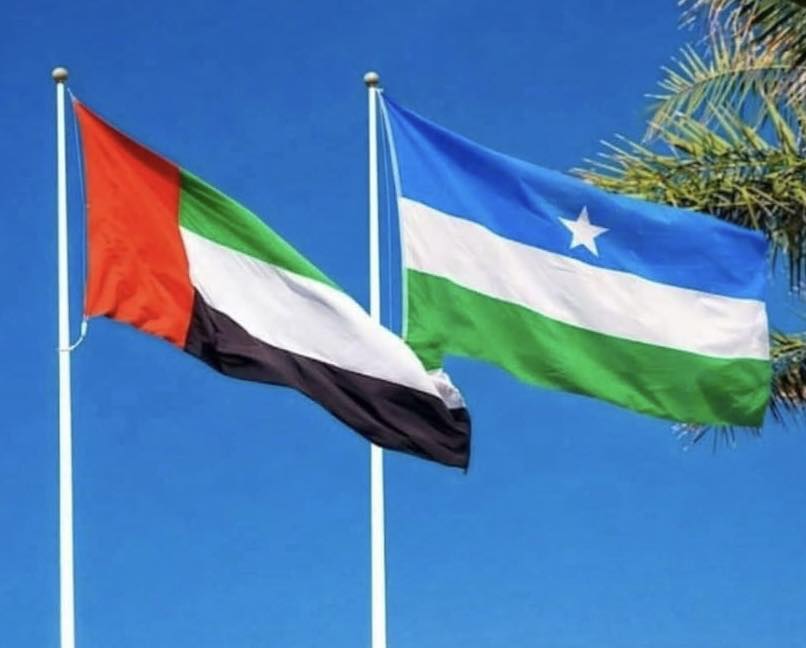


GAROWE (Kaab TV) – As Somalia’s Federal Government in Mogadishu continues to place obstacles in the way of Puntland’s development efforts, members of Puntland’s civil society say the United Arab Emirates (UAE) has played a visible and effective role in investment, development, and security.
Civil society representatives specifically highlighted the DP World project at Bosaso Port, widely regarded as one of the largest and most strategic infrastructure investments implemented in Puntland.
Dr. Abdifatah Guutaale, a Puntland intellectual who recently returned from the diaspora, described the UAE’s role as filling “a vacuum left by the Federal Government of Somalia.”
UAE-backed projects have led to major modernization of Bosaso Port—the economic lifeline of Puntland—significantly increasing trade capacity and creating hundreds of direct and indirect jobs. Many of these employment opportunities have benefited Puntland’s youth.
“The UAE filled a role abandoned by the Federal Government, which failed to support the Puntland administration, despite Puntland being a member state of the federal system,” Dr. Abdifatah told Kaab TV.

Civil society groups said the investment has substantially strengthened Puntland’s economy, particularly in trade, imports, and exports, helping to reduce unemployment and increase domestic revenue.
On the security front, they noted that the UAE provided critical support to Puntland security forces at a time when the regional administration was engaged in intense fighting against ISIS, particularly in the Calmiskaad mountain range. According to civil society actors, this assistance helped enhance the operational capacity of Puntland forces and sustain counterterrorism operations.
Residents of Puntland responded
Earlier this month, when the Federal Government in Mogadishu announced that it was abandoning all contracts with the United Arab Emirates, residents of Puntland responded with public demonstrations of support for continued UAE–Puntland cooperation.
In Garowe, hundreds of Puntlanders gathered to denounce the decision, describing it as harmful to Puntland’s security and development. Participants welcomed the ongoing collaboration between the UAE and Puntland, arguing that it has delivered tangible support during the most critical moments.
“The UAE came when we needed them most—when our soldiers were bleeding and urgently needed medical assistance,” said Asha Jama, one of the participants at the Garowe gathering last week.
Since the establishment of the Federal Government of Somalia, Puntland has played a significant role in providing financial and political support for the reconstruction of the Somali state.
However, according to Mohamed Geelle, a young Puntland intellectual, the Puntland administration has increasingly become a victim of political marginalization.

“People in Puntland have long complained of injustices imposed by the Somali state. Today, the largest investor in Puntland is the UAE—whether in economic support, security, or development projects,” Geelle told Kaab TV.
Geelle noted that the UAE previously provided Somalia with financial assistance ranging from approximately $5 million to $43.5 million to support Somali security forces. However, after relations between the Mogadishu-based government and the UAE deteriorated, President Hassan Sheikh Mohamud’s administration sought alternative backing from Qatar, while no solution was pursued for Puntland forces that remain heavily dependent on UAE support.
According to Geelle, this indicates that the Mogadishu government “has little interest in Puntland’s security and development,” at a time when Puntland is engaged in active combat against terrorist groups.
Meanwhile, the Federal Government of Somalia has also been accused of imposing a blockade on Puntland during the conflict, resulting in Puntland forces on the front lines facing shortages of supplies, military equipment, and emergency medical services—particularly for wounded soldiers.
Civil society representatives said this situation directly undermined counterterrorism efforts and further worsened the humanitarian conditions faced by Puntland soldiers and their families.