

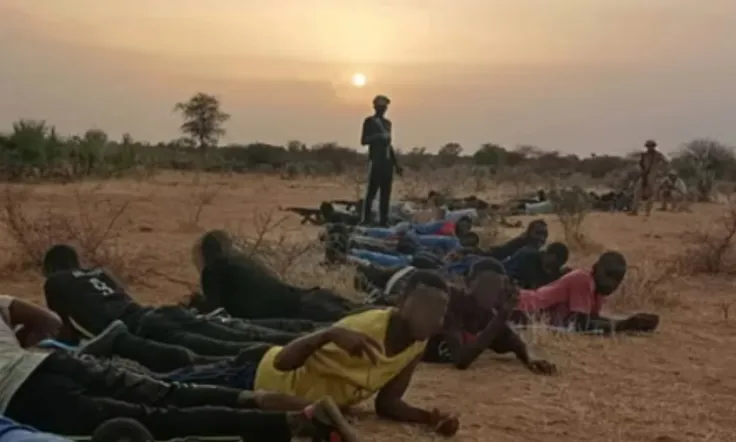
MOGADISHU (KAAB TV) – A bombshell investigation jointly published by The Guardian and Colombian media outlet La Silla Vacía has uncovered alarming details about a secretive military operation that connects the Horn of Africa to one of the deadliest conflicts in recent history — the war in Sudan.
According to the report, a military base located in Bosaso, a coastal city in Somalia’s Bari region and owned by the United Arab Emirates (UAE), is being used as a transit hub for Colombian mercenaries en route to Sudan.
These mercenaries are allegedly being contracted to support the Rapid Support Forces (RSF), a paramilitary group engaged in a brutal civil war against Sudan’s national army.
Bosaso: From Naval Training Center to Secret Military Hub
The base in Bosaso was originally constructed by the UAE several years ago under the premise of training Puntland’s maritime forces. However, its current use appears to be far removed from its initial purpose.
Sources suggest the UAE now operates the facility independently of Somali oversight, raising serious questions about Somalia’s territorial sovereignty and Puntland’s complicity — or lack of control — in the covert operations occurring on its soil.
Security analysts say Bosaso has quietly evolved into a strategic node in the UAE’s expanding regional military network.
The revelations come amid increasing scrutiny of the UAE’s involvement in proxy conflicts, particularly in Sudan, where it has been repeatedly accused of supporting the RSF — allegations that the Emirati government has consistently denied.
Colombian Mercenaries and the Sudan Conflict
The deployment of Colombian mercenaries to Sudan marks a dark turn in the country’s ongoing civil war, which erupted in April 2023 between the Sudanese Armed Forces (SAF) and the RSF.
The war has already claimed an estimated 150,000 lives and displaced nearly 13 million people, according to UN and humanitarian sources. The United Nations has labeled the conflict one of the worst humanitarian crises in modern history.
In the most harrowing revelation, Colombian mercenaries have reportedly been involved in training child soldiers for the RSF. One Colombian national, identified only as Carlos for his safety, told The Guardian that his role included instructing underage conscripts in handling assault rifles, machine guns, and rocket-propelled grenades.
“There were thousands of conscripts in the camps — some adults, but mostly children,” Carlos recounted. “They had never even held a weapon. We taught them how to use guns, then sent them to the front lines. We trained them to kill.”
Carlos further detailed how he was recruited for $2,600 per month. After medical examinations in Bogotá, he was flown to Ethiopia and later transferred to the UAE-run military base in Bosaso, before being deployed to Nyala in South Darfur — a region deeply scarred by the ongoing violence.
Foreign Fighters in Darfur: “A Double Crime”
The presence of foreign mercenaries in Sudan was publicly acknowledged by local leaders. In August, Mohamed Khamis Douda, spokesperson for the Zamzam displacement camp in Darfur, confirmed to Sudan Tribune that outsiders were operating in the region.
“We have seen with our eyes a double crime — the RSF’s violence against our people, and now the occupation of our camp by foreign mercenaries,” he said.
The Guardian reported that the mercenaries were sighted in Zamzam, the largest displacement camp in Sudan, further confirming their role in the ongoing conflict. Colombian outlet La Silla Vacía first broke the story in 2024, revealing that over 300 former Colombian soldiers had been recruited by intermediaries on behalf of a third-party country — now believed to be the UAE.
The Mercenary Pipeline: Why Colombians?
Experts say the recruitment of Colombian fighters is not coincidental. Colombia’s decades-long conflict with guerrilla groups and drug cartels has produced a large pool of highly trained veterans.
Many of these soldiers received counter-insurgency training from the U.S. military and NATO allies during their service.
“Colombia has over half a century of warfare. These soldiers are not only experienced but hardened by some of the world’s most difficult conditions,” said Elizabeth Dickinson, senior analyst at the International Crisis Group.
“They are in high demand, especially in environments where plausible deniability is needed,” added Sean McFate, a military analyst and author specializing in the use of mercenaries.
McFate also pointed out that the UAE has used Colombian fighters before — notably during its military intervention in Yemen, where these mercenaries were used to guard oil infrastructure and fight Houthi rebels.
“Using mercenaries allows countries to escape accountability. If they’re captured or killed, governments can simply deny involvement,” McFate said.
Exploiting the Veteran Gap
Both Dickinson and McFate argue that Colombia’s own systemic issues make its veterans vulnerable to mercenary recruitment. Soldiers in Colombia are often forced to retire in their late 30s or early 40s with little pension and minimal job retraining options.
“Imagine joining the army at 18, serving 20 years, and retiring before you’re 40 — with no career prospects,” Dickinson explained. “The mercenary route becomes not just tempting, but necessary for survival.”
Carlos, who left Colombia’s military after only five years, echoed that sentiment. He joined the war in Sudan for economic reasons but left due to what he described as “payment issues.” He said around 30 men left with him, while another 30 were arriving.
What This Means for Somalia
The use of Somali territory, specifically Bosaso, as a military transit hub without the full transparency of the Somali federal government raises deeply troubling concerns. Puntland, the semi-autonomous region in which Bosaso lies, has had historical ties with the UAE, particularly in security and infrastructure.
But this new development suggests a dangerous erosion of Somali sovereignty, as well as a potential violation of international law if Somali land is being used to facilitate child soldier training and foreign intervention in Sudan.
The Somali federal government has yet to issue an official statement in response to the report.
A Brewing Scandal in Global Politics
As the Sudanese civil war continues with no end in sight, the international community may be forced to reckon with the shadowy mechanisms that allow proxy wars to flourish.
The revelations from The Guardian and La Silla Vacía expose how war economies exploit vulnerable ex-soldiers, weaken fragile states, and perpetuate cycles of violence — often far from the public eye.
If confirmed, the UAE’s use of Somali territory to deploy foreign fighters into a war zone involving potential war crimes could not only violate multiple international laws but also fundamentally reshape regional diplomacy in the Horn of Africa and the Gulf.