



MOGADISHU (KAAB TV) – The United Arab Emirates (UAE) has significantly expanded its network of military and intelligence installations across key coastal areas of the Horn of Africa and the Gulf of Aden, enhancing its strategic position along some of the world’s busiest maritime corridors. This development has raised alarms in Somalia, where federal authorities in Mogadishu view the expansion as a direct challenge to the country’s sovereignty and unity.
Satellite imagery analyzed by Middle East Eye and corroborated by open-source intelligence (OSINT) groups reveals that Abu Dhabi, in coordination with Israel and the United States, has established or modernized military facilities at key locations including the Socotra archipelago (Yemen), the Somali ports of Berbera (Somaliland) and Bosaso (Puntland), and several offshore islands. These installations form an interconnected network of surveillance, radar, drone operations, and logistics hubs intended to monitor regional maritime traffic, Houthi military activity, and movements by Iran-aligned groups.
The UAE’s strategic installations in Puntland and Somaliland were developed without the formal approval of Somalia’s federal government.
Mogadishu maintains that all foreign defense agreements must be authorized by the central government under the 2012 provisional constitution. However, Abu Dhabi has signed direct agreements with the regional administrations of Puntland and the self-declared independent state of Somaliland—effectively bypassing the capital.
This approach has exacerbated tensions between Mogadishu and regional governments, deepening existing fractures within Somalia’s fragile federal system. Analysts note that such external deals undermine efforts to consolidate national security forces under a unified command.
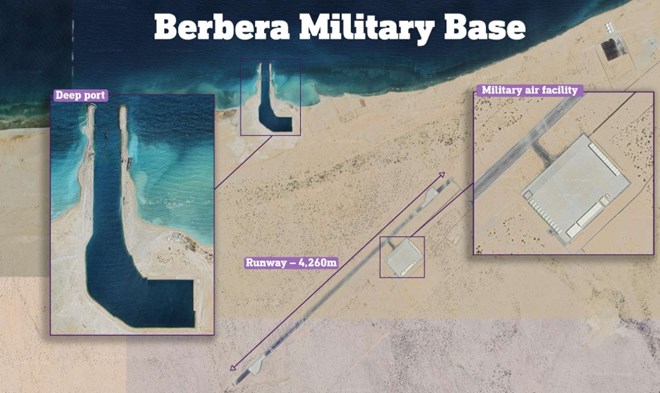
The UAE’s involvement in Somaliland began in earnest in 2017, when it announced plans to develop a military base at Berbera. The installation sits adjacent to one of Africa’s longest airstrips, originally built by the Soviet Union, which has since been upgraded to accommodate large cargo planes and military aircraft.
Since early 2025, satellite images and reports indicate further expansion at Berbera, including the construction of naval facilities, fuel depots, and logistics yards.
These developments complement the adjacent commercial port managed by DP World, a UAE-based company, and a proposed rail corridor connecting Berbera to Ethiopia—another sign of Abu Dhabi’s broader regional ambitions.
Somaliland’s willingness to engage directly with the UAE is part of its ongoing quest for international recognition, using its partnership with Abu Dhabi as evidence of its capability to conduct foreign relations independent of Mogadishu.
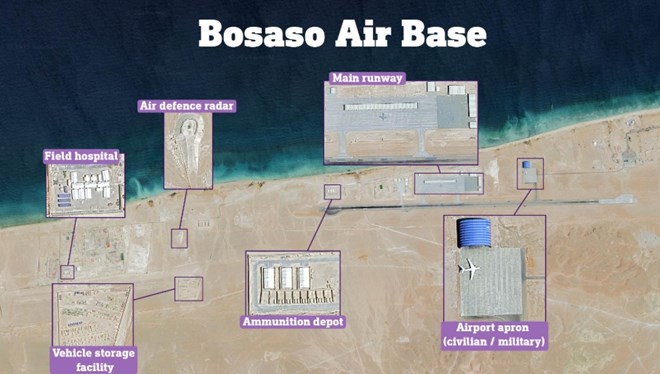
In Puntland, satellite imagery from late 2024 through mid-2025 reveals accelerated construction of military infrastructure in Bosaso, including radar towers, hangars, drone pads, and ammunition storage facilities adjacent to the international airport.
Intelligence analysts identified an Israeli-made radar system—believed to be part of the Iron Dome missile defense family—at the site in April 2025.
These facilities reportedly overlap with the Puntland Maritime Police Force (PMPF), a UAE-trained paramilitary unit that has faced criticism from the United Nations for operating outside Somalia’s national command structure.
Across the Gulf, Abu Dhabi has upgraded installations on the Yemeni islands of Abd al-Kuri and Samhah in the Socotra archipelago. The islands’ strategic location between the Arabian Sea and the Bab al-Mandab Strait enables UAE and Israeli forces to monitor shipping lanes and potential missile launches from the Red Sea.
Further west, on the volcanic island of Mayun (also known as Perim), the UAE is believed to be operating an airbase with runways and hangars capable of housing surveillance drones and reconnaissance aircraft.
These installations, though nominally civilian or humanitarian in purpose, have been repurposed for military use as defense cooperation between the UAE and Israel deepened following the 2020 Abraham Accords.
In May 2025, Reuters published an investigation detailing Sudanese allegations that the UAE had supplied weapons to the Rapid Support Forces (RSF), the paramilitary group accused of atrocities during Sudan’s civil conflict.
These arms, according to Sudanese officials, were transported via Chad and Somalia. While Abu Dhabi denied the accusations, UN investigators deemed the claims “credible.”
Sudan subsequently filed a case with the International Court of Justice (ICJ), accusing the UAE of complicity in RSF war crimes. The ICJ later dismissed the case on jurisdictional grounds, but the incident has intensified scrutiny of the UAE’s regional role.
Reports from late 2024 also showed large IL-76 cargo aircraft landing in Bosaso, prompting concerns that the UAE may be using Somali airstrips for covert arms transfers to conflict zones such as Sudan and Yemen.
Beyond infrastructure, the UAE appears to be expanding its human presence through military recruitment. In 2024, Intelligence Online reported that Abu Dhabi was planning the creation of a 3,000-strong “Foreign Emirati Legion”—a force composed of foreign military veterans reportedly earmarked for deployment in Yemen and Somalia.
Recruitment is allegedly being overseen by an Emirati defense contractor offering high salaries and long-term contracts to ex-soldiers.
Analysts view the UAE’s growing military footprint as part of a broader strategy to shape the political and security outcomes of fractured or failed states. Jalel Harchaoui, a North Africa expert, noted:
“Because countries like Ethiopia, Libya, Yemen, Somalia, and Sudan are increasingly mismanaged or in crisis, the UAE can exert a level of influence impossible in more stable regions. It’s a form of power projection through infrastructure and patronage.”
While the UAE claims its activities are aimed at regional stability and counterterrorism, critics argue that its bypassing of international norms and sovereign procedures undermines peace-building and state sovereignty in already fragile states.