




Mogadishu (Kaab TV) – While Washington debates future threats from China, Iran, and Russia, U.S. forces remain engaged in conflicts most Americans assume ended years ago — in Syria, Iraq, Somalia, and Yemen.
These missions are smaller and quieter than the post-9/11 wars that once defined U.S. foreign policy. There are no troop surges, no primetime addresses. Yet American service members continue to conduct raids, launch airstrikes, and intercept enemy fire under war authorities passed more than two decades ago — long after public attention has moved on. The wars did not end; they simply faded from view.
As of June, some 40,000 U.S. troops remain stationed in the Middle East, a reminder that America’s military footprint has shrunk but never disappeared.
Syria: The war that never formally ended
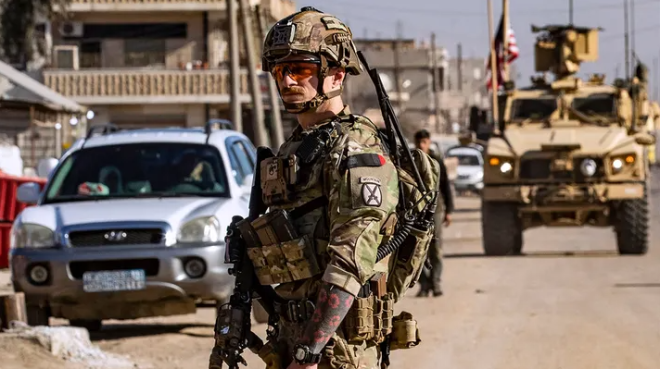
About 900 U.S. troops remain in eastern Syria, conducting counterterrorism operations against the Islamic State and defending themselves against Iranian-backed militias.
Officially, the mission is a stabilization effort following ISIS’ territorial defeat. In reality, U.S. forces still face rocket, drone, and indirect-fire attacks, especially as regional tensions rise. Working alongside the Syrian Democratic Forces, they target ISIS cells responsible for assassinations, ambushes, and prison breaks.
The mission drew attention in December when two National Guardsmen and one American contractor were killed by a suspected ISIS fighter. U.S. airstrikes and special operations raids continue even as Syria has largely disappeared from the national conversation.
There is no declared war, no defined end state — yet American troops operate in an active combat environment.
The U.S. military entered Syria in 2014, launching airstrikes and deploying special operations forces to support local partners against ISIS. U.S. forces expanded alongside Kurdish-led units in eastern Syria during the fight to dismantle ISIS’ caliphate.
After ISIS lost its territory in 2019, Washington reduced its presence but retained several hundred troops to prevent a resurgence and counter Iranian-backed militias. Despite repeated calls for withdrawal, U.S. forces have remained for more than a decade, operating under post-9/11 authorities never formally repealed.
Iraq: A war winding down, but not finished
Under a 2024 agreement with Baghdad, Washington has begun drawing down forces and transferring responsibility for countering ISIS to Iraqi security forces. The coalition plans to reduce its footprint by roughly 20% of the remaining 900 troops, consolidate forces mainly in the Kurdish region, and conclude its mission by September.
Even amid the drawdown, U.S. forces face threats from Iranian-backed militias, retaining authority to defend themselves and strike ISIS targets if necessary.
The Iraq war no longer resembles the conflict of the 2000s. But American troops remain deployed, armed, and active in a country where risk persists. U.S. forces initially entered Iraq in 2003, toppling Saddam Hussein and fighting through years of counterinsurgency before formally ending combat operations in 2011. They returned in 2014 to counter ISIS, gradually narrowing their mission from combat to advisory roles.
Somalia: America’s quietest war
Few Americans realize the U.S. is still conducting one of its most persistent counterterrorism campaigns in Somalia.
U.S. special operations forces assist Somali troops against al-Shabab, an al Qaeda-linked terrorist group, with airstrikes regularly conducted, though often underreported. There is no large troop presence and little media coverage, but the fighting continues.
U.S. military involvement dates to the early 1990s humanitarian intervention. After the 1994 “Black Hawk Down” incident, forces withdrew, only to return in the 2000s through counterterrorism strikes and advisory roles. The presence expanded after 2017, shifted to an “over-the-horizon” posture in 2020, then partially redeployed in 2022 under the Biden administration. Today, roughly 500 U.S. troops remain in Somalia, maintaining an ongoing counterterrorism mission.
Yemen: A war Americans are fighting without realizing it
The U.S. has no base presence in Yemen but frequently engages with Iran-backed Houthi rebels. Naval and air forces intercept missiles and drones targeting Red Sea and Gulf of Aden shipping lanes, putting American personnel in direct combat.
In spring 2025, U.S. forces launched a weekslong campaign against Houthi targets, striking over 1,000 sites linked to missile, drone, and weapons infrastructure to protect trade and deter escalation.
Operation Southern Spear: Counter-narcotics in the Caribbean and Eastern Pacific
The U.S. has conducted 28 strikes on alleged narco-trafficking boats near Venezuela, killing 103 people. South and Central America now host the largest U.S. military buildup in decades, including 15% of naval assets and the USS Gerald R. Ford. While operations have avoided strikes on Venezuelan soil, the scale of forces underscores how quickly a counter-narcotics mission could escalate into a more overt confrontation.
None of these conflicts were formally concluded by Congress. Most continue under post-9/11 authorizations passed more than two decades ago.
While Washington has signaled potential changes, as long as Iran remains a threat, a broad U.S. withdrawal from the Middle East is unlikely.
“The days in which the Middle East dominated American foreign policy are thankfully over — not because the region no longer matters, but because it is no longer the constant source of imminent catastrophe it once was,” said the White House national security strategy in December. “It is emerging as a place of partnership, friendship, and investment — a trend that should be welcomed and encouraged.”