

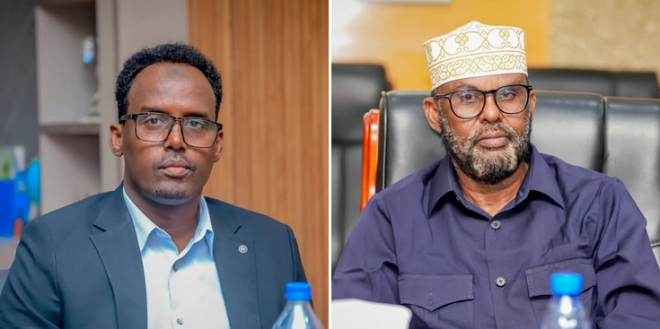

Mogadishu (Kaab TV) — Two Somali federal ministers from Puntland have resigned in protest over constitutional amendments approved on Wednesday, intensifying political tensions between Mogadishu and regional leaders.
Aynaashe Yusuf Hussein, State Minister for Labor and Social Affairs, and Ismail Buraale, State Minister for Petroleum and Minerals—both members of the House of the People representing constituencies in Puntland—announced their resignations following a parliamentary vote to adopt a revised constitution.
In a statement, Aynaashe accused the federal leadership of attempting to reshape Somalia’s governance into a system dominated by a single authority, warning that such changes could threaten national unity and the federal balance.
“The people of Puntland entrusted me with this seat,” he said. “I cannot be part of anything that harms them and their government.”
He also alleged that lawmakers from Puntland had been obstructed from carrying out their constitutional duties and prevented from traveling to their constituencies, describing the situation as a violation of parliamentary rights.
Ismail Buraale said he opposed what he described as an incomplete and unilateral constitutional process. He argued that fundamental amendments require broad consultation and national consensus, rather than approval through a parliamentary session marked by opposition boycotts.
The presidency and the prime minister’s office have not yet publicly responded to the resignations.
The departures follow the approval of a revised constitution by Somalia’s bicameral parliament on Wednesday, formally replacing the provisional charter adopted in 2012 at the end of the country’s transitional period.
During a joint sitting of the House of the People and the Upper House, 223 lawmakers voted in favor of the amended document, including 186 members of the lower house and 37 senators.
Government officials have described the new constitution as a milestone in Somalia’s state-building process, saying it clarifies the division of powers between federal and state authorities and strengthens institutional governance.
Opposition figures, however, argue that the process lacked sufficient political consensus and risks exacerbating tensions between the federal government and regional administrations at a sensitive political moment.
The resignations underscore widening political divisions as Somalia approaches key electoral deadlines, with debates continuing over the structure of its federal system and the future direction of national governance.