


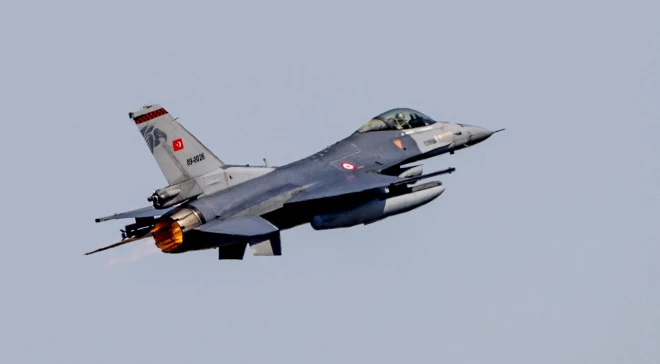


The presence of Turkish combat aircraft in Somalia became a major topic of widespread discussion this year, following the appearance of Turkish Air Force F-16 fighter jets in Mogadishu and across Somali airspace.
Turkey deployed F-16 fighter jets to Somalia as part of bilateral military cooperation and the ongoing campaign against Al-Shabaab.
Three F-16 aircraft were reportedly deployed to Aden Adde International Airport in Mogadishu on January 28, 2026, and their presence was later officially confirmed as part of Turkey’s expanded military operations in Somalia.
However, the deployment of these fighter jets has raised another critical question: If Somali civilians are killed or injured in an airstrike conducted by Turkish aircraft, who bears the legal responsibility?
Turkey has maintained long-standing security and military cooperation with Somalia. Ankara has trained Somali security forces while providing vital military and technical support.
The year 2026 marked a new phase in this partnership, following the integration of F-16 fighter jets into Turkey’s operational framework in Somalia.
In January 2026, three F-16s arrived in Mogadishu alongside a deployment of military helicopters.
Military reports indicated that these aircraft were intended to support counter-terrorism operations against Al-Shabaab.
On April 12, 2026, the Turkish Ministry of Defense formally acknowledged the presence of the F-16s in Somalia, with three aircraft participating in a ceremonial display commemorating the anniversary of the Somali National Armed Forces (SNAF).
Consequently, the presence of Turkish F-16s in Somalia extends beyond social media speculation, backed by formal confirmations of their deployment.
On June 30, 2026, the Somali Ministry of Defense announced that the Somali National Armed Forces, operating in coordination with Turkish forces, carried out airstrikes in the Godey area of the Lower Shabelle region.
The ministry stated that the airstrikes targeted underground hideouts, weapon depots, and assembly points used by Al-Shabaab fighters, adding that approximately 35 militants were killed and over 20 others wounded.
This indicates that the F-16 fighter jets are not stationed in Somalia merely for training or ceremonial displays, but have actively integrated into the strike capabilities of military operations.
It is important here not to conflate these newly introduced F-16s with previous airstrikes conducted by Turkish aircraft.
In 2024, Amnesty International investigated two airstrikes that occurred on March 18, 2024, which reportedly involved Turkish Bayraktar TB2 unmanned aerial vehicles (drones).
Amnesty reported that 23 civilians were killed in those attacks—including 14 children and five women—while 17 others were injured.
The organization also stated that its investigation utilized interviews, medical records, satellite imagery, and weapon remnant analysis, noting that the recovered ordnance matched the MAM-L munitions deployed by TB2 drones.
Amnesty called upon the governments of Somalia and Turkey to conduct investigations, stating that attacks failing to properly distinguish between military targets and civilians can breach international humanitarian law and, in certain instances, amount to war crimes.
This is a critical point, as it demonstrates that the issue of civilian accountability is not a novel question arising solely from the deployment of F-16s.
Legally, liability cannot be assigned to an individual or government based solely on ownership of the aircraft.
If the aircraft belongs to Turkey and the pilot is a Turkish service member, the Turkish government may bear state responsibility for the actions of the forces under its direct command.
If the target and the strike were executed under orders originating from the Turkish chain of command, responsibility must be investigated along that same chain.
If Somali forces provided the intelligence or the targeting data, that could constitute a critical factor when examining who was involved in the decision-making process.
Fourth, whether the target was lawful or not.
International humanitarian law clearly distinguishes between combatants and civilians.
Forces must take necessary precautions to protect civilians and effectively differentiate between military objectives and civilian persons or objects.
If an attack is deliberately directed against civilians, or if an indiscriminate strike is launched where civilians are present, the situation can entail severe legal liability.
The possibility of Somali responsibility would depend on its actual role in the operation.
If Somali security forces provided the targeting data, intelligence, or strike authorization, that role could form a significant element of any legal investigation.
Amnesty International noted in its 2024 investigation that Somali government sources indicated Somali officials supplied the targets, while TB2 drones were operated directly by Turkish personnel.
However, Amnesty stated that it could not independently verify who had direct operational control over the aircraft that executed the strike.
This illustrates why an official investigation is imperative whenever civilians are harmed in an airstrike.
If it is established that Turkish forces carried out the attack, Turkish accountability could emerge as a central focus of the investigation.
Nevertheless, the mere presence of a Turkish aircraft does not automatically prove that the Turkish government bears legal liability for any harm resulting from an operation.
The fact that an F-16 takes off from Aden Adde International Airport does not mean the airport authority or the Somali government automatically assumes responsibility for every action taken by that aircraft.
However, if an operation is executed under a formal partnership between the two governments, it is vital to understand how the military agreement defines command authority, operational control, and liability.
Consequently, a genuine investigation requires access to the terms of bilateral agreements, the chain of command, and the rules of engagement.
Throughout this year, reports and visual media have captured Turkish F-16s flying over Mogadishu.
An investigation must clarify the location and timing of the strike, the type of aircraft, the munitions used, the target, the individuals present at the site, and who issued the order.
Evidence from the scene must also be collected, including weapon remnants, photographic and video documentation, medical records, and eyewitness accounts from individuals present on the ground.
Should it be verified that civilians were unlawfully harmed, victims and their families are entitled to seek truth, accountability, and reparations, depending on the applicable law and the party held responsible.
In light of the controversy surrounding airstrikes and civilian casualties, it is crucial for both governments to transparently address the public’s concerns.
It must be clarified who commands the F-16s, who authorizes the airstrikes, who selects the targets, and what investigative procedures are followed if civilians are harmed during an operation.
It must likewise be clarified whether the bilateral military agreements between Somalia and Turkey contain provisions outlining liability when a joint operation results in civilian casualties.
Above all, the death and injury of civilians must not be treated as overlooked data; rather, every such incident demands an independent investigation to uncover the truth and establish responsibility.