


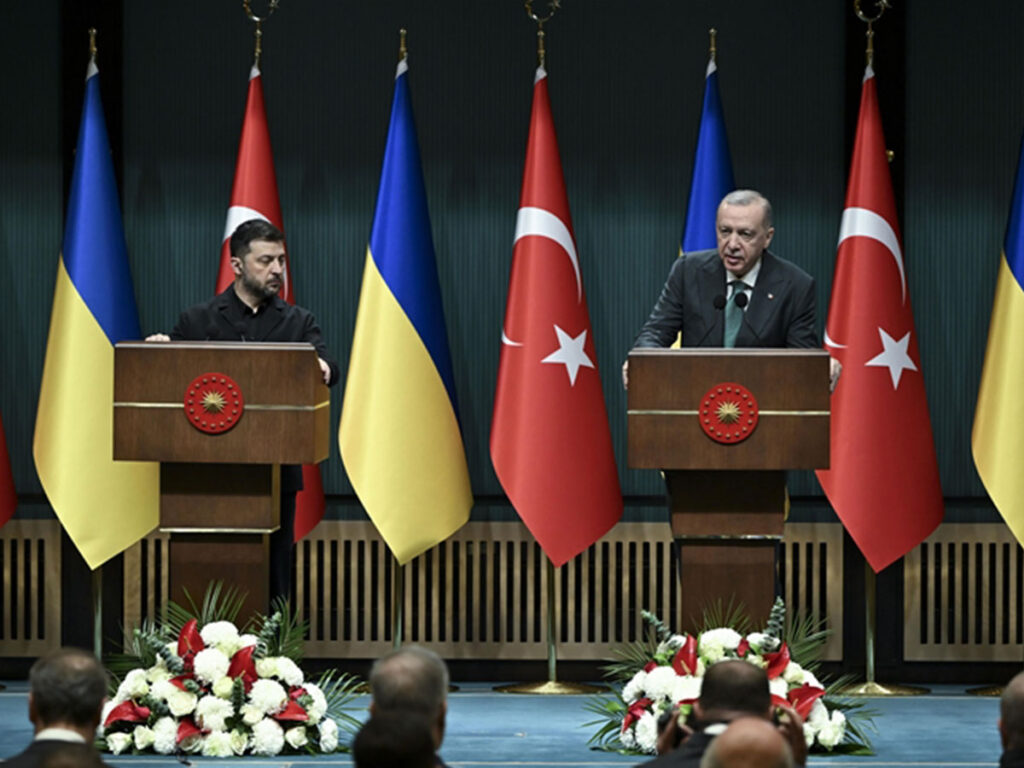


ANKARA (Kaab TV) – Turkish President Recep Tayyip Erdoğan has expressed cautious optimism about the ongoing negotiations between Russia and Ukraine, stating that the talks are “progressing well” and that there remains genuine hope for a breakthrough.
Erdoğan reaffirmed that Turkey stands ready to host and facilitate dialogue aimed at achieving both an immediate ceasefire and a durable, long-term peace agreement between the two warring nations.
During his visit to Ankara, Ukrainian President Volodymyr Zelensky voiced strong confidence in Turkey’s role as a mediator. He emphasized that Turkey’s diplomatic channels have been crucial in maintaining dialogue between Kyiv and Moscow at a time when direct communication remains difficult.
Zelensky also announced that he is hopeful about resuming prisoner-exchange operations before the end of the year, noting that Turkey’s involvement has greatly accelerated negotiations on this front.
The two leaders held an extensive meeting attended by senior ministers and security officials from both sides. Their discussions followed a series of direct negotiations between Ukrainian and Russian delegations held in Istanbul in recent months.
The first round of talks, held in mid-May, marked the first substantive face-to-face meeting between Russia and Ukraine in years.
Although the meeting did not yield a ceasefire, both sides agreed on a significant humanitarian measure: a large-scale exchange of prisoners of war, involving roughly 1,000 detainees from each side.
A second round of negotiations took place in early June, also in Istanbul. While the delegations again failed to reach a ceasefire, they secured another major agreement—this time focusing on the exchange of seriously wounded or ill prisoners, as well as young soldiers aged 18 to 25.
The agreement also included provisions for returning the remains of fallen soldiers, representing a rare moment of cooperation amid ongoing military hostilities.
Despite these humanitarian advances, the parties remain sharply divided on the terms of a broader truce. Ukraine continues to push for a full, unconditional 30-day ceasefire, whereas Russia has so far offered more limited “localized pauses” lasting only a few days, primarily intended to retrieve wounded personnel and bodies from the battlefield.
Turkey has sought to bridge this gap. Erdoğan has publicly proposed hosting a leader-level summit that could bring together Zelenskyy, Russian President Vladimir Putin, and potentially other international figures, in hopes of generating momentum toward a comprehensive peace framework.
Moscow has not yet committed to such a meeting, and high-level negotiations remain stalled.
Zelenskyy has stated that Ukrainian negotiators have continued exchanging proposals through Turkish intermediaries.
He also presented Turkey with documentation concerning hundreds of Ukrainian children taken to Russia during the conflict—a humanitarian issue Kyiv has prioritized in every round of talks.
While a full peace agreement still appears distant, Turkey’s active mediation has yielded concrete results in the form of large-scale prisoner exchanges and renewed diplomatic channels.
Ankara continues to position itself as a crucial intermediary capable of maintaining communication between the parties and pushing the process forward, even as the broader political and military landscape remains uncertain.