

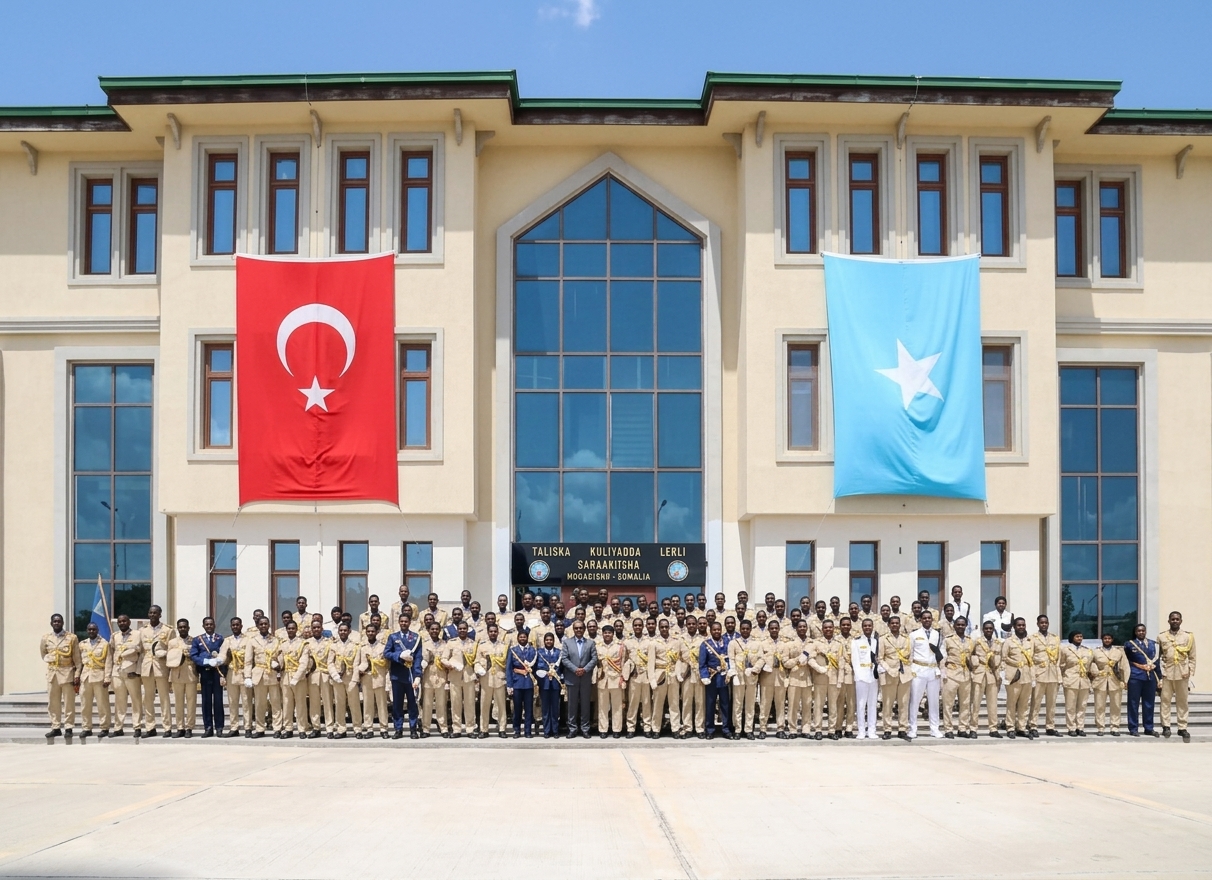

A report published by Bloomberg media indicates that Turkey continues to expand its military, economic, and strategic footprint in Somalia, as Mogadishu has emerged as a crucial anchor for Ankara’s Horn of Africa policy.
The report highlights that Turkish influence is visible across various facets of Somali society and economic infrastructure—ranging from the management of Mogadishu’s seaport and international airport to road construction, healthcare delivery, and training the Somali Armed Forces.
Turkish enterprises play a central role in operating and developing the Port of Mogadishu and Aden Adde International Airport.
Turkey has also contributed to civil infrastructure development and medical facilities, including the Recep Tayyip Erdoğan Hospital in Mogadishu, which stands among the flagship projects solidifying bilateral ties.
This footprint underscores that Somalia-Turkey relations extend beyond diplomatic alignment into commercial trade, municipal public services, direct investment, and joint strategic megaprojects.
On the security front, Turkey maintains a prominent role in training and modernizing the Somali defense establishment.
The TURKSOM military training facility in Mogadishu serves as a core institute for training Somali National Army personnel as part of bilateral defense cooperation.
Ankara’s assistance supports the Somali government’s efforts to build sovereign force capabilities, enabling national troops to assume primary security responsibilities and counter armed insurgent groups threatening Somalia’s national stability.
The Bloomberg report further notes that military cooperation has reached advanced dimensions, incorporating unmanned aerial vehicles (UAVs) and F-16 fighter jets.
These developments emphasize Somalia’s growing strategic weight within Turkey’s defense architecture, though specific operational logistics and tactical capabilities require further verification.
Larry André, former US Ambassador to Somalia, was quoted in the report stating that Turkey is fully embedded in Somali affairs and that he sees no indication of Ankara intending to scale back its posture in the country.
His assessment reflects how seasoned former US diplomats evaluate the deepening operational alignment between Mogadishu and Ankara.
Another major pillar of bilateral cooperation involves offshore oil and natural gas exploration along the Somali coastline.
Turkey is engaged in survey and exploration frameworks aimed at evaluating the country’s natural resource reserves, aligned with Somalia’s push to leverage its hydrocarbon potential.
Should survey operations and offshore projects achieve commercial extraction feasibility, they could significantly transform Somalia’s long-term economic prospects.
Nevertheless, direct fiscal yields will depend on geological findings, finalized production-sharing agreements, operational extraction costs, and transparent revenue management.
Bloomberg also referenced plans concerning the establishment of a spaceport/rocket launch facility in Somalia.
This initiative is linked to Turkey’s ambitions to expand its national space program and technical technological capabilities.
Reports regarding the missile/rocket testing and space facility have drawn international focus, as a project of this nature would grant Somalia heightened significance in scientific-technological collaboration while raising strategic and security considerations across the region.
Somali President Hassan Sheikh Mohamud stated that Turkey provides Somalia with requested assistance, particularly across defense and security sectors.
The Federal Government’s posture demonstrates that Mogadishu views its partnership with Ankara as vital for building state institutional capacity, modernizing security forces, and delivering critical economic development projects.
Bilateral relations remain anchored in comprehensive multi-sectoral agreements. Turkey provides Somalia with assistance in healthcare, education, physical infrastructure, and military training, while Somalia offers Turkey strategic geopolitical positioning and commercial access along vital maritime choke points.
However, scaling this partnership reinforces the necessity for bilateral agreements to maintain legal transparency, safeguard Somali sovereign interests, and explicitly delineate tangible socio-economic benefits for the Somali population.
Geographically, Somalia occupies a pivotal juncture connecting the Indian Ocean to the Gulf of Aden, situated in close proximity to the Bab al-Mandab Strait—one of the world’s most critical maritime transit choke points for global shipping and international commerce.
This geographical baseline makes Somalia highly valuable to foreign powers seeking to project influence across the Horn of Africa and the Red Sea maritime corridor.
International shipping, maritime domain security, and global energy transit all compound the region’s elevated geopolitical value.
For Turkey—seeking to project its broader African diplomatic footprint alongside its economic and military capabilities—Somalia presents strategic avenues spanning international trade, foreign direct investment, defense collaboration, and maritime operations.
Ankara’s expanding posture in Mogadishu comes at a time when other international powers are increasingly focusing on the Horn of Africa.
While this grants Somalia opportunities to diversify its international partnerships, it simultaneously demands prudent strategic management to ensure the nation is not drawn into broader regional and global superpower rivalries.
The Bloomberg report paints a picture of an expanding relationship that has transcended traditional humanitarian aid and development projects into defense integration, natural resource exploitation, advanced technology, and core strategic alignment.
The future trajectory of bilateral relations will depend on how existing legal agreements are executed, the commercial outcomes of hydrocarbon and infrastructure ventures, and the extent to which Turkish support strengthens sustainable Somali state institutions.