

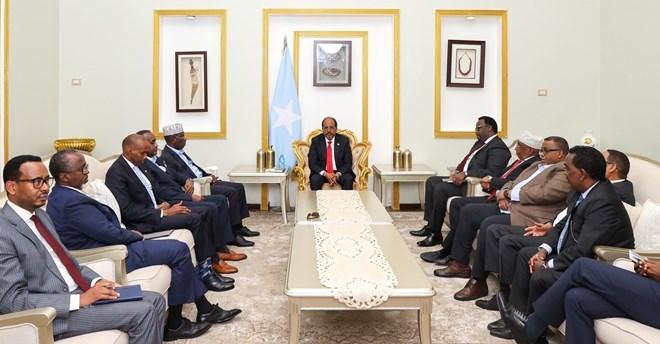

The city of Mogadishu was scheduled to host the opening today, November 14, of a political consultative conference announced by President Hassan Sheikh Mohamud to be convened by Villa Somalia from the 14th to the 18th of this month, to which various political stakeholders and civil society groups were invited.
This conference was expected to serve as an opportunity to resolve the acute dispute between the Federal Government and opposition politicians—specifically Puntland and Jubaland, who reject the electoral framework and constitutional changes pursued by the government.
Nevertheless, the meeting arrives at a juncture where divergences persist regarding conference participants, the management of the negotiation process, and whether the summit can yield a mutually acceptable political agreement.
On October 26, Villa Somalia announced that the conference would span five days, running from November 14 to November 18. Invited parties included the Nabad iyo Nolol party, the Somali Council of Futures, the National Unity Forum, and the civil society coalition.
The stated objective of the meeting was to discuss federal electoral matters and forge a political consensus regarding the nation’s trajectory toward upcoming elections.
However, certain opposition factions attached prerequisites to their participation, insisting that negotiations must be inclusive and not utilized to legitimize pre-determined decisions.
Puntland and Jubaland constitute two of the primary parties locked in political friction with the Federal Government. Both administrations reject basing electoral and constitutional matters on decisions in which they did not participate, demanding instead a comprehensive political agreement acceptable to all stakeholders.
Certain opposition figures viewed the Villa Somalia conference as lacking sufficient guarantees to ensure that its outcome decisions would represent a shared consensus.
Concerns were likewise expressed that the conference might be leveraged for political term extension, as the government continues preparing for elections based on its previously announced schedule.
Conversely, the government maintains that the door to dialogue remains wide open and that disputes can be resolved through consultation and mutual understanding.
Days prior to the conference, high-level meetings occurred in Mogadishu involving senior military and security officials who met with opposition politicians.
Reported details indicate these meetings focused on the security situation, political disputes, and the imperative of avoiding any actions capable of damaging national stability.
Military officials also visited former President Mohamed Abdullahi Farmaajo, delivering a message concerning the Villa Somalia conference. The Nabad iyo Nolol party stated that Farmaajo insisted negotiations must be inclusive, credible, and resume from the precise point where previous talks stalled.
These developments demonstrate that efforts to bridge the gap between rival factions existed prior to the summit’s opening date, although it remains unverified whether all key parties reached consensus regarding participation and conference conditions.
The core political dispute is rooted in the electoral schedule promulgated by the National Independent Electoral Commission.
The commission’s roadmap stipulated that elections for both houses of the Federal Parliament be held on April 15, 2027, while setting the presidential election for May 15, 2027.
President Hassan Sheikh previously commended the commission, urging the acceleration of electoral preparations. The Federal Government contends that the schedule complies with the constitution and ratified electoral laws.
Nevertheless, the opposition alongside the administrations of Puntland and Jubbaland rejects this timeline, arguing that no comprehensive political agreement has been reached defining the electoral model, electoral administration, and the role of Federal Member States.
Consequently, the dispute transcends mere election dates, encompassing administrative control, procedural mechanics, and the legal baseline for any agreement.
The sensitivity surrounding this conference intensified after the Supreme Court issued a ruling on November 5 concerning the term limits of government institutions.
Reported assessments indicate the court ruled that the president’s term expired on May 15, 2026, while the terms of Parliament and the Council of Ministers concluded on April 14, 2026. The court also granted political actors a 30-day window to reach an agreement on the electoral framework while ordering that elections be held within 90 days.
The Federal Government rejected this ruling, with the Office of the Attorney General questioning the court’s jurisdiction and the procedural legality of its decision.
This development imparted profound additional significance to the November 14 conference, as the meeting was expected to serve as a venue where parties could negotiate electoral disputes, constitutional disagreements, and executive term limits.
The central question remains whether the Villa Somalia summit will transform into genuine negotiations yielding a political agreement, or whether it will conclude as another gathering failing to alter the prevailing impasse.
Should opposition factions and the regional administrations of Puntland and Jubbaland condition their participation on political guarantees and independent mediation, the conference agenda and format may undergo modifications.
Conversely, if the government insists on holding the conference under originally announced formats without resolving contentious preliminary points, securing universally accepted outcomes will prove exceptionally difficult.