

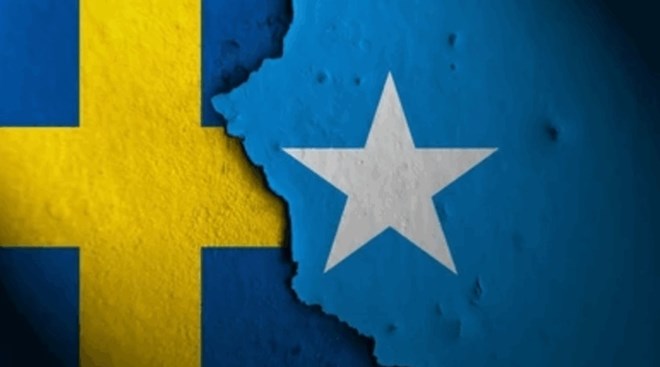

Mogadishu (KAAB TV) – Sweden’s opposition parties are demanding a full parliamentary investigation into Migration Minister Johan Forssell following revelations that his government authorized a secret payment of more than five million kronor (approximately $517,000) to Somalia’s federal government to facilitate the deportation of Somali nationals from Sweden.
The payment — approved during a cabinet meeting in April and personally signed by Forssell — was reportedly transferred through the International Organization for Migration (IOM) to the Office of the Somali Prime Minister under a confidential arrangement kept outside Sweden’s official aid budget, according to the Swedish daily Dagens Nyheter (DN).
According to the report, the funds were intended to help the Somali government process and accept 28 Somali citizens who had been denied asylum in Sweden and were subject to deportation orders.
DN’s investigation revealed that part of the money financed three newly created positions within Somalia’s Prime Minister’s Office, each with salaries exceeding 100,000 kronor per month.
The positions were allegedly filled by individuals connected to senior officials in Prime Minister Hamza Abdi Barre’s inner circle.
When Swedish journalists initially requested access to government records, the cabinet’s case file for the decision was reportedly empty.
Later-released documents from IOM were heavily redacted, with the Ministry of Foreign Affairs citing confidentiality in matters of foreign relations.
Minister Forssell has denied any wrongdoing, describing the transfer as part of a “migration cooperation framework,” not an aid payment.
“This is about ensuring that countries take responsibility for their citizens — especially those convicted of serious crimes, including violent and sexual offenses, in Sweden,” Forssell told Swedish media. “There is no evidence of corruption or misuse of funds.”
However, critics point to Transparency International’s 2024 Corruption Perceptions Index, which ranked Somalia among the most corrupt countries in the world.
Officials from Sida (the Swedish International Development Cooperation Agency) and Sweden’s embassy in Nairobi reportedly warned the Foreign Ministry that the plan was “completely insane,” given the lack of transparency in Somalia’s financial systems.
The controversy follows earlier reports that Sweden had tied a much larger 100 million kronor ($10 million) aid package to Somalia’s acceptance of deported nationals in late 2023.
According to Swedish and Somali sources, Sweden’s ambassador in Mogadishu negotiated an agreement that redirected development aid to projects linked to the Prime Minister’s Office — effectively conditioning aid on Somalia’s cooperation in accepting deportees.
That arrangement drew strong objections from Sida and the World Bank, which froze funding over accountability and governance concerns.
Tensions escalated in May 2025, when Somalia expelled Sweden’s aid director, accusing Stockholm of interfering in domestic affairs.
The remaining funds were subsequently rerouted through the UN Development Programme (UNDP) before deportation operations resumed later in the year.
The revelations have sparked a major political storm in Stockholm. The Social Democrats and the Left Party have filed formal complaints with the Riksdag’s Constitutional Committee (KU), demanding an investigation into whether Forssell violated Sweden’s foreign aid and budgetary laws. The Green Party has gone further, calling for his immediate resignation.
“This is outright bribe money paid to an Islamist government,” said Morgan Johansson, the Social Democrats’ foreign affairs spokesperson.
Green Party leader Amanda Lind added that “public trust in the migration minister is completely broken. This case shows a shocking lack of transparency and accountability.”
Forssell has rejected those accusations, saying Sweden worked only through IOM, not directly with Somali officials. He emphasized his government’s “zero tolerance” policy toward corruption and pledged to investigate any irregularities if they emerged.
“If anything improper is discovered, we will act immediately,” Forssell told Aftonbladet. “In fact, we want more partnerships like this to speed up deportations of individuals who have no legal right to stay in Sweden.”
Sweden, like many European countries, has struggled to enforce deportations to unstable or non-cooperative states. Somalia, lacking robust administrative systems and facing persistent security challenges, has often refused to accept deportees unless logistical and financial support is provided.
Forssell has claimed that since his government took office, the number of successful deportations has increased by about 60 percent, though he did not specify figures for Somalia.
Swedish officials credited this rise to “enhanced cooperation” with foreign governments — cooperation that critics now argue may blur the line between diplomatic negotiation and bribery.
In a statement released on October 9, 2025, the Office of the Prime Minister of Somalia categorically denied the Swedish media reports, calling them “false, misleading, and unfounded.”
“All cooperation between the Federal Republic of Somalia and the Kingdom of Sweden is conducted transparently and through established multilateral mechanisms such as the World Bank, UNDP, and IOM,” the statement read. “No bilateral agreement exists that links aid funding to deportations or migration management.”
The Somali government emphasized that development funds are subject to cabinet oversight and external auditing through international agencies, asserting that “no Somali official received funds in exchange for accepting deported individuals.”
The scandal has deepened existing divisions in Swedish politics over migration enforcement, international aid, and government accountability.
It also raises broader questions about the ethics of European migration policies — particularly the practice of making financial or development incentives conditional on cooperation from fragile and corruption-prone states.
For many observers, the case underscores a difficult dilemma: how to balance Sweden’s domestic political pressure to increase deportations with its long-standing reputation for human rights, transparency, and ethical foreign policy.
As the Constitutional Committee prepares to review the case, opposition parties say the findings could have far-reaching consequences not only for Minister Forssell’s future but also for Sweden’s credibility as a global advocate for clean governance and rule of law.