


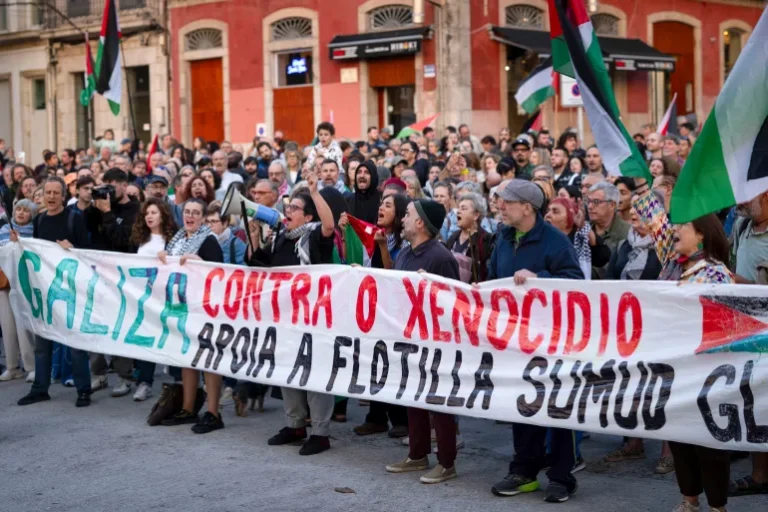


Madrid, Spain (KAAB TV) – Across Spain, waves of protests have erupted over the past two years in response to Israel’s military actions and humanitarian policies in Gaza. As the crisis deepens, with thousands of civilians affected and infrastructure severely damaged, public outcry in Spain has intensified, prompting both civil and governmental responses.
Demonstrations have taken place in major cities such as Madrid, Barcelona, Valencia, and Seville, with protesters calling for an end to what they describe as human rights violations in the Gaza Strip. Citizens and advocacy groups have shown strong support for international justice efforts, including the recent actions taken by Spain’s own judiciary.
Spain’s public has largely welcomed the announcement by the country’s Public Prosecutor’s Office, which is reportedly reviewing legal grounds for investigating alleged war crimes and humanitarian law violations committed by Israeli forces in Gaza.
These include accusations of deliberately obstructing humanitarian aid, targeting civilian infrastructure, and disproportionate use of force—especially during recent escalations.
Legal experts in Spain have cited universal jurisdiction laws that allow national courts to investigate crimes against humanity, even if they occurred outside the country’s borders. This has laid the groundwork for a possible legal inquiry, in cooperation with international bodies such as the International Criminal Court (ICC).
In a landmark move, Spain formally recognized the State of Palestine in May 2024, aligning itself with other European countries such as Ireland and Norway. The Spanish government has emphasized that this recognition is part of a broader strategy to promote a two-state solution and push for peace negotiations under international law.
Additionally, the Spanish government has taken further measures, including:
-
Restricting entry to Spanish territory for individuals linked to the Israeli government or military who are suspected of involvement in alleged war crimes.
-
Supporting legal actions against Israel in international courts, including the case filed at the International Court of Justice (ICJ) by South Africa, which accuses Israel of genocide.
-
Advocating for an EU arms embargo on Israel and increased humanitarian support for Palestinians.
While Spain’s actions have garnered praise from human rights organizations and pro-Palestinian groups, they have also sparked diplomatic tensions. Israel condemned Spain’s recognition of Palestinian statehood and accused it of undermining peace efforts.
Meanwhile, some of Spain’s NATO and EU allies—initially supportive of Israel—have become increasingly critical of Israel’s policies, especially in light of mounting civilian casualties and the worsening humanitarian crisis in Gaza.
There is growing international pressure for a ceasefire, the reopening of border crossings, and an end to the blockade of Gaza, which has made it extremely difficult for essential supplies—like food, water, and medical aid—to reach over two million people living under siege conditions.
Spain’s stance marks a significant shift in the European political landscape regarding the Israeli-Palestinian conflict. As the situation in Gaza remains dire and the death toll continues to climb, Spain has positioned itself as a vocal advocate for international accountability and humanitarian justice.
Whether these efforts will bring about meaningful change or escalate geopolitical tensions further remains to be seen, but the message from the Spanish people and government is increasingly clear: war crimes must not go unpunished, and peace must be pursued with justice at its core.