


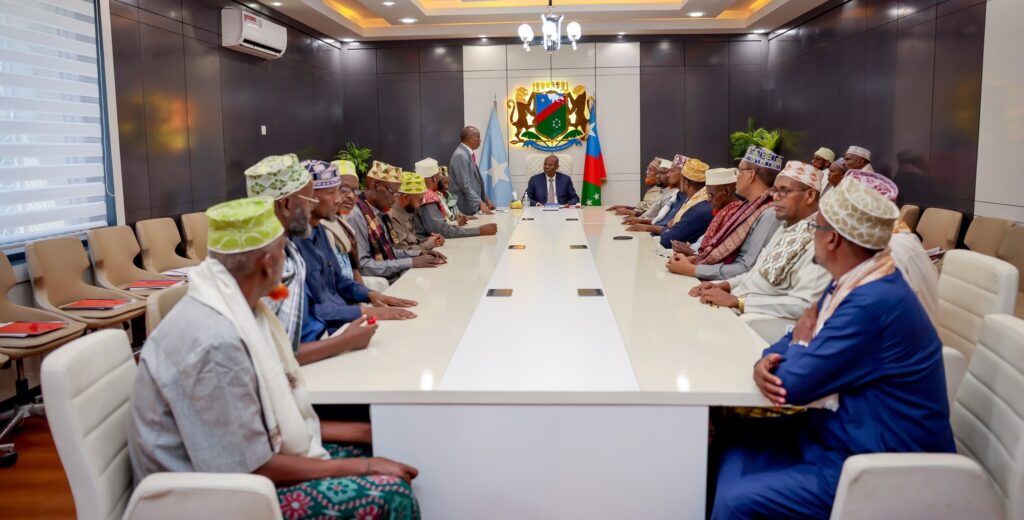


LONDON (Kaab TV) – On Monday morning [March 23, 2026], Southwest State of Somalia (SWS) announced the appointment of a nine-member State Electoral Commission. According to a press statement read by Presidential Spokesperson Ugaas Hassan Abdi, the body will be responsible for organizing the state-level elections in Southwest.
The commission consists of eight men and one woman, all from Southwest State.
Officials in Baidoa told Kaab TV that the electoral process is expected to be completed within 10 days starting from today.
Southwest State based its decision on Article 142 of the Federal Constitution, as well as its own regional constitution.
The move signals that SWS has charted its own path and eased the deadlock surrounding Somalia’s 2026 federal electoral process, which has been marked by uncertainty and disputes.
The Federal Government of Somalia has been pushing to centralize the elections under a commission previously appointed by President Hassan Sheikh Mohamud, who has 53 days remaining in his term and is seeking re-election.
Federal Member States, particularly Jubaland and Puntland, have rejected this approach, opposing both the president’s unilateral electoral commission and recent constitutional changes, arguing that they lack broad consensus.
Regional administrations say the federal government’s efforts are aimed at extending its mandate and legitimizing constitutional amendments and electoral arrangements without agreement.
Somalia’s federal system comprises five Federal Member States and the Banaadir region. Southwest has now joined the ranks of Puntland and Jubaland in rejecting the constitutional amendments and any election process not based on consensus.
By appointing its own electoral commission, Southwest State has reinforced the likelihood that Somalia’s 2026 elections will follow an indirect model agreed upon by stakeholders—a path now clearly adopted by SWS.
Puntland held its elections in 2023, while Jubaland conducted its vote in 2024, both despite opposition from the federal government.
Meanwhile, the Federal Government, according to a directive issued by Interior Minister Ali Yusuf Hosh, has also rejected SWS move. Reports indicate that Mogadishu may attempt to organize a parallel election in Baraawe, where federal forces, including Haramcad and Gorgor units, were recently deployed after SWS troops withdrew.
If the Federal Government takes the parallel election route, it will not only risk undermining Baydhabo’s authority but could also trigger a backlash against its own legitimacy. Opposition figures in Mogadishu may respond by declaring themselves “president” after May 15, when the current term ends—effectively creating parallel leadership in the capital.
Galmudug, which has not endorsed the March 4, 2026 constitutional changes, and Hirshabelle, reportedly facing political and security pressure from Villa Somalia, have yet to clarify their positions.
With Southwest, Jubaland, and Puntland forming a majority among Federal Member States, their continued adherence to the 2012 Provisional Constitution and preference for indirect elections suggests that Somalia’s 2026 polls are likely to be based on a clan-delegate selection model.
Given that Somalia’s power-sharing system still follows the 4.5 formula, and no alternative has yet been agreed upon, many believe that the indirect, clan-based electoral model remains the only viable framework for maintaining political balance—one that continues to give a central role to traditional elders.