

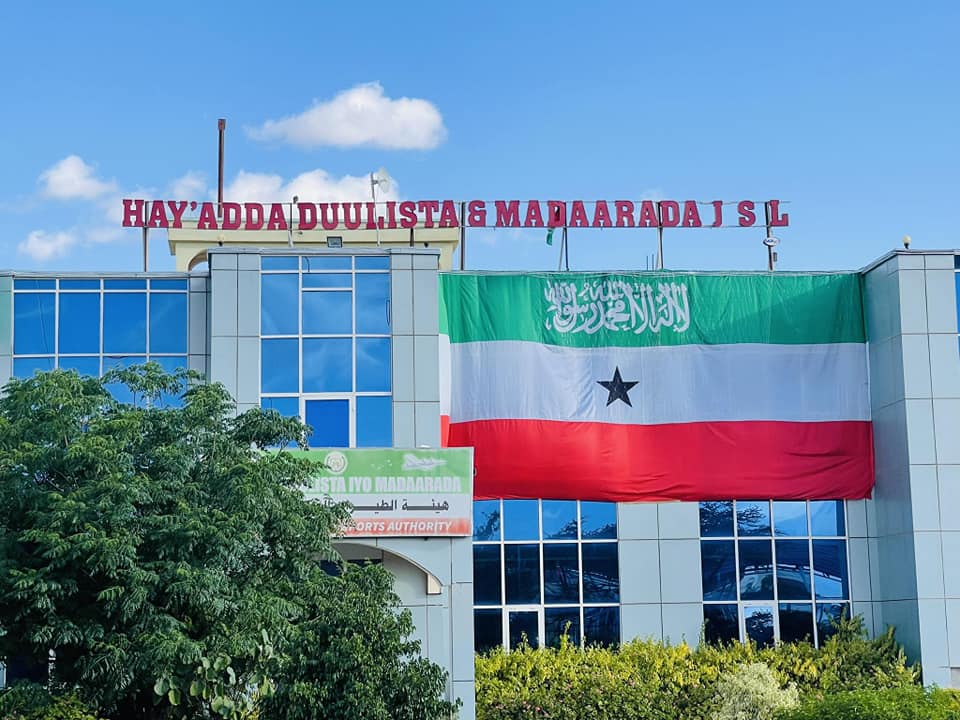
HARGEISA (KAAB TV) – The Ministry of Civil Aviation and Airports Development of the Republic of Somaliland has issued a stern warning to all airlines operating in its territory, stating that any carrier requiring travelers to obtain a Somali visa before flying to Somaliland will lose its authorization to operate within Somaliland’s airspace and airports.
Speaking at a press briefing in Hargeisa, the Minister of Civil Aviation and Airports, Fu’ad Ahmed Nuux (Fu’ad Adde), said that his ministry is aware of recent incidents in which passengers holding Western passports were asked by airlines to apply for visas through Somalia’s online system before being allowed to board flights to Somaliland.
“The Ministry, in fulfilling its constitutional responsibilities, has taken all necessary measures to ensure that every airline operating at Somaliland airports or using Somaliland’s airspace complies fully with the Aviation and Travel Laws of the Republic of Somaliland,” Minister Fu’ad stated.
“Any airline that imposes unnecessary conditions or follows directives from outside Somaliland’s jurisdiction will immediately lose its operational license in our territory,” he added.
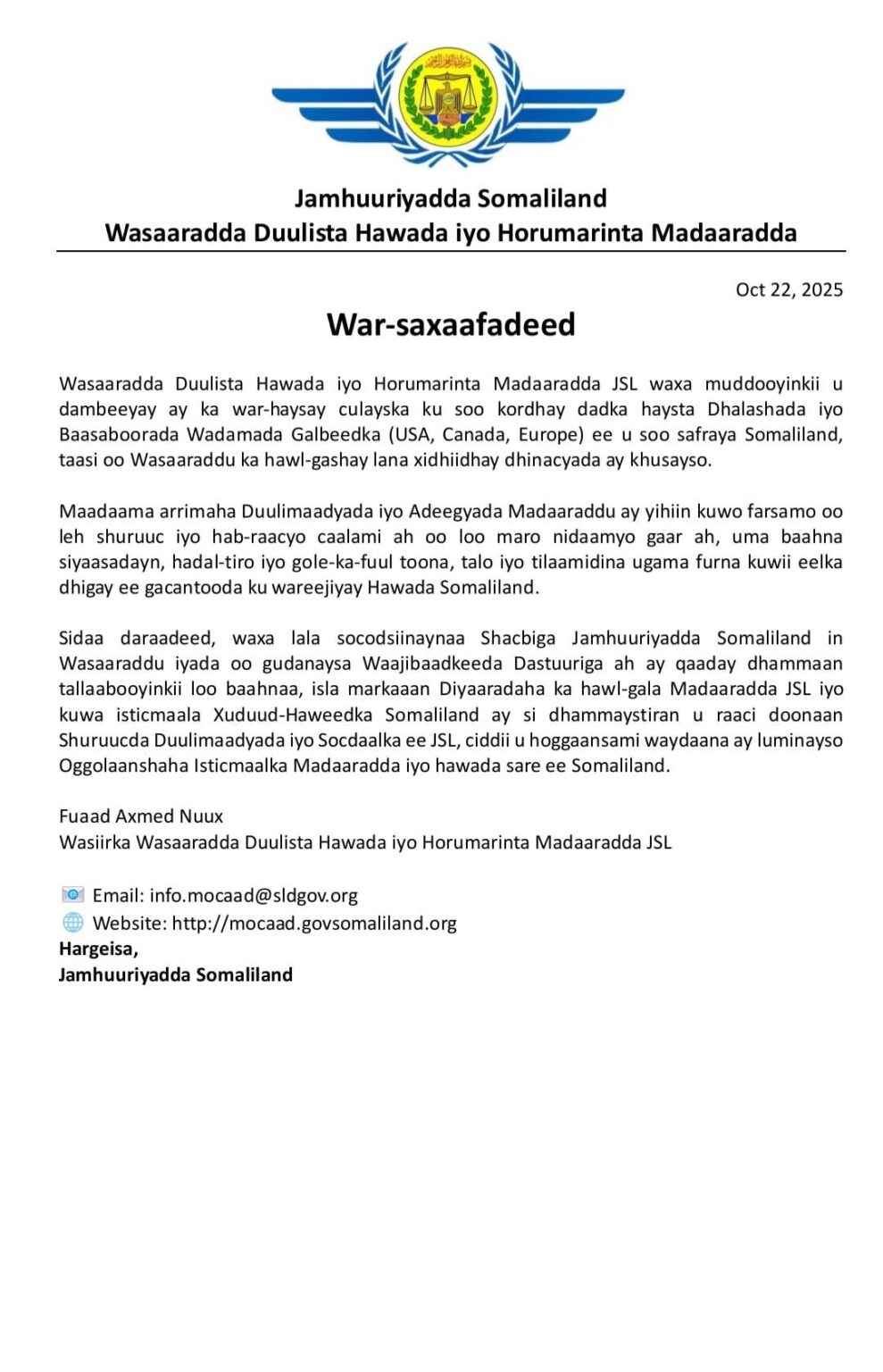 In recent weeks, Somaliland citizens and foreign visitors have reported that airlines at major international airports — including Nairobi (Kenya), London (UK), Addis Ababa (Ethiopia), and Dubai (UAE) — have demanded that passengers bound for Somaliland obtain a Somali eVisa before check-in. Some travelers, including local politicians and businesspeople, said they were denied boarding when they refused to apply for the Somali visa.
The confusion stems from an announcement made two months ago by the Federal Government of Somalia’s Immigration Department, which introduced an online eVisa system mandatory for all travelers entering Somalia.
Somalia’s directive was extended to airlines operating flights to Somaliland — a move Hargeisa firmly rejects.
Somaliland, which declared independence from Somalia in 1991, has operated as a self-governing state with its own government, parliament, military, and administrative systems.
Despite its autonomy, it remains unrecognized internationally and is still considered by the United Nations and the African Union as part of Somalia.
The two sides have long disputed control over airspace management and aviation revenues.
Since 2018, Somaliland and Somalia have clashed over which authority should manage flight permissions and air traffic control for flights entering or leaving Somaliland’s airports, such as Hargeisa Egal International Airport and Berbera Airport.
In 2024, the disagreement escalated when conflicting instructions from air traffic control authorities in Hargeisa and Mogadishu caused confusion for international pilots, temporarily disrupting several flights.
The Somaliland government insists that Somalia’s immigration and aviation policies do not apply to its territory or citizens. Officials in Hargeisa argue that Somaliland’s sovereignty allows it to regulate its own airspace and border entry requirements independently of Mogadishu.
Minister Fu’ad reaffirmed that Somaliland will continue to uphold its aviation laws and will not tolerate interference from external authorities.
“We are a self-governing nation with clear laws regarding our airports and borders. Any attempt to undermine that sovereignty through airlines or foreign regulations is unacceptable,” the minister emphasized.
The warning from Somaliland’s Aviation Ministry marks another chapter in the ongoing dispute between Hargeisa and Mogadishu over control of airspace and international recognition.
Travelers to Somaliland are advised to ensure that airlines respect Somaliland’s entry policies and to report any incidents of being asked to apply for Somali visas before traveling.