


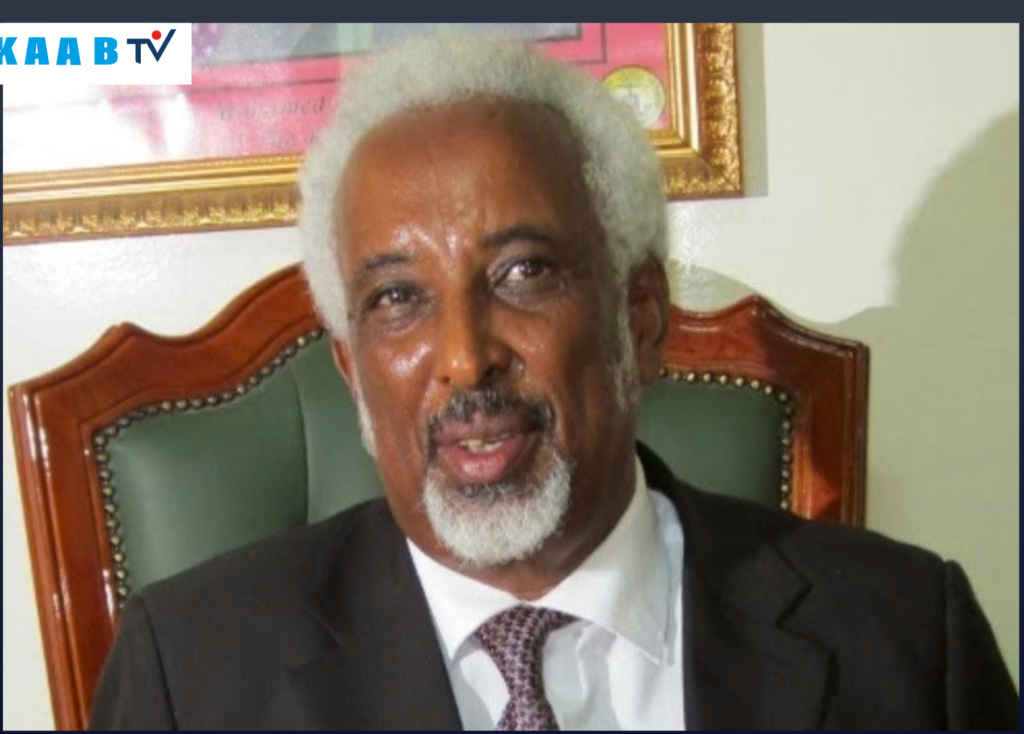


Former Somaliland Interior Minister Ali Mohamed Waran-Cadde has announced that Somaliland has acquired advanced weapons that are superior to those supplied by Türkiye to Somalia’s federal government.
He also alleged that Somaliland is allocating 60 percent of its national budget to security and defence.
His remarks come amid growing concern in Somaliland over Türkiye’s expanding military relationship with Mogadishu and the potential implications for regional security.
Earlier this week, two aircraft carrying Turkish military personnel and travelling to Mogadishu via Djibouti reportedly diverted from Somaliland’s airspace.
Sources cited in the reports suggested that Türkiye had received information about the new weapons allegedly acquired by Somaliland.
The developments coincide with a series of Turkish military activities in Mogadishu.
On Sunday, Türkiye’s Chief of General Staff and Commander of the Turkish Naval Forces visited the Somali capital, where they attended the groundbreaking ceremony for a Turkish naval command headquarters.
On Saturday, November 21, Türkiye also reportedly delivered a shipment of around 300 loitering munitions, commonly known as suicide drones, to Mogadishu, according to security sources in the city.
Waran-Cadde did not disclose the quantity of weapons Somaliland had obtained or identify their country of origin.
However, he maintained that the territory now possessed weapons that were more advanced and powerful than those provided by Türkiye to the Federal Government of Somalia.
“Whether you stand as a mountain or lean against one, Somaliland is no longer afraid of Türkiye, which has established itself in Mogadishu and wants to turn Somalia into a kingdom ruled by Hassan Sheikh.
The people of Somaliland have sought international partners,” Waran-Cadde said during an online discussion on X on Monday evening.
Waran-Cadde is a former senior police official who has been involved in Somaliland’s security affairs and the movement that campaigned for its separation from Somalia.
He also addressed Somaliland’s relationship with Israel and allegations that Israel had supplied weapons to the territory.
Referring to what he described as changes in Somaliland’s international alliances following Israel’s recognition of Somaliland on December 26, 2025, he said the territory’s strategic position had changed significantly.
“Sixty percent of our national budget goes to defence, although that information is confidential,” he added.
Waran-Cadde further claimed that Somaliland was strengthening its military preparedness in anticipation of a possible conflict, describing Türkiye and Somalia’s federal government as potential security threats.
He said residents of Hargeisa could hear heavy weapons being tested at night and pointed to the recruitment and training of additional forces.
He argued that establishing a strong defence capability was essential for Somaliland’s security and said the territory was now better equipped to protect itself.
“The principle of statehood is to have strong defences that allow people to sleep knowing their country is protected. That has now become possible. We have weapons more advanced than those Türkiye supplied, and there is nothing for us to fear,” he said when asked about Somaliland’s military capabilities.
Earlier this week, Somaliland’s representative in Israel, Dr Mohamed Haji, also spoke about the territory’s military preparations. He said Somaliland had learned lessons from previous attacks and was now investing in strengthening its weapons stockpile and armed forces.
Security sources in Hargeisa separately told Kaab TV that Somaliland was rapidly preparing thousands of troops and putting them through military training.
The claims about the scale of the weapons acquisitions and military preparations have not been independently verified.
Waran-Cadde also called on Somaliland authorities to close Türkiye’s office in Hargeisa and expel Turkish diplomats.
He alleged that information previously obtained by Somaliland’s Interior Ministry indicated that Turkish officials had been attempting to discreetly organise discussions between traditional elders from Somaliland and southern Somalia, an initiative he said the authorities had prevented.
“I believe the Turkish office should be closed and its officials expelled. Türkiye’s presence is damaging to Somaliland. The day will come when they are sent away like rubbish,” he said.
The Somaliland administration has not announced any decision to close the Turkish office or expel its diplomatic representatives.
The increasingly forceful statements from Somaliland officials come as tensions persist in the disputed regions of Sool and Sanaag, where reports have emerged of forces linked to Somalia’s federal government being assembled.
Last month, Somaliland President Abdirahman Mohamed Abdullahi, commonly known as Irro, accused Mogadishu of moving troops towards the area surrounding Buuhoodle.
Somalia’s federal government has said it intends to establish the headquarters of the Somali National Army’s 26th Division there.
In Sanaag, local sources have also reported that officers involved in training local armed groups recently visited areas near Las Qoray, a coastal settlement with a port on the Red Sea.
These developments have added to concerns over the possibility of further military tensions in the region.